
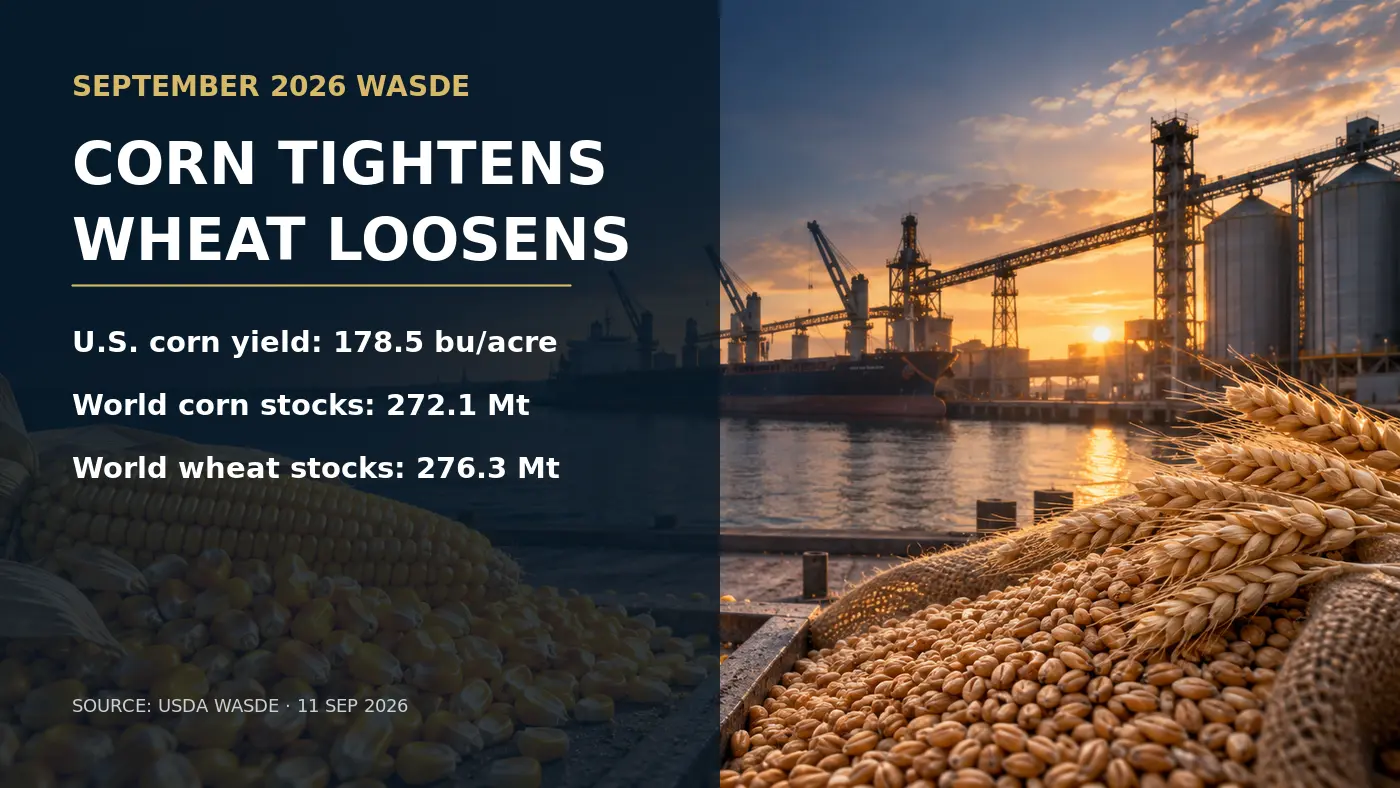
Grain buyers received two different signals from the September 2026 World Agricultural Supply and Demand Estimates. The corn balance tightened, particularly in the United States, while the global wheat outlook gained supply and stock. The practical implication is straightforward: buyers should evaluate each commodity, origin and shipment window on its own economics rather than assuming the broader grain complex will move together.
Corn has a smaller production and inventory cushion
USDA forecast the 2026/27 U.S. corn crop at 15.8 billion bushels, down 213 million from the prior month. The national yield estimate fell by 2.2 bushels to 178.5 bushels per acre, while harvested area was placed at 88.5 million acres.
Demand was adjusted too. Total U.S. corn use was lowered by 150 million bushels to 16.2 billion, entirely through a reduction in feed and residual use. Exports remained unchanged at 3.3 billion bushels. Because the demand reduction only partly offset smaller supply, projected U.S. ending stocks fell by 86 million bushels to 1.6 billion. USDA raised the season-average farm price by $0.30 to $4.80 per bushel.
The global direction was similar. World corn ending stocks were reduced by 2.6 million tonnes to 272.1 million tonnes. Production forecasts declined for India, Kenya and Russia, although increases elsewhere provided a partial offset. Brazil’s export forecast also moved lower as more corn was expected to be used domestically for ethanol.
Wheat supply improved—but access is not uniform
Global wheat supply moved the other way. USDA lifted total world wheat supply by 3.5 million tonnes to 1,103.0 million, supported by larger production forecasts for Australia, Canada and Ukraine. World wheat ending stocks increased by 3.0 million tonnes to 276.3 million tonnes.
That does not mean every buyer will see easier execution. USDA reduced projected world wheat trade by 0.9 million tonnes to 211.8 million. Export forecasts were lowered for Russia, Ukraine and Kazakhstan, with weak August shipments and Black Sea logistics cited for Russia and Ukraine. Higher exports from Australia, Canada and Argentina only partly offset those cuts.
Australia is especially relevant for Asian procurement teams. USDA raised its wheat production estimate by 3.0 million tonnes to 31.0 million and lifted barley output to a record 17.1 million tonnes. Those revisions can widen origin choices, but buyers still need to compare grade, port, voyage length and seasonal loading pressure.
What the market reaction says—and does not say
Successful Farming reported that the lower corn yield and ending stocks were broadly near pre-report expectations. Market commentary cited in its 11 September coverage said much of the supportive information had already been priced in. That distinction matters: a tighter balance sheet is a procurement risk signal, but it is not by itself a forecast of an immediate price spike.
For physical buyers, the more useful question is whether the available supply buffer can absorb a weather problem, logistics delay or renewed demand without disrupting the required delivery window. Price screens may react quickly; executable cargoes, freight and documents move on different schedules.
A practical procurement response
- Separate corn and wheat strategy. Review coverage, alternatives and shipment timing commodity by commodity rather than using one broad “grain” view.
- Recheck corn exposure. Map open requirements against the reduced U.S. and global stock buffer, especially where the contract depends on a narrow origin or arrival month.
- Test wheat alternatives. Compare Australia, Canada, Argentina and other acceptable origins after normalizing quality, freight, transit time and destination rules.
- Verify logistics before price. Confirm load port, laycan, vessel class, discharge rate, demurrage basis and document timing before treating an offer as comparable.
- Keep compliance current. Review sanctions exposure, banking routes, inspection terms, phytosanitary requirements and counterparty authority for every proposed origin.
The One Discovery view
EXECUTION SIGNAL
Corn is tighter; wheat is better supplied, but not equally accessible. Buyers should use the divergence to strengthen origin options and contract readiness—not to chase a headline price without confirming the complete landed transaction.
The September report supports a disciplined approach: protect vulnerable corn requirements, test expanded wheat and barley options, and compare every proposal on specification, timing, logistics and compliance. Good sourcing is not simply finding supply. It is matching verified supply to an executable procedure at the required destination.
Sources
Discuss a qualified grain sourcing requirement or market opportunity.
Connect with John on LinkedIn