
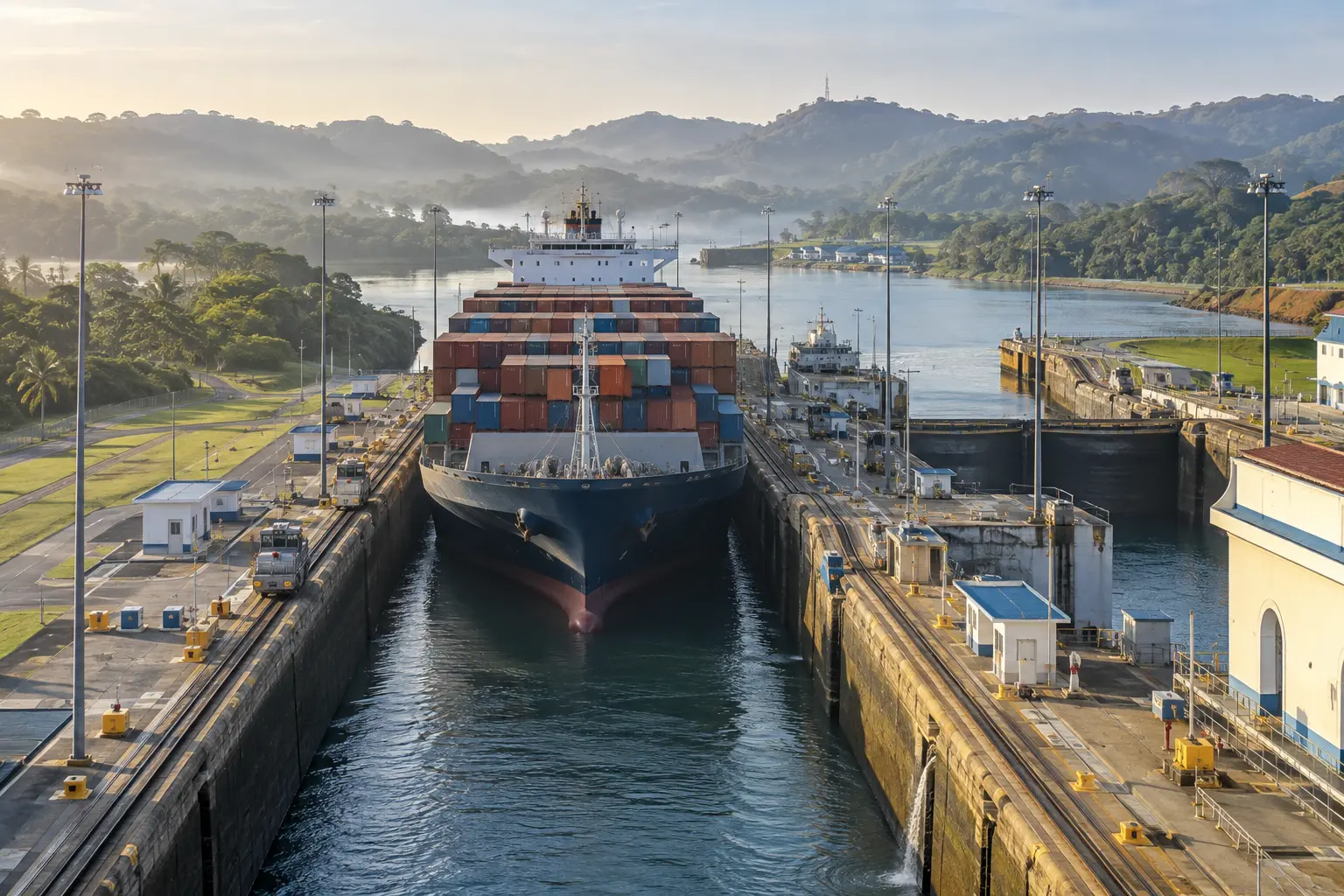
A reported bid of more than US$5 million for a Panama Canal transit reservation has drawn attention to renewed pressure on one of the world’s most important maritime corridors. Reuters reported that an LPG carrier paid the record auction premium as energy flows shifted in response to Middle East disruption. The amount was an auction result for priority access—not a standard canal toll—and should not be treated as a universal cost for every vessel.
The signal is still important for global buyers. Competition for a scarce transit window can rise quickly when energy carriers, container ships and other vessel classes seek the same route. A disruption at one chokepoint can redirect tonnage toward another, reducing effective fleet capacity and changing voyage economics even for cargo that never passes through the original area of conflict.
Strong traffic does not remove capacity risk
The Panama Canal Authority reported in July that the canal averaged 35 daily transits during the first nine months of fiscal 2026, with 10,726 total transits through 30 June. That was a 5.2% increase from the same period in fiscal 2025. The authority also said it was preparing for expected El Niño conditions, a reminder that operational capacity depends partly on water availability.
These official figures show a canal handling substantial traffic, not a closed or non-functioning route. The procurement issue is narrower: when demand approaches available booking capacity, the marginal cost of securing a particular passage and arrival window can rise sharply. Average operating statistics therefore do not guarantee that a specific vessel will receive the slot, draft allowance or timing assumed in a commercial quotation.
Why one expensive slot matters to buyers
A record auction result reflects urgency and competition at a specific moment. It does not prove that all freight rates will rise by the same amount. However, carriers may respond to higher waiting, routing or reservation costs through surcharges, revised quotations, shorter validity periods or more conservative estimated arrival dates. Some cargoes may be rerouted, while others may wait for a later slot.
The effect can move beyond ocean freight. Longer or less predictable transit times can increase inventory financing, container detention exposure, production risk and the need for safety stock. Buyers using delivered-price contracts should confirm which party absorbs new route-related costs. Buyers using FOB or other origin-based terms should model how changes in freight and insurance affect the final landed cost.
Five controls procurement teams should apply now
- Compare route scenarios. Model the Panama Canal, Suez Canal and any commercially realistic alternative. Compare total transit time, vessel availability, fuel, insurance, surcharges and destination reliability—not distance alone.
- Verify the route behind the ETA. Ask the carrier or forwarder whether the quoted schedule already has a canal reservation, whether the route may change and what assumptions support the estimated arrival date.
- Test the quotation. Confirm the freight validity period and identify congestion, war-risk, canal, fuel and peak-season surcharges. A low quotation is not fully executable until capacity and the main cost components are confirmed.
- Review contract allocation. Check the Incoterm, risk-transfer point, delay provisions, force-majeure language and responsibility for extraordinary routing costs. Commercial teams should avoid assuming that every disruption automatically falls on the carrier or supplier.
- Protect the delivery window. Consider alternative ports, suppliers or origins and hold appropriate buffer inventory for critical inputs. The correct buffer depends on consumption rate, replacement lead time and the operational cost of a stockout.
Separate reported facts from planning assumptions
The reported record bid is a market event. One Discovery’s analysis is that buyers should use it as a trigger to review execution assumptions, not as proof of a permanent price level or inevitable canal shutdown. Conditions can change as vessel demand, rainfall, booking rules and geopolitical routes evolve.
Procurement decisions should therefore rely on current carrier confirmation and transaction-specific evidence. A workable shipping file should identify the named vessel or service when available, planned route, booking status, freight validity, insurance coverage, required documents, latest shipment date and contingency plan. Each item should align with the supply contract and inventory plan.
ONE DISCOVERY VIEW
Route availability does not guarantee execution certainty. The relevant question is whether capacity, cost, documents and timing are secured well enough for the cargo to reach the required destination within the buyer’s operating window.
The Panama Canal remains a functioning global trade artery, but record auction premiums show how quickly urgency can be priced when multiple pressures converge. Buyers do not need to predict the next disruption. They need purchasing and logistics controls that remain workable when the route, schedule or cost changes.
Sources
Review a documented sourcing requirement or logistics-sensitive international transaction.
Contact One Discovery