
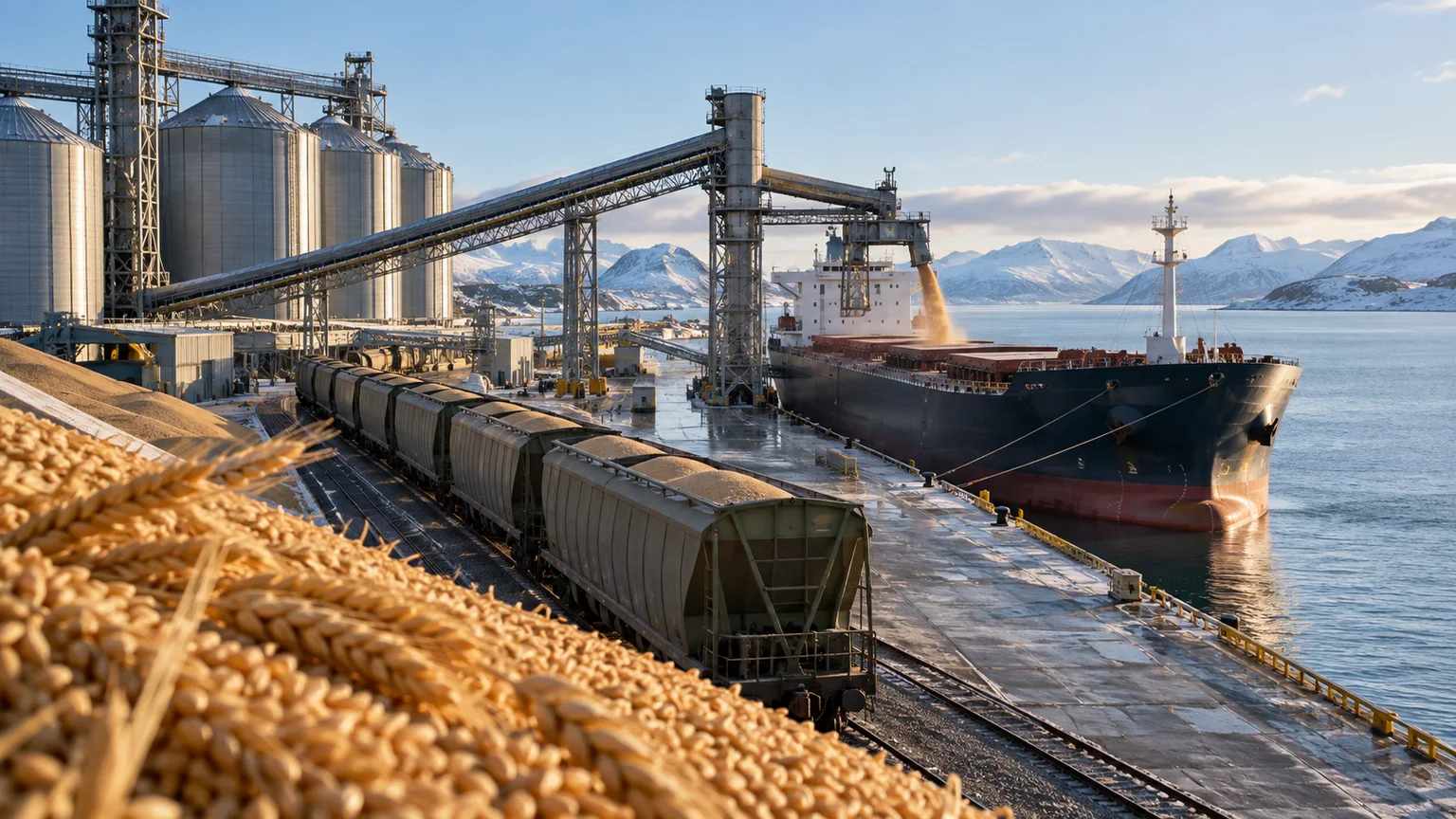
Russian companies are adapting terminals at Baltic and Arctic ports to handle more grain as Black Sea logistics face disruption. For international buyers, the development could widen the set of workable loading points—but it does not instantly replace the capacity, economics or operating patterns of established southern routes.
The immediate procurement question is therefore not simply whether grain can leave through a northern port. Buyers need to know whether the cargo can reach that terminal by rail, be stored and loaded to the required standard, sail economically to the destination and arrive with the correct documents inside the contractual window.
What is changing at northern ports?
Reuters reported on 21 September that companies were repurposing fertilizer and coal infrastructure at Ust-Luga, St Petersburg and Murmansk for grain exports. The report said Russia had historically shipped nearly 90% of its grain through Black Sea and Azov Sea ports, making the push north a material change in route planning rather than a minor port substitution.
That shift is occurring against a tighter export outlook. The U.S. Department of Agriculture's September 2026 WASDE reduced its forecast for Russian wheat exports to 43 million tonnes and Ukraine's to 12.5 million tonnes, citing weak August shipments and logistical disruption. USDA's September grain report also shows that Russia remains one of the world's largest wheat exporters, so constraints around its export channels can influence freight, origin spreads and buyer behaviour well beyond the region.
These are related signals, not proof that northern ports will immediately restore every delayed tonne. Terminal conversion, rail delivery, storage turnover and vessel loading must work as one system before nameplate capacity becomes dependable export capacity.
The constraint may move inland
A northern loading option changes the land-side journey. Grain that would normally move toward southern terminals may need different rail paths, wagon allocations, transshipment arrangements and storage plans. Competition for rail slots can matter as much as berth availability, particularly when the same corridor serves fertilizers, coal, containers and other bulk commodities.
Buyers should ask for evidence of the physical chain rather than accept a port name as proof of readiness. Useful checks include the cargo's current location, the nominated inland route, confirmed rail or truck capacity, terminal intake capability, storage availability and the expected loading rate. If the seller cannot explain how the grain reaches the vessel, the ETA is still an aspiration.
Terminal compatibility matters too. Facilities converted from another bulk commodity require suitable cleaning, dust control, sampling and contamination procedures. The contract should identify the inspection company, sampling point, quality certificate and remedy if the loaded cargo falls outside specification.
Northern routes change the ocean calculation
Moving the load port can alter distance, bunker consumption, vessel suitability and weather exposure. The commercial effect is destination-specific: a Baltic option may be competitive for one market and unattractive for another. Murmansk has different operating characteristics from Baltic ports, and neither should be treated as a generic substitute for the Black Sea.
Procurement teams should obtain a fresh voyage estimate based on the actual load port and destination, not carry forward an old freight assumption. The calculation should include the vessel class, bunker basis, port costs, seasonal operating conditions, insurance, permitted route and any transshipment requirement. Sanctions and compliance screening must cover the specific vessel, owners, operators, banks and counterparties involved.
Longer or less familiar execution chains can also increase financing duration. A seemingly attractive FOB price may lose its advantage once inland freight, port handling, ocean freight, insurance and the cost of working capital are included.
Capacity announcements are not shipment evidence
Infrastructure investment is strategically important, but buyers contract cargoes, not future capacity. A terminal may be technically capable of loading grain while still building throughput, learning new handling routines or waiting for consistent inland supply.
Before treating a northern route as executable, buyers should request a transaction-specific package:
- the exact load port, terminal and expected loading window;
- evidence that the cargo is available and allocated to the contract;
- the nominated vessel or a credible nomination timetable;
- terminal acceptance, storage and loading arrangements;
- the applicable quality, weight and inspection procedure;
- export, customs and phytosanitary document responsibilities;
- an updated freight, insurance and sanctions review; and
- the contractual response if rail delivery or terminal loading is delayed.
This is the same execution discipline required when buyers switch origins. One Discovery's analysis of Asian wheat origin switching explains why physical availability, specifications, documents and timing must be compared together.
Build scenarios, not assumptions
A practical buyer model should compare at least three cases: the original Black Sea route, a Baltic load port and an Arctic load port where commercially relevant. Each scenario should use an executable delivery window and total landed cost, with a separate contingency for missed rail slots, weather delays or vessel substitution.
The comparison should also identify the decision deadline. If the buyer waits until the original route has already failed, the remaining alternatives may be more expensive or unavailable. Pre-qualifying terminals, inspection providers, documentary flows and replacement origins creates usable optionality before disruption becomes an emergency.
The procurement conclusion
Russia's effort to expand northern grain exports may improve route resilience over time. For buyers, however, the value of that capacity depends on the complete movement from inland stock to destination discharge—not on the existence of a berth alone.
The disciplined response is to welcome additional routing options while verifying every operational link. A new corridor can reduce dependence on one region, but only confirmed rail capacity, terminal readiness, vessel economics, compliant documentation and a realistic delivery window turn it into supply.
ONE DISCOVERY VIEW
Route diversification is valuable only when the full chain is executable. Verify the cargo, inland movement, terminal, vessel, documents and delivery window together.
Sources
- USDA — September 2026 World Agricultural Supply and Demand Estimates
- USDA Foreign Agricultural Service — Grain: World Markets and Trade, September 2026
- Reuters — Russia adapts Baltic and Arctic terminals for grain exports, 21 September 2026
- World-Grain — Russia rerouting grain exports to Baltic Sea, 31 August 2026
Test the full route before accepting the ETA.
Contact One Discovery