
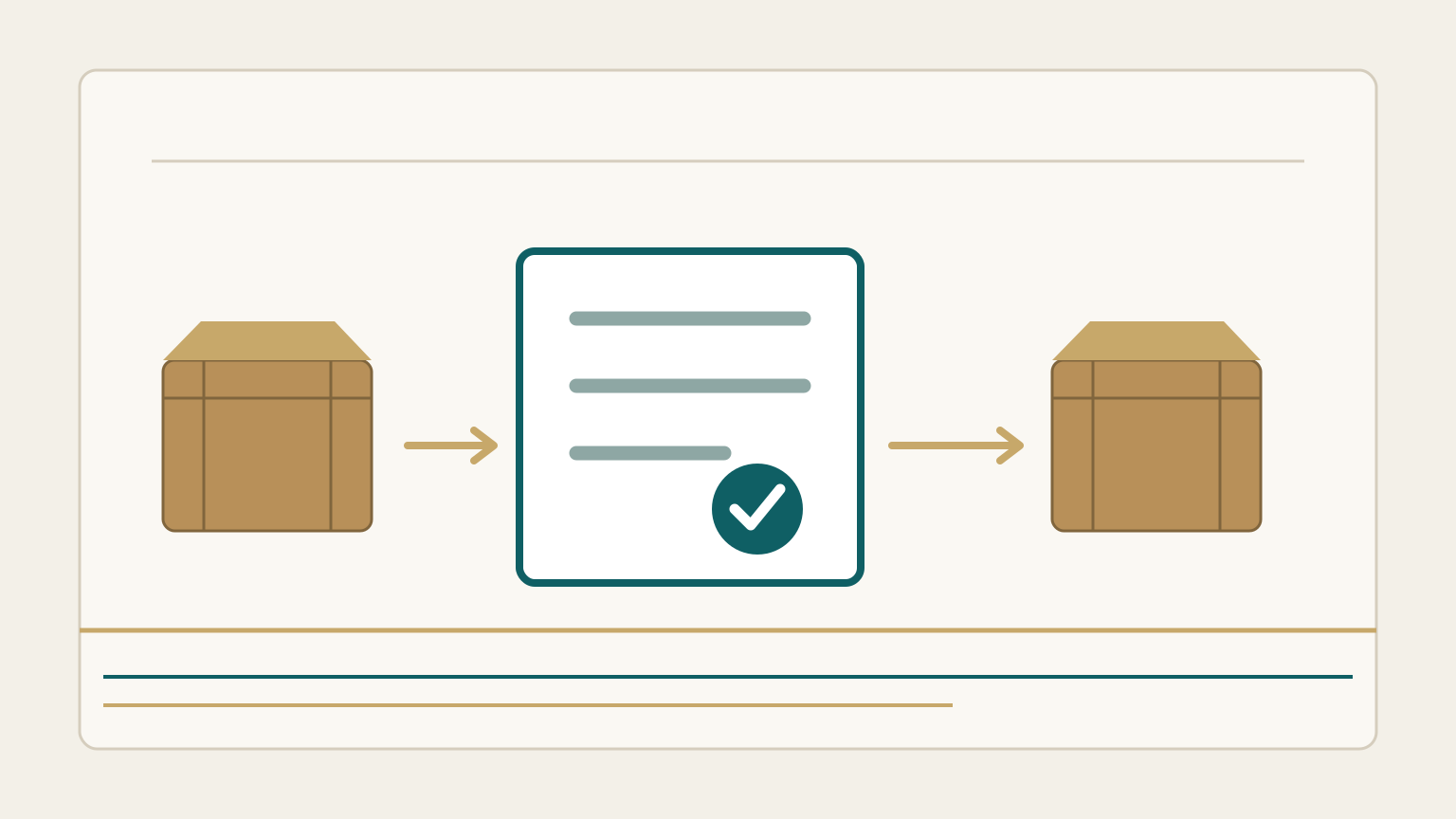
Brazilian President Luiz Inácio Lula da Silva said on 21 September that Uruguay had authorised Brazil to use the surplus from Uruguay's beef export quota to China. The announcement may create an additional route for trade, but it is not yet enough for a buyer to assume that Brazilian beef can clear Chinese customs under Uruguay's unused quota.
China's safeguard measure is administered through country-specific quantities and an additional tariff once a country's threshold is reached. A bilateral understanding between exporting countries therefore needs a recognised Chinese legal and customs mechanism before it can change the tariff treatment of a shipment.
What has been announced
Reuters reported Lula's statement after a meeting with Uruguayan President Yamandú Orsi in New York. Lula thanked Uruguay for authorising Brazil to use the surplus from Uruguay's beef export quota. Reuters also reported that Uruguay's foreign ministry had not immediately commented.
The statement is important, but it leaves practical questions unanswered. It does not identify the volume to be transferred, the eligible exporters, the customs codes to be used, the validity period or the Chinese authority that will recognise the arrangement. These details determine whether the announcement can be executed as a shipment.
For that reason, this article treats the proposed use of surplus quota as a reported policy development, not as confirmed commercial availability or guaranteed tariff treatment.
What China's safeguard rules currently say
China's Ministry of Commerce introduced a three-year beef safeguard measure from 1 January 2026. The system applies country-specific quantities and adds 55 percentage points to the otherwise applicable tariff after the relevant threshold is reached.
MOFCOM's implementation notice reported that Brazilian beef had reached 90% of its 2026 country quantity on 10 August. The notice says the additional tariff applies from the third day after imports reach 100% of the specified amount. A Brazilian Agriculture Ministry note published in July described Brazil's 2026 amount as 1.106 million metric tons and said the in-quota tariff was 12%.
Those official notices establish the existing country-specific framework. They do not, in the sources reviewed for this article, set out a public procedure for moving unused quota from Uruguay to Brazil. That does not mean such a procedure cannot be created; it means buyers should wait for the implementing document rather than infer it.
Why origin and quota identity matter
Customs treatment follows declared goods, origin, producer eligibility, documentation and the applicable legal measure. A commercial invoice cannot simply describe Brazilian-origin beef as Uruguayan quota. Any authorised mechanism would need to explain how China attributes the cargo and how exporters, importers and customs brokers should declare it.
The distinction is especially important for contracts already priced around an assumed tariff. If the additional 55-percentage-point duty applies unexpectedly, the landed cost, duty deposit and working-capital requirement can change sharply. A dispute can then arise over whether the seller promised an in-quota result or only agreed to deliver the cargo.
Buyers should separate three decisions: whether the product is eligible for China, whether quota treatment is available for that shipment and who bears the cost if customs assigns a different tariff treatment.
What importers should verify before contracting
- Chinese legal authority: obtain the MOFCOM, General Administration of Customs or other competent authority document that recognises the transferred or shared quota.
- Effective date and volume: confirm when the mechanism begins, how much quota is available and whether it is allocated by arrival, declaration or licence date.
- Origin treatment: verify how Brazilian origin remains declared and how the quota entitlement appears in the customs entry.
- Eligible parties: check whether specific plants, exporters, importers or licences are required.
- Tariff responsibility: state which party bears additional duty, storage and delay if quota treatment is rejected or exhausted.
- Arrival risk: align shipment timing with the quota balance and obtain a contingency plan for cargo already at sea.
A buyer should ask its Chinese customs broker for a written entry plan tied to the actual HS code, origin, plant and expected arrival date. A general statement that quota is “available” is not equivalent to an entry instruction accepted by customs.
How to price the transaction while details are pending
Until an implementing mechanism is public, procurement teams can model two landed-cost cases. The first assumes recognised in-quota treatment. The second assumes the safeguard duty applies. The contract can then state whether the order proceeds only after documentary confirmation or whether a party accepts the downside case.
This is a practical risk-control step, not a prediction that the arrangement will fail. Governments can complete the required approvals after a political announcement. The execution risk lies in the period between the announcement and the operative customs rule.
Our tariff-cut landed-cost checklist explains why a political agreement must be matched to product coverage and entry dates. Our customs importer-readiness guide shows why document ownership and system timing belong in the purchase plan.
The commercial lesson is simple: a quota transfer can improve market access only when customs can identify, measure and apply it. Before buying, verify the legal notice, the remaining balance, the declaration method and the party carrying tariff risk.
ONE DISCOVERY VIEW
A political quota announcement becomes a trade instrument only when customs has an operative rule for the actual cargo.
Sources
- China MOFCOM — 2026 beef safeguard implementation notice, 11 August 2026
- Brazil Ministry of Agriculture — China beef quota clarification, 22 July 2026
- Reuters — Brazil says it may use Uruguay's surplus beef quota, 21 September 2026
- China MOFCOM — Announcement No. 87 of 2025 on beef safeguard measures
Turn quota headlines into an executable customs and contract checklist.
Contact One Discovery