
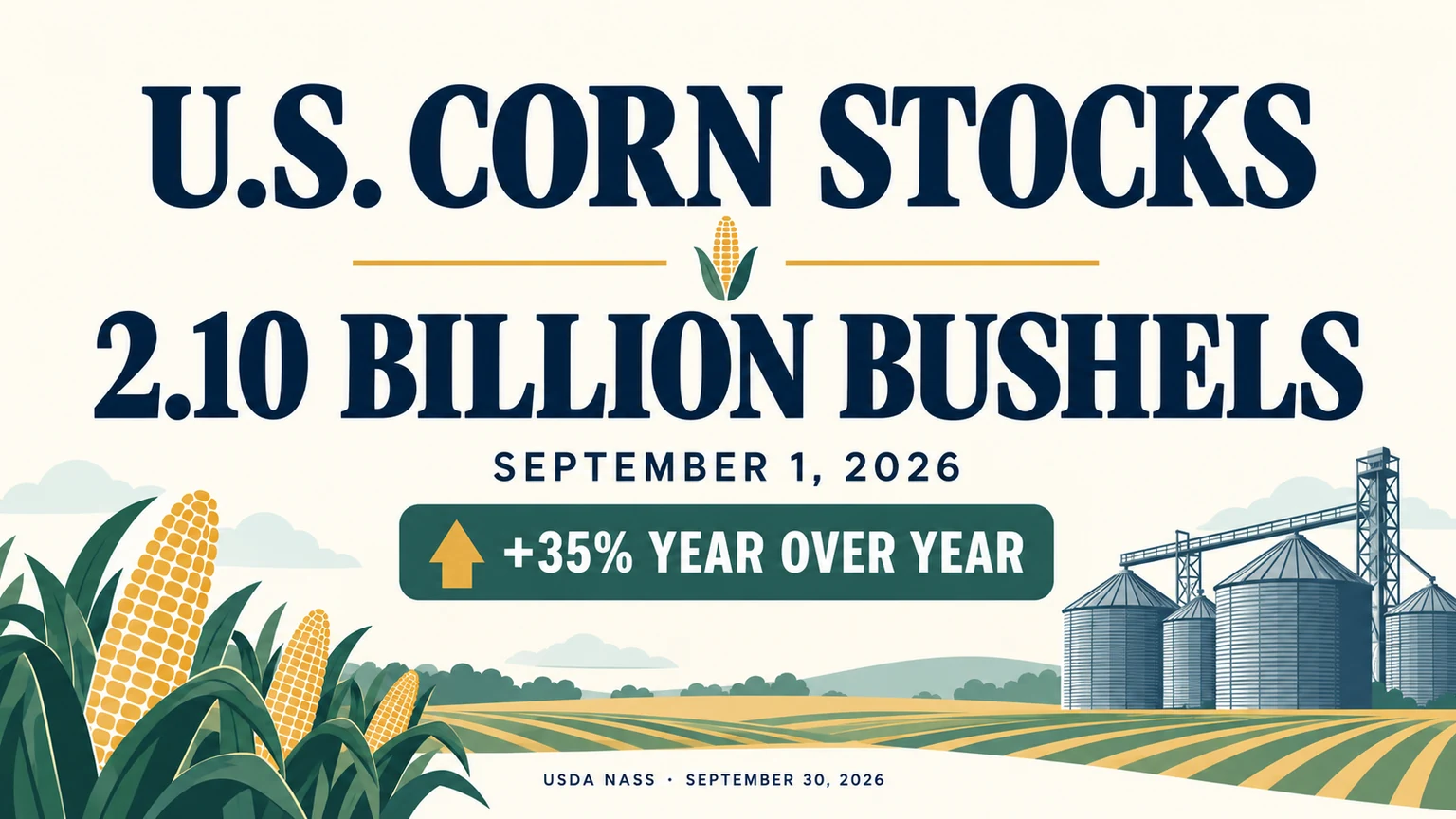
The United States entered its new corn marketing year with more old-crop corn than traders expected. The USDA National Agricultural Statistics Service (NASS) put corn stocks in all positions at 2.10 billion bushels on September 1, 2026, up 35% from a year earlier. For importers, the report changes the negotiating context. It does not establish a delivered export price or guarantee that a particular grade is available at a named port.
Farm Progress reported the more precise figure of 2.095 billion bushels, above an analyst expectation near 1.918 billion. Futures fell after the release. Those are market observations, not a physical cargo quotation. A buyer should compare current offers by origin, specification, shipment window, and landed cost before treating a stock surprise as an executable opportunity.
What did USDA actually measure?
NASS counted corn stored in all positions as of September 1. Of the rounded 2.10 billion-bushel total, 787 million bushels were on farms and 1.31 billion were in off-farm facilities. The annual increases were 22% and 44%, respectively. The agency surveyed farm and off-farm holdings separately in the first two weeks of September. It also revised its estimate of the previous corn crop by less than one percent, a routine adjustment after the marketing year ended.
These holdings are an inventory snapshot, not a list of export-ready lots. Stored grain may be committed to domestic feed, ethanol, processors, or earlier contracts. Farm-held grain may not be immediately deliverable. Location, grade, ownership, and export capacity cannot be inferred from a national total. The measured balance informs the broad supply picture; a transaction still depends on a specific lot, counterparty, and logistics chain.
Why did the surprise move the market?
Farm Progress reported that analysts had expected roughly 1.918 billion bushels and that corn futures fell toward a six-week low following the USDA release. The difference between that expectation and the precise reported stock figure is about 177 million bushels. This is One Discovery's calculation from those two published figures, and it is not a measure of newly available export tonnage.
A large carryover can put pressure on bids, but the effect differs by delivery date and location. New-crop harvest, inland transport, domestic use, and export bookings determine what can be loaded when an importer needs it. A futures decline may improve the starting point for a negotiation while basis, freight, insurance, and currency move in different directions. Procurement teams should separate the benchmark price from the actual invoice and delivered cost.
How should an importer test an offer?
Start with a written specification. Moisture, foreign material, test weight, mycotoxin limits, and applicable inspection methods can matter more to a feed mill than the national stock figure. Agree who arranges independent sampling and which standard governs a quality dispute. A cheap reference price does not help if the cargo cannot meet destination requirements.
Next, establish the route and loading window. Ask for the loading region, inland movement plan, export terminal, vessel nomination timetable, and shipment laycan. Compare FOB, CFR, and CIF proposals on the same basis: destination port, quantity tolerance, freight assumptions, insurance where applicable, demurrage allocation, and required documents. A lower commodity component does not necessarily produce a lower landed cost.
Verify the seller's capacity for the particular lot. Inventory evidence, contractual authority, and previous documentary performance should be checked independently, with sensitive records handled privately. Neither a USDA statistic nor a futures-screen image establishes that a trader owns or controls grain. Contract terms should address inspection, substitution, delivery delay, and document presentation.
Where the purchasing mandate permits, compare more than one executable offer and revisit timing as harvest and freight information develops. A buyer with an imminent vessel may need to prioritize reliable loading over a hoped-for price decline. A buyer with a longer horizon can compare origins and shipment months. This is a purchasing framework, not a prediction that futures will keep falling.
What remains uncertain?
The September 1 inventory precedes much of the 2026 harvest. Later USDA production, demand, and export data can change the outlook. This stock report alone does not identify the best supplier, the freight for a particular day, or the customs treatment at a destination. Each requires fresh quotations and documents.
For a team negotiating now, the practical response is to use the larger reported carryover as a reason to request competitive offers, then test each against quality, shipment timing, and landed economics. Keep the source statistic, the futures reaction, and the commercial decision separate. Related reading: our procurement view of grain shipment windows and the Insights archive.
Sources
Verify the cargo behind the market signal.
Explore all insights