
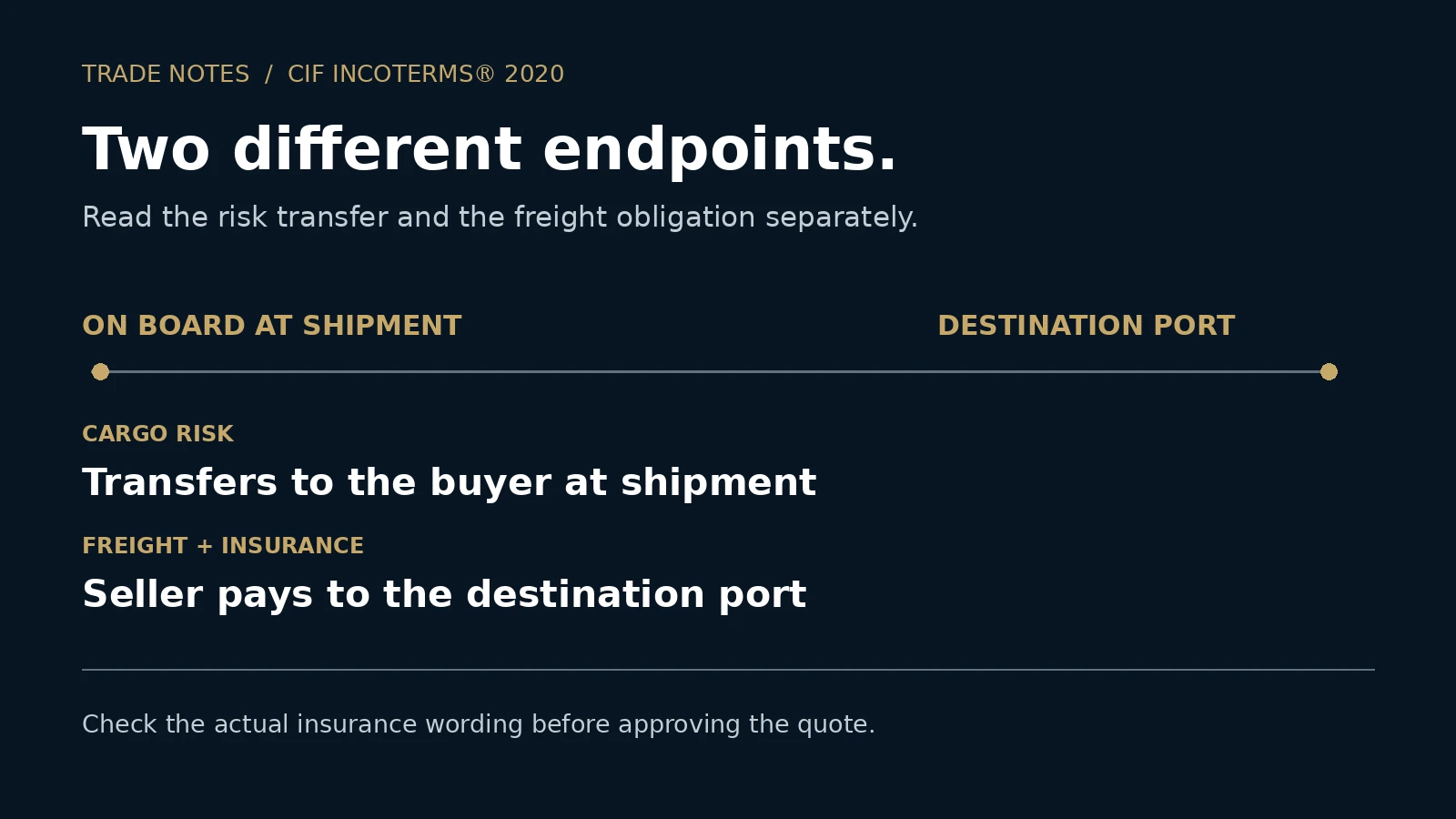
A CIF quote can make a purchase look simple: one price includes the goods, insurance and freight to a named destination port. The important question is where the buyer starts carrying the risk of loss or damage. Under CIF Incoterms® 2020, that happens when the goods are loaded on board the vessel at the port of shipment—not when the vessel reaches the destination.
ICC Academy explains that the seller arranges and pays for port-to-port carriage and insurance, while the risk transfers at loading. [1] For procurement teams, the useful response is to review the transport arrangement and the insurance evidence together before accepting an offer.
Read the destination and the delivery point separately
ICC Academy’s explanation of the C rules draws a distinction between the place to which transport is paid and the place where delivery occurs for risk allocation. The named destination in a CIF term should therefore not be read as a promise that transit risk stays with the seller until arrival. [2]
One Discovery analysis: put two separate fields on an offer-comparison sheet. Record the named destination port in one and the shipment port and delivery event in the other. Ask the supplier to resolve any mismatch between the quotation, contract draft and shipping instructions before comparing headline prices.
This is also a useful way to organize an internal handover. The colleague arranging discharge may work from the arrival schedule, while the colleague handling insurance needs to understand the earlier transfer of risk. A short written handover can give both people the same shipment reference, insurer contact and document list.
Look at the coverage, not just the word “insured”
ICC states that CIF’s default insurance level is Institute Cargo Clauses (C), with the parties able to agree a higher level of cover. CIP uses a higher default level under Institute Cargo Clauses (A) or similar clauses. [3] These are different insurance arrangements; the presence of insurance in a quote does not make the terms interchangeable.
For a specific cargo, ask the insurance specialist to review the actual policy wording. Useful questions include which events are covered, what exclusions apply, how the goods and voyage are described, and whether any additional cover is needed for the planned route. Treat those as questions requiring a written answer, rather than assumptions that a short commercial offer has already settled.
Do not leave this discussion until the vessel is sailing. An unanswered coverage question belongs on the open-items list for the purchase. If additional protection changes the premium or the quotation, record the change clearly so that procurement and finance compare the same package.
Compare offers on a consistent working sheet
The following is a proposed procurement worksheet, not a statement that every cost is automatically allocated in the same way under every contract.
| Review item | Information to request |
|---|---|
| Trade basis | Complete term, named port and Incoterms® version |
| Shipment plan | Loading port, intended shipment window and routing |
| Insurance | Policy or certificate, applicable clauses and claims contact |
| Destination work | Written allocation of discharge, handling and onward transport |
| Commercial documents | Agreed specification, quantity and documentary requirements |
| Exceptions | Each unresolved point, its owner and a deadline for resolution |
Ask the seller, freight provider and insurance adviser to clarify the items relevant to their roles. Where the documents disagree, obtain a corrected document or an agreed explanation. Avoid silently choosing the interpretation that produces the lowest estimated purchase cost.
For example, imagine two hypothetical grain offers carrying the same CIF destination label. One includes detailed insurance evidence and a defined shipment plan; the other provides only a price and an estimated sailing month. That does not establish that either offer is better. It identifies the information missing from a fair comparison. Keep the second offer provisional until the gaps are answered.
Rehearse a cargo problem before committing
A short tabletop exercise can make the document review more practical. Ask the team to imagine that damage is reported after loading and write down whom they would contact first, which shipment documents they would retrieve, and who would coordinate the response.
This is an operational planning exercise, not a prediction about coverage or a claim outcome. The insurance adviser should confirm the policy’s notification and evidence requirements. The purpose is to expose missing contact details and unclear responsibilities while there is still time to correct them.
Keep commercial quality disputes and transport-loss questions distinct in the review. Ask the contract adviser how the agreed specification, inspection process and remedies interact with the proposed transport arrangement. A three-letter delivery term should not be used as a substitute for that discussion.
What to do with the next quotation
Start with one live requirement and complete the working sheet before asking for a revised price. Send a single consolidated clarification request, assign someone to follow up each unresolved item, and retain the answers alongside the quotation.
For grain purchases, combine this with the exporter-registration checks in our earlier buyer guide. Keep registration, cargo documentation and shipment terms as separate review tasks so that a positive answer in one area does not close the others.
The next action is straightforward: identify the risk-transfer point and obtain insurance details for the proposed cargo before treating the CIF quotation as ready for approval.
ONE DISCOVERY
Sources
- ICC Academy — CIF and CIP Incoterms® 2020 explained.
- ICC Academy — C rules versus D rules: risk transfer explained.
- International Chamber of Commerce — Incoterms® 2020, insurance coverage levels.
Sources reviewed 9 October 2026. The procurement worksheet and operational suggestions are One Discovery analysis.