
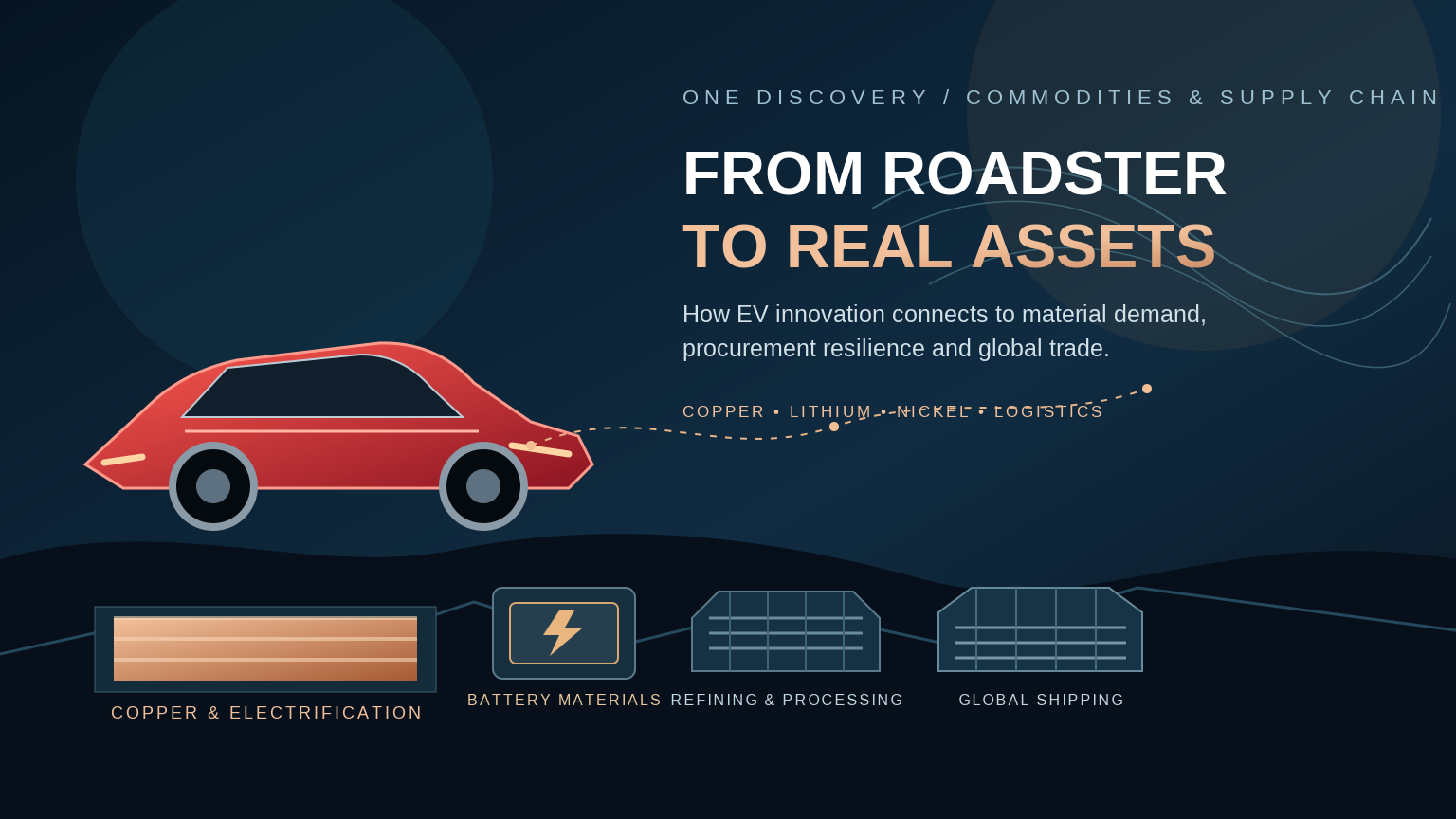
A futuristic electric sports car captures attention through design, performance and the promise of what comes next. But the more important story for commodity markets sits behind the bodywork: metals, battery materials, power electronics, manufacturing capacity and the global logistics network that brings them together.
The Tesla Roadster is a useful lens for examining a much larger industrial shift. This is not a claim about the precise bill of materials or sourcing contracts for any specific vehicle. It is a look at the commodity and procurement systems that advanced electric vehicles depend on—and why supply-chain resilience matters as much as product ambition.
The road car is the headline. The materials are the underlying story.
Electrification depends on a web of materials and industrial processes. Copper is essential to electrical wiring, motors, charging infrastructure and power distribution. Lithium is a key input for many lithium-ion batteries, while nickel is used in several battery chemistries. Graphite remains an important anode material in many lithium-ion cells. Aluminium and specialty steels contribute to lightweight structures and vehicle safety.
The exact mix varies by design and battery chemistry. No single vehicle should be assumed to use every material in the same proportions. The broader point is that progress in electric mobility is linked to reliable access to mined materials, refined products, processed components and manufacturing expertise.
Four commodity signals worth watching
1. Copper: electrification beyond the vehicle
Copper demand is not only about the car itself. Charging networks, grid upgrades, renewable power connections, data infrastructure and industrial electrification all require electrical equipment and cabling. For buyers, the important variables include refined-copper availability, regional premiums, fabrication capacity and delivery lead times—not just the headline exchange price.
2. Lithium and battery materials: chemistry changes the sourcing map
Battery technology is not static. Different chemistries have different material requirements, and manufacturers continually balance cost, energy density, safety, performance and supply risk. Procurement teams should track chemistry choices, processing concentration, supplier qualification and the difference between mined supply and battery-grade refined material.
3. Nickel: quality and processing matter
Nickel is used in some high-energy battery chemistries, but not all battery types rely on it equally. Buyers need to distinguish between total mine output and material that meets the specification, purity and traceability requirements of a particular industrial customer. Processing routes and qualification standards can matter as much as nominal resource availability.
4. Logistics: materials must arrive in the right form, at the right time
Mining, refining, component manufacturing and final assembly are geographically distributed. Port congestion, shipping disruptions, export restrictions, energy costs and changing trade policies can affect the delivered cost of materials. A low quoted price is not a good deal if the cargo cannot meet specification or arrive within the production window.
What procurement teams should do differently
- Map dependencies: identify critical materials, processing stages, regions and single-source suppliers.
- Compare delivered cost: include freight, insurance, duties, financing, quality adjustments and inventory costs.
- Qualify alternatives early: secondary suppliers and substitute materials require testing, not just a price comparison.
- Monitor concentration risk: distinguish diversified mining supply from concentrated refining or component capacity.
- Build scenarios: test how price volatility, shipping delays, policy changes or demand surges affect production continuity.
- Use traceability as a procurement tool: document origin, processing, specifications and compliance requirements.
Diversification does not mean buying from as many suppliers as possible. It means knowing which risks are material, which alternatives are technically acceptable and how quickly a replacement source could be activated.
From product spectacle to industrial strategy
A Roadster reveal can make the future of mobility feel immediate. Commodity markets move more quietly, through mine development, refining capacity, long-term contracts, technology choices and logistics planning. Yet those less visible systems help determine whether ambitious products can be manufactured at scale and at a competitive cost.
For One Discovery, the takeaway is straightforward: watch the materials and the supply chain behind the headline. Product innovation creates the story; procurement execution helps turn that story into industrial reality.
Questions for buyers and market watchers
- Which materials are most exposed to processing concentration rather than mining scarcity?
- How much of delivered cost is driven by freight, regional premiums and specification?
- Which alternative suppliers are already qualified—and which exist only on paper?
- What changes if battery chemistry, vehicle architecture or production location shifts?
The strongest market view connects technology signals to the physical flow of materials. That is where commodity intelligence becomes a practical procurement advantage.
Sources
- International Energy Agency — Global Critical Minerals Outlook 2024
- U.S. Geological Survey — Copper Statistics and Information
- U.S. Department of Energy — Electric vehicle market context
Editorial note: This article discusses broad industry material dependencies. It does not disclose or assert Tesla-specific sourcing contracts, exact vehicle material quantities, or investment advice.