
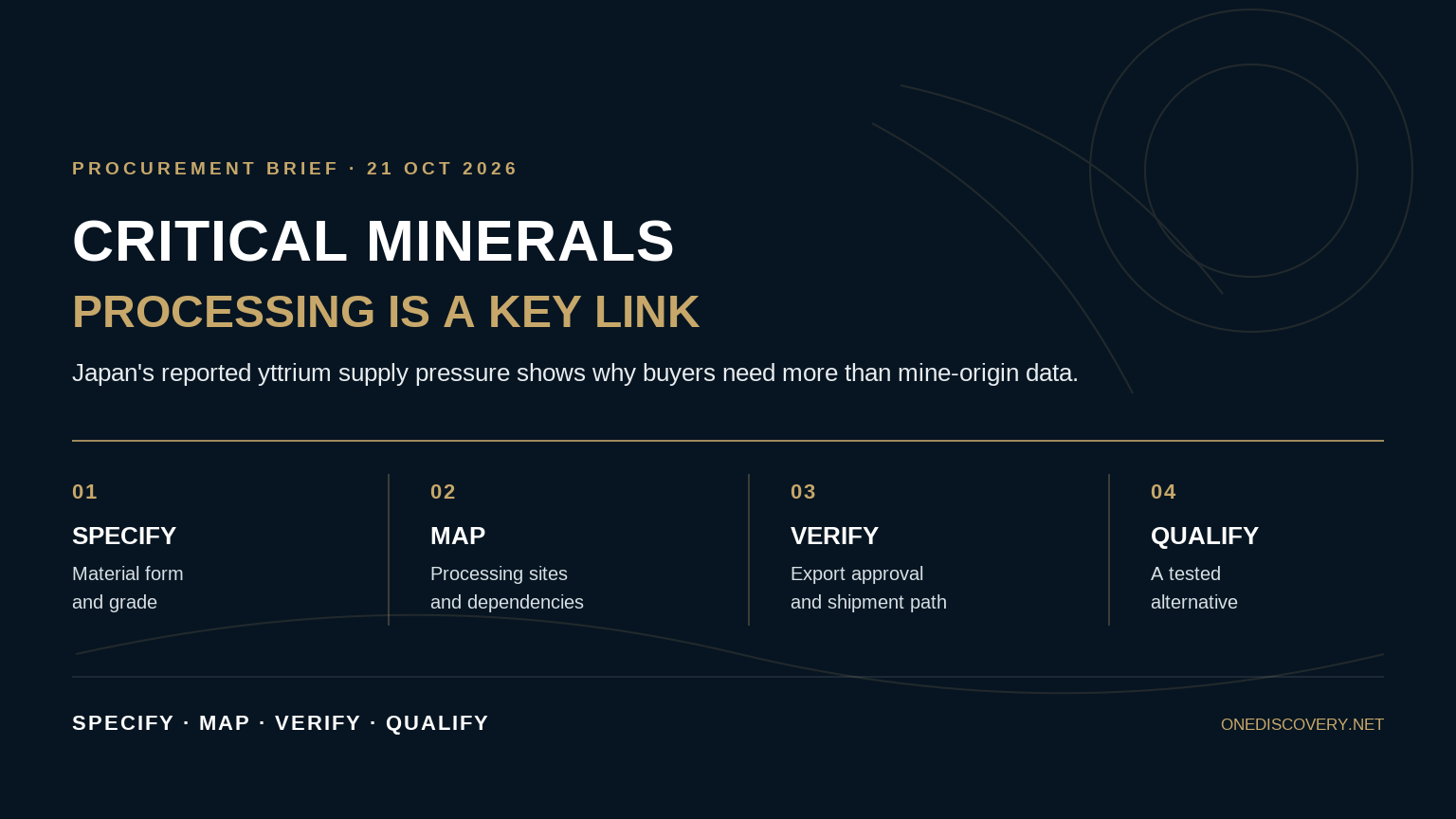
Japan's recent yttrium supply pressure is a reminder that critical-mineral resilience cannot be measured by mine count alone. Buyers also depend on separation and refining, export authorisation, product qualification and reliable logistics. If one of those links is concentrated, a new mine may not provide an immediately usable substitute.
The procurement question is not simply, “Where was this mineral mined?” It is also: which facility processed it, in what form is it delivered, can it legally move to the destination, and has the material been qualified for the buyer's production process?
What the latest evidence says
On 20 October 2026, the Financial Times reported that Japan could face a shortage of yttrium within months if supply conditions do not improve. The report cited Chinese customs data showing that China exported 14.1 tonnes of yttrium oxide to Japan in January–May 2026, compared with 605.3 tonnes in the same period a year earlier. Those figures describe reported trade flows; they are not a complete measure of Japan's inventory, demand or every available source.
Reuters had reported in June that Chinese restrictions were continuing to put pressure on Japanese supplies of heavy rare earths, including yttrium. The episode illustrates how export controls and diplomatic friction can turn a concentrated sourcing route into a near-term operating risk for downstream manufacturers.
The International Energy Agency's 2026 critical-minerals analysis points to the structural issue behind such cases. New projects in the United States and higher output in Malaysia helped reduce the leading supplier's share of rare-earth refining from more than 90% in 2023 to 85% in 2025. That is progress, but the IEA also finds that announced projects outside the leading supplier still leave gaps between expected mine output and planned refining and downstream capacity. A mine, a separated oxide, a metal or alloy, and a finished component are not interchangeable stages of supply.
Yttrium is one of the 17 rare-earth elements identified by the U.S. Geological Survey. Its specialised industrial uses mean that buyers may need a precise material form and consistent performance, not simply a generic “rare earth” substitute.
Why processing is the pinch point
Mining capacity is only the beginning of a usable supply chain. Material may need to be concentrated, separated, refined, converted to a specific chemical form, tested and approved before it can enter a manufacturing process. Each stage can have different owners, locations, lead times, technical requirements and trade-control exposure.
That is why counting mines or announcing a new source does not automatically create resilience. A buyer can identify a second mine and still depend on the same processor, the same export route or the same qualified component supplier. A substitute may also require laboratory work, production trials or customer approval before it can replace the incumbent material.
Six checks for critical-mineral buyers
- Specify the material, not just the mineral name. Record the required chemical or physical form, purity range, performance criteria, packaging and intended use. Confirm which parameters are acceptance-critical with the engineering or quality team.
- Map the chain beyond the mine. Ask for the mine or feedstock origin, separation and refining locations, processing companies, final material form and any toll-processing steps. Distinguish the country of extraction from the country where the material was processed or transformed.
- Verify the export path for this shipment. Check the current rules for the specific material, exporter, destination and end use. Ask which party obtains any required authorisation and what evidence will be available before shipment. Have the customs broker or qualified trade-compliance adviser confirm the applicable requirements; do not rely on an old licence or a general statement that exports are permitted.
- Qualify an alternative before a disruption. Request representative samples and test them against the same specification. Where necessary, plan laboratory analysis, production trials and formal approval by the relevant customer or equipment owner. A supplier name on a contingency list is not a qualified substitute.
- Measure real exposure. Identify single-source materials, shared processors, long replenishment times and inventory that is not actually available for allocation. Model how long operations could continue if a shipment were delayed, a licence were not granted or a processor stopped production.
- Put evidence and escalation into the contract. Define required traceability data, change-notification duties, delivery milestones, quality remedies, audit rights where appropriate and the process for responding to export-control changes. Agree who informs the buyer when a processing site, material form or route changes.
Diversification that can actually work
Useful diversification reduces common points of failure. Two suppliers that use the same refinery may provide less resilience than the supplier list suggests. Conversely, a second processing route may help only if its material meets the technical specification, has a workable delivery route and can be exported lawfully to the destination.
Build a short risk map for each critical input: the current material form, the critical processing stages, the most concentrated dependency, the lead time to qualify a substitute and the person responsible for monitoring changes. Review it with procurement, engineering, logistics and compliance rather than leaving it solely with the buying desk.
Inventory can buy time, but it is not a complete strategy. Stock levels should reflect actual consumption, replenishment lead time, storage conditions, shelf-life or handling constraints, working-capital cost and the availability of qualified alternatives. A buffer is useful only when the stored material is suitable and can be released when needed.
A practical go / pause / stop rule
- Go: the material specification is clear, the processing chain is documented, the export route has been checked and the lot meets the buyer's qualification requirements.
- Pause: a processor, licence, origin detail or qualification step remains unconfirmed but can reasonably be verified before commitment.
- Stop and escalate: the supplier cannot substantiate a material claim, the shipment depends on an unresolved authorisation, or the proposed substitute has not met a critical technical requirement.
The lesson from the yttrium case is not that every rare-earth shipment is at risk. It is that concentrated processing and changing trade controls can expose dependencies that a mine-origin field will miss. Buyers gain more from mapping and testing the full chain than from adding unqualified supplier names to a spreadsheet.
Sources
- Financial Times: Japan faces potential yttrium supply shortage
- Reuters: China's rare-earth curbs extend pressure on supply to Japan
- International Energy Agency: Critical-mineral supply concentration and export restrictions
- U.S. Geological Survey: Rare Earths Statistics and Information
Market information only. Export controls and licensing requirements vary by jurisdiction, material, exporter, destination and end use. Verify current rules with the competent authority and qualified trade-compliance counsel before acting.
One Discovery · Critical Minerals and Procurement · 21 October 2026