
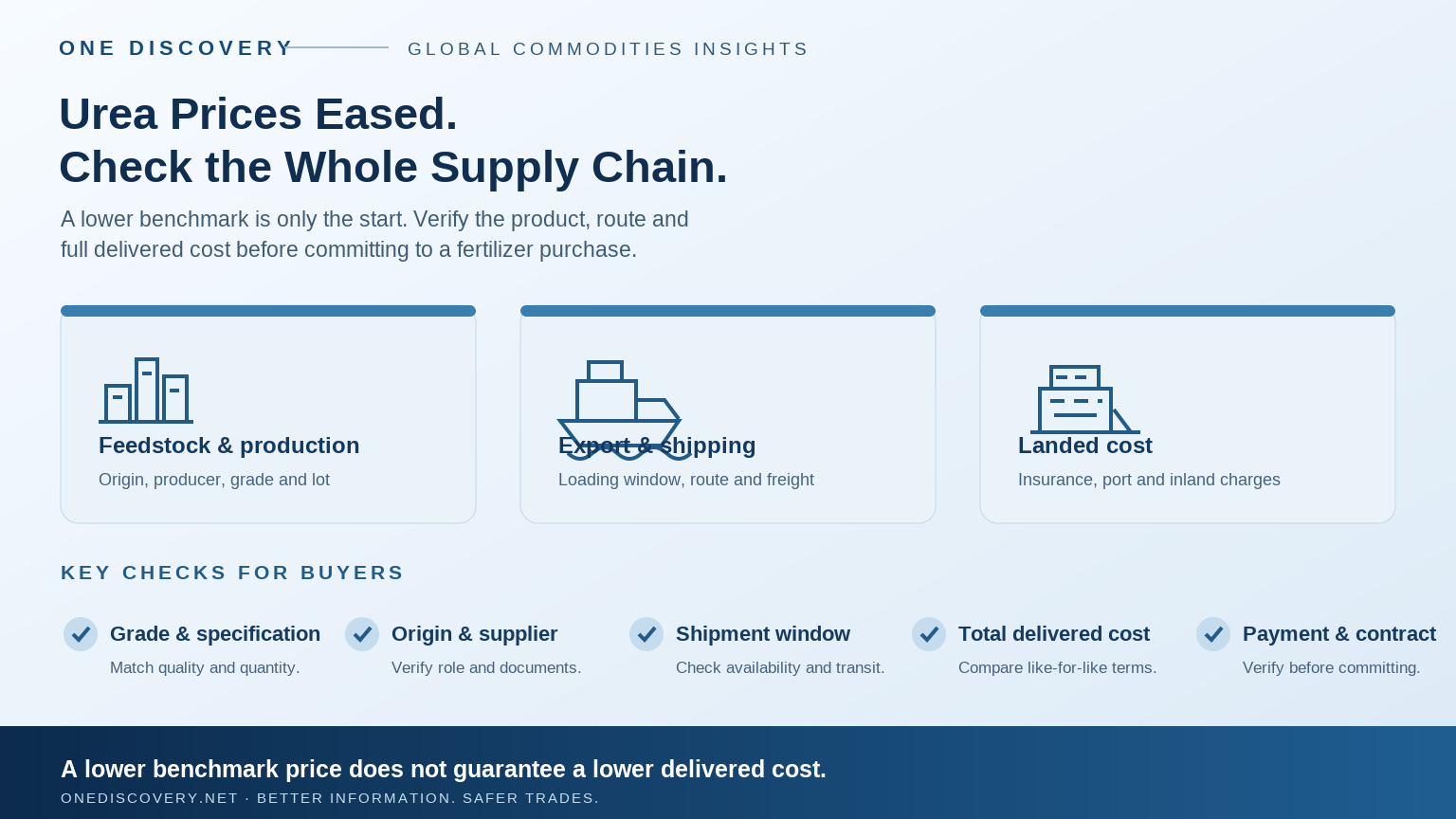
A lower urea quotation can create a buying opportunity, but it does not automatically mean fertilizer is easier or cheaper to secure. Buyers should separate a market-price signal from a deliverable offer: verify the product, origin, seller’s authority, shipment window, logistics and full landed cost before committing.
What the latest signals tell buyers
A report published by Financial Express on 19 October 2026 said Indian import prices for urea had fallen to about US$392 per metric tonne in September, roughly 60% below a May peak of US$947/t. That is a useful sign of easing in the reported Indian import market—not a universal price for every grade, origin, destination or contract basis. A buyer comparing a new offer should first establish whether the reference is FOB, CFR/C&F, CIF or another delivery basis, and whether the product specification and timing are comparable.
The World Bank’s April 2026 Commodity Markets Outlook described a very different phase earlier in the year: its fertilizer price index rose by more than 12% quarter-on-quarter in 2026 Q1, while urea averaged US$725/t in March. The Bank linked the sharp increase to shipping disruption, production constraints and higher input costs. Its April forecast anticipated a large rise in the fertilizer index for 2026, followed by easing in 2027 as supply recovered. These figures are historical observations and forecasts, not a substitute for a current executable quotation.
Rabobank’s September 2026 fertilizer outlook likewise noted that prices had eased while affordability, geopolitical uncertainty and supply risks continued to matter. Taken together, the signals argue against using one headline number as a buying decision. Prices can retreat while freight, availability, specification differences or local delivery costs remain uneven.
Five checks before comparing offers
1. Match the product specification
Confirm whether the offer is for granular or prilled urea, the required nitrogen content, applicable standards, packaging and quantity tolerance. Ask for a current specification sheet and certificate of analysis, then verify the issuer and the relevance of the document to the offered lot. Similar product names do not guarantee identical commercial specifications.
2. Verify origin and the actual supplier role
Record the producer, production location, export origin and contracting entity separately. Establish whether the counterparty is the producer, title holder, distributor or intermediary, and what evidence supports that role. Confirm company and signatory details through independent channels. A document image or a claimed allocation should not be treated as proof of current stock or control.
3. Confirm shipment timing and route
Ask for a realistic loading window, load port, destination, vessel or transport assumptions, and any transshipment or storage requirements. Check whether the seller’s proposed schedule fits the buyer’s inventory position and agricultural demand window. A low-priced cargo that arrives too late may cost more in operational terms than a slightly higher-priced, reliable delivery.
4. Compare the full landed cost
Build a like-for-like cost sheet that includes the product price, freight, insurance where applicable, port and terminal charges, inspection, handling, inland delivery, financing, currency exposure and any taxes or duties relevant to the destination. Clarify the Incoterms® rule and the named place or port. Avoid comparing an FOB offer with a delivered-price offer as if they were equivalent.
5. Validate payment and contract controls
Ensure payment instructions match the contracted legal entity and independently verify any changes to beneficiary details. Review quality and quantity tolerances, inspection rights, rejection procedures, delivery obligations, delay remedies, force-majeure language and dispute resolution. For significant purchases or unfamiliar counterparties, obtain qualified legal and trade-finance review before transferring funds.
A practical way to make the decision
Use a simple comparison table for every offer: specification, origin and producer, verified supplier role, quantity, shipment window, delivery basis, total landed cost, document status and unresolved risks. Mark each field as verified, pending or not acceptable. Do not let a lower headline price conceal missing documents or uncertain delivery.
If two offers are not comparable, request clarification rather than forcing a ranking. If a critical claim cannot be independently checked, pause the transaction and record what evidence is missing. Revisit market references when the quotation is refreshed, but keep the timestamp and basis attached to each benchmark.
The key takeaway is straightforward: easing urea prices may improve the negotiating environment, but procurement quality still depends on evidence and execution. The best offer is not simply the lowest number on a page; it is the offer whose product, supplier, delivery path and full cost can be verified.
Sources
- Financial Express — Import prices of urea down 60% since May peak (19 October 2026)
- World Bank — Commodity Markets Outlook, April 2026
- Rabobank — Semiannual fertilizer outlook (2 September 2026)
Market information only. Independently verify current prices, product specifications, counterparty authority, delivery terms and applicable legal or compliance requirements before acting.