
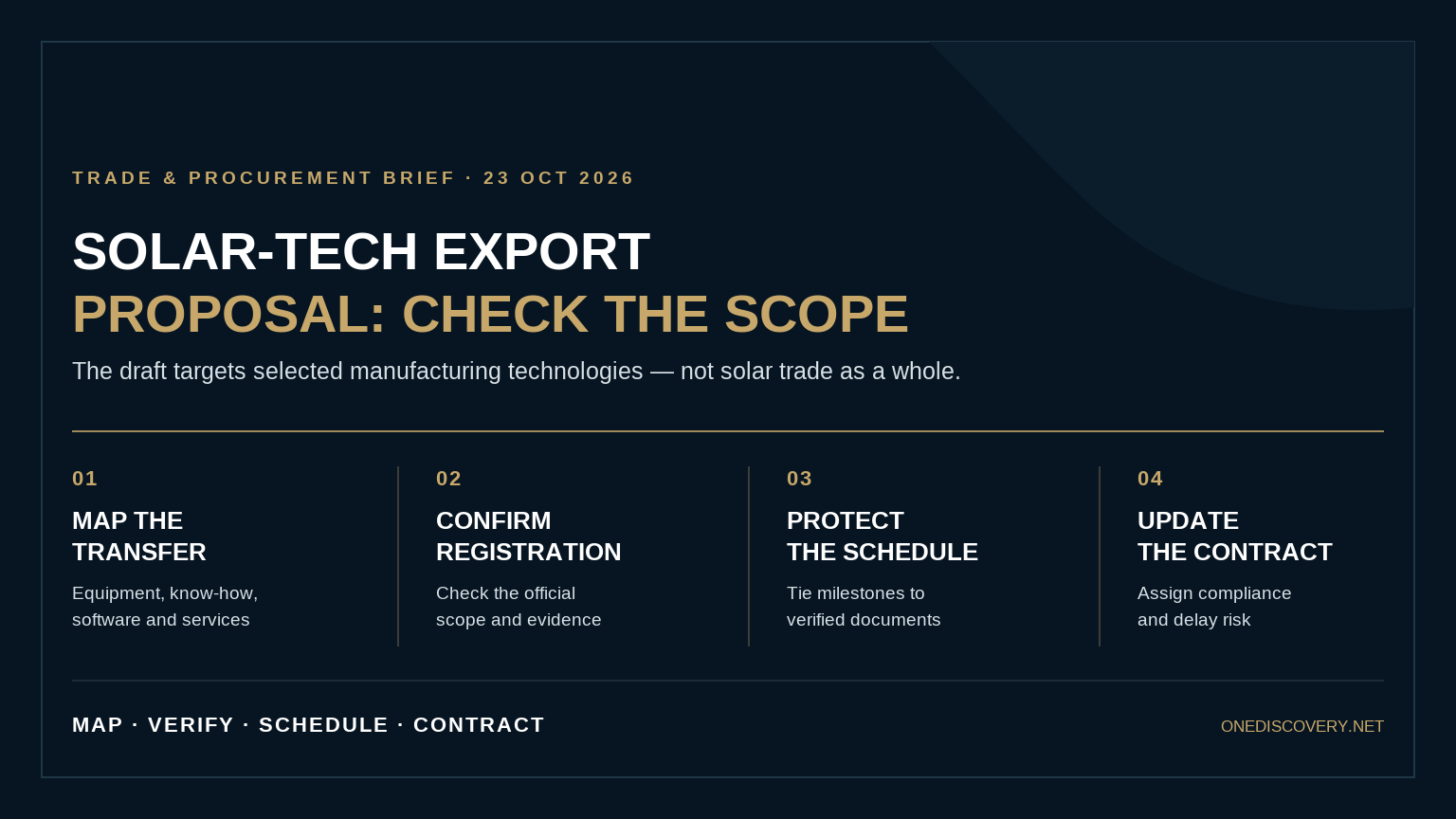
China’s proposed export controls on selected solar-manufacturing technologies are a supply-chain planning issue, not a blanket announcement that finished solar panels can no longer be traded. Buyers of production lines, process know-how, engineering support and technology licences should map what is actually crossing the border, confirm whether interim registration applies, and build realistic delivery contingencies before committing capital.
What has changed
On 16 October 2026, China’s Ministry of Commerce (MOFCOM) and Ministry of Science and Technology opened consultation on a revision to the country’s catalogue of technologies prohibited or restricted for export. The proposal covers 40 technologies across artificial intelligence, biomedicine and photovoltaics. MOFCOM says 12 photovoltaic technologies are included, spanning polysilicon, silicon-wafer and solar-cell manufacturing.
The consultation period runs from 16 October to 15 November 2026. Importantly, the authorities also introduced an interim pre-export registration requirement for the technologies identified in the notice. That registration measure applies from publication of the notice until the revised catalogue formally takes effect. Companies should therefore distinguish between the proposed final catalogue and the interim administrative step that has already begun. See the MOFCOM spokesperson’s official explanation for the scope and interim measure.
Reuters reported that the proposed solar provisions would prohibit certain technologies used in thin wafers, perovskite and tandem cells, and large-scale fluidized-bed polysilicon production. Other advanced cell technologies, including TOPCon, HJT and XBC, were reported as subject to restrictions rather than a complete prohibition. The exact technical thresholds and scope matter; a broad label such as “solar equipment” is not a sufficient classification. Read Reuters’ report on the proposed controls for the technology examples described in the draft.
MOFCOM also says the scope is intended to be limited and that products manufactured using the technologies are not automatically brought within the catalogue merely because those products use the technology. The official notice should be checked directly before making a transaction-specific decision.
Why this matters to project buyers
Solar projects depend on more than the physical delivery of modules. A new manufacturing line may require process recipes, engineering drawings, software, commissioning, operator training, technical troubleshooting and later upgrades. A contract that appears to cover only equipment can therefore include separate cross-border transfers of technical knowledge or rights.
If a particular technology or item of key equipment is in scope, a buyer may face additional documentation, approval or scheduling requirements before the supplier can complete an agreed milestone. That does not mean every shipment will be delayed or denied. It means the procurement plan should identify the relevant transfer, the responsible exporter and the evidence required to proceed.
The practical exposure differs by buyer type:
- A project developer buying finished modules should confirm product specification, warranty, origin and delivery commitments rather than assume the technology proposal automatically prohibits module imports.
- A manufacturer purchasing a production line should review the equipment list and the technical services bundled with it.
- An investor funding a factory expansion should check whether the project depends on technology licences, overseas installation or continuing technical support from China.
- An EPC contractor should map which subcontractor is responsible for each export, installation, software and commissioning obligation.
Five checks before signing or releasing a payment
1. Separate products from technology transfers
List the physical goods and the technical deliverables separately. Include equipment, spare parts, drawings, process parameters, software, licences, remote support, installation, commissioning, training and upgrades. Ask the supplier to identify which items are ordinary products and which may involve controlled technology or a specified item of key equipment.
2. Match the exact technical scope
Compare the proposed transfer with the official notice and its technical descriptions, thresholds and listed equipment. Record the model, function, process stage and relevant technical specifications. Do not rely only on a commercial description, marketing brochure or an informal assurance that the item is “standard solar equipment.”
Where the scope is unclear, request a written classification from the exporter and obtain advice from qualified export-control counsel. The importer should not make a legal determination based only on a supplier’s sales team.
3. Confirm interim registration and any licence requirement
MOFCOM states that exporters must register covered technology exports through its technology-trade management system during the interim period. For any potentially in-scope transfer, confirm who is responsible for registration, whether a separate export licence is required, and what document or reference can be provided before the relevant milestone.
Make the evidence a contractual deliverable where appropriate. Do not treat a promise to “handle compliance later” as proof that a required step has been completed. Requirements may differ by technical scope and transaction structure, so verify the actual case.
4. Build the schedule around evidence, not assumptions
Identify which milestones depend on export documentation: shipment, factory acceptance, installation, commissioning, performance testing, training and handover. Set realistic dates for each stage and agree how both parties will communicate if a required registration or approval is delayed.
Qualify an alternative source or process where the business case justifies it. Compare not just equipment price but output, yield, product quality, service response, spare-parts access, warranty coverage and the cost of validating a substitute. A second supplier is useful only if it can meet the production and quality requirements.
5. Update the contract and decision record
Allocate responsibility for export classification, registration, licences and supporting documents. Define the consequences of a regulatory delay, including notice periods, revised delivery dates, acceptance criteria, payment milestones, cancellation rights and refunds. Preserve confidentiality and intellectual-property terms for process information and technical support.
Keep a short evidence file containing the official notice reviewed, the supplier’s item-by-item scope statement, any registration or licence evidence, the legal review date, and the assumptions used in the project schedule. Recheck it when the consultation closes or the final catalogue is issued.
Questions buyers should ask now
Does the proposal ban finished solar panels? Not as a blanket rule. The proposal focuses on selected manufacturing technologies and specified equipment. MOFCOM says products made using the technologies are not automatically included. Buyers must still verify the exact product and transaction.
Are the rules final? The catalogue revision is still under consultation through 15 November 2026. However, the notice also introduced interim pre-export registration for the technologies it identifies. Companies should not wait for the final catalogue before checking whether a planned transfer falls within that interim measure.
What should be done first? Ask the supplier for a written list of equipment, technology and services; map the cross-border transfer points; then verify the scope and required documentation against the official notice before locking the project schedule or payment milestones.
The takeaway is simple: buyers should not overreact to a proposal as if it were a blanket product ban, but they should not ignore the interim registration measure either. A precise scope review now can prevent avoidable uncertainty in project commissioning and delivery.
Sources
- China Ministry of Commerce — spokesperson Q&A on the proposed technology-catalogue revision, 16 October 2026
- Reuters — China proposes export controls on solar-manufacturing technologies, 18 October 2026
Market information only. This article is not legal advice. Independently verify the current official catalogue, transaction scope and applicable export-control requirements with qualified advisers before acting.