
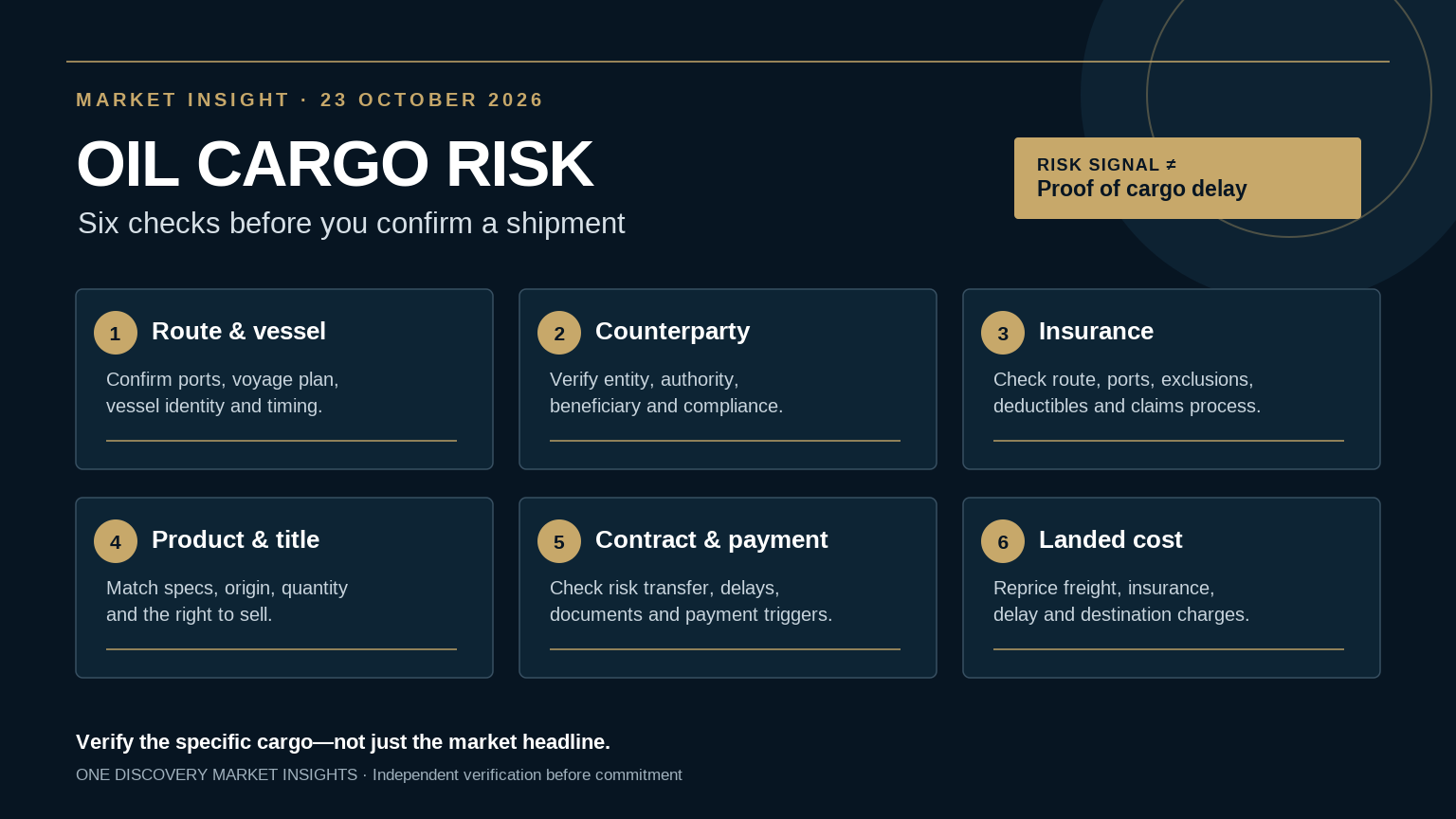
Oil prices and shipping-risk concerns moved higher on 23 October 2026 as renewed attacks in Saudi Arabia raised fresh questions about energy flows and the Red Sea corridor. For buyers, the useful response is not to assume every shipment is delayed. It is to verify whether the specific cargo can still be delivered, insured, cleared and priced on workable terms.
What the latest signal tells buyers
Reuters reported on 23 October that Brent crude futures rose to $114.31 a barrel after reaching an intraday high of $114.72, their highest level since 4 May. The report linked the move to concerns about attacks in Saudi Arabia and threats around the Bab el-Mandeb shipping chokepoint. A price move is a market signal, not proof that a particular seller, vessel or cargo has been affected.
The route matters because the Red Sea connects the Suez Canal with the Gulf of Aden through Bab el-Mandeb. The U.S. Energy Information Administration estimated that about 4.2 million barrels per day of crude oil and petroleum products transited Bab el-Mandeb in the first half of 2025; about 4.9 million barrels per day moved through the Suez Canal and SUMED pipeline over the same period. EIA said these flows were roughly half their 2023 levels. These are historical flow estimates, not a measure of today's traffic.
The International Maritime Organization describes the Red Sea corridor as one of the critical maritime routes for global trade and notes that instability and security threats can endanger vessels transiting the area. When operators avoid a route, a longer voyage around the Cape of Good Hope can change sailing time, bunker use, vessel availability, insurance terms and the timing of arrival. The effect depends on the cargo's actual route, ports, vessel and contract. Do not treat a risk headline as confirmation that a route is closed or that every shipment will be delayed.
Six checks before you confirm a cargo
- Route and vessel. Ask for the planned loading and discharge ports, laycan, nominated vessel, current voyage plan and any proposed transshipment or diversion. Verify vessel identity and available tracking data independently. A position report can help establish where a ship appears to be, but it does not prove cargo ownership, product quality or delivery commitment.
- Counterparty and authority. Confirm the legal entity on the sale contract and invoice, and verify that the person negotiating has authority to bind that entity. Independently compare the seller, chartering party, terminal and payment beneficiary. Complete current sanctions and trade-compliance screening for the parties, vessel, origin and destination that apply to your transaction. A familiar name or forwarded introduction is not a substitute for independent checks.
- Insurance for the actual voyage. Obtain written confirmation from the insurer or broker that the cargo, vessel, route and relevant ports are covered. Check war-risk wording, exclusions, deductibles, deviation and transshipment provisions, notification requirements and claims procedures. A certificate alone may not answer whether a changed route is covered; verify through contact details obtained independently rather than relying only on a number supplied in a message.
- Product, origin and title. Match the product specification, grade, quantity tolerance, origin and inspection requirements to the contract. For oil cargoes, use the applicable product-specific quality and testing terms. Confirm that the named seller has a documented right to sell and that the chain of title and terminal or allocation evidence is consistent. Documents should agree on the product, quantity, parties, ports and shipment window.
- Contract and payment triggers. Review the agreed Incoterms, risk-transfer point, delivery window, force-majeure language, demurrage, deviation rights, document-release conditions and payment milestones. If a route change affects cost or delivery, record who must approve it and who bears the extra expense. Do not release funds solely against screenshots, unverified documents or a promise that insurance will be arranged later.
- Landed cost and contingency. Recalculate the economics using current freight, bunker exposure, insurance, port charges, expected demurrage, financing, duties, taxes, foreign exchange and any quality adjustment. Compare a realistic alternative route or replacement supply option, including its additional time and cost. Ask whether the supplier can support the revised schedule and whether the contract allocates route-related costs clearly.
What a credible supplier should be able to show
A decision-ready file should bring together the sale contract, corporate and authority checks, product and quantity specifications, terminal or allocation evidence where applicable, vessel and route information, insurance confirmation, inspection requirements, document list and payment schedule. Each item should be independently verifiable and consistent with the other records.
If an offer says a route is “secured,” clarify what that means. Is a vessel nominated? Is a charter confirmed? Has an insurer confirmed coverage for the actual voyage? Is a berth or loading window confirmed? Or is the seller describing only an intended route? These are different levels of execution readiness and should not be treated as equivalent.
A simple decision rule
Mark each critical item verified, pending or unacceptable. Pause if identity, authority, title, insurance, compliance, product evidence or payment conditions remain unresolved. If the route or vessel changes, recheck coverage, delivery dates and landed cost before approving the amendment.
The current market signal deserves attention, but it does not remove the need for cargo-level evidence. In a volatile shipping environment, the strongest procurement decision is the one that remains defensible when the route, documents, cost and delivery obligation are checked independently.
Sources
- Reuters — Oil little changed as supply concern lingers amid Houthi attacks on Saudi Arabia (23 October 2026)
- U.S. Energy Information Administration — World oil transit chokepoints
- International Maritime Organization — Red Sea area: maritime security information
Market information only. Independently verify current commercial, legal, insurance and compliance requirements with qualified professionals before acting.