
CBAM entered its definitive period on 1 January 2026. It covers imports in carbon-intensive sectors including iron and steel, aluminium, cement, fertilisers, electricity and hydrogen. The practical question for buyers is no longer just whether a supplier says a product is “CBAM-ready.” It is whether the importer, product classification, emissions evidence and reporting responsibilities are properly documented.
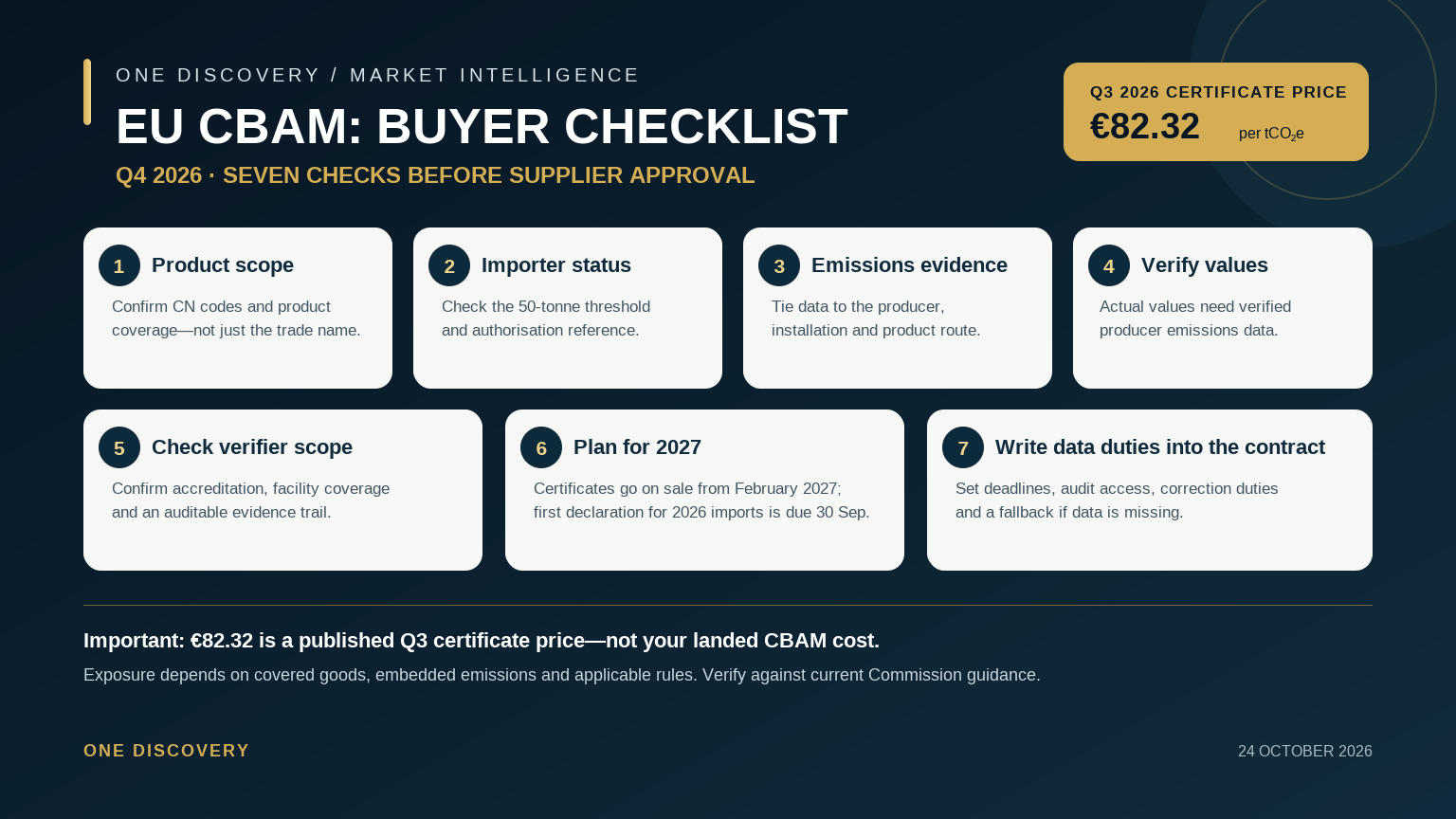
On 5 October 2026, the European Commission published a Q3 2026 CBAM certificate price of €82.32. That figure is a quarter-specific certificate price, not a stand-alone estimate of a shipment’s total CBAM liability or landed cost. The actual assessment depends on the goods in scope, their embedded emissions and the rules applicable to the importer and transaction. The Commission’s current CBAM certificate price page sets out the quarterly 2026 prices and explains that prices will be published weekly from 2027.
What matters before the next purchase order
The Commission’s 30 September 2026 CBAM update included an assessment of the single mass-based de minimis threshold, currently 50 tonnes. For the assessment period from 1 April 2025 to 31 March 2026, it estimated that the threshold would exempt 0.87% of embedded emissions—below the 1% benchmark in the regulation. This is a system-level assessment, not a substitute for checking an individual importer’s scope and volume.
The 50-tonne threshold applies to the relevant mass-based categories; electricity and hydrogen are treated separately. Confirm the current rules and product coverage directly with the Commission rather than assuming the threshold applies identically to every CBAM good. The Commission’s CBAM communications and news page is the best starting point for the latest threshold, verifier and guidance updates.
Seven checks for procurement and compliance teams
1. Map each product to the current CBAM scope
Start with the customs classification and product specification—not the supplier’s marketing name. Match the relevant CN code, product category and country-of-origin data to the current official scope. A product description such as “steel component,” “fertiliser blend” or “aluminium part” is not enough to determine treatment. If the classification is uncertain, resolve it with your customs broker or trade-compliance adviser before the purchase order is released.
2. Confirm which entity is the importer and check its threshold and authorisation position
Identify the importer of record and any indirect customs representative, then confirm who owns the CBAM account and filing responsibility. For covered mass-based goods, reconcile the importer’s annual volume against the current 50-tonne threshold. Electricity and hydrogen have different treatment. If authorisation or an application reference is required, confirm the reference with the responsible compliance team and broker; do not rely on a supplier saying that “the paperwork is handled.”
3. Tie emissions data to the actual producer and installation
Request the producing installation, product route, reporting period, quantity basis and embedded-emissions data needed for the declaration. Check that the evidence corresponds to the goods you are buying and to the relevant production installation—not a group-wide sustainability statement, a different factory or a generic industry average. Make the data traceable from the supplier’s product line to the import records.
4. Decide whether actual or default values will be used—and document why
The Commission provides default values, while actual values require verified emissions data from the producer in the third country. Ask the supplier which approach it can support, which data it will deliver, and how corrections will be handled if the evidence is incomplete or inconsistent. Do not treat a carbon-neutrality claim, an offset certificate or a generic emissions spreadsheet as a substitute for the CBAM evidence required by the applicable rules.
5. Check the verifier’s accreditation and scope
Where actual values are used, confirm that the emissions data has been verified in line with CBAM requirements. Check the verifier’s accreditation, the covered installation and activity, the relevant reporting period, and the version of the verification statement. The Commission published additional resources for CBAM verifiers in September 2026; use its current guidance and registry instructions rather than accepting an unverified PDF at face value.
6. Build a certificate and cash-flow plan for 2027
CBAM certificates for 2026 imports are scheduled to be purchased through the common central platform from February 2027. The first annual CBAM declaration covering 2026 imports is due by 30 September 2027. Map the expected import volume, emissions evidence, responsible filing entity and internal approval dates now. The published Q3 price of €82.32 is a useful reference for that quarter, but it should not be multiplied by shipment tonnage as if it were the complete landed-cost calculation.
For budgeting, show the assumptions separately: covered product quantity, emissions value and source, applicable certificate price, treatment of any carbon price paid abroad where relevant, and any other adjustment required by the current rules. Mark estimates clearly and refresh them when official prices or guidance change.
7. Put supplier data duties into the contract
Specify who must provide installation-level data, the required format, delivery deadlines, verification evidence, audit access, correction procedures and notice of any change in production route or facility. Agree what happens if the supplier misses a deadline or cannot substantiate the values: escalation, a revised cost estimate, use of an applicable default value where permitted, or another contractual remedy. Protect confidential production data while ensuring that the importer receives the evidence it needs to meet its obligations.
Questions to send before approving the supplier
- Which CN code and CBAM product category do you believe applies to this item, and what is the basis?
- Which installation and production route will supply the goods?
- Will you provide actual embedded-emissions data or rely on default values?
- If actual values are provided, who verified them, for which installation and reporting period?
- What data can you deliver before customs clearance, and who is responsible for corrections?
- Will the contract allow the buyer or its adviser to audit the relevant evidence and require timely updates?
A practical approval rule
Do not approve a covered purchase solely because the supplier says it is “CBAM compliant.” Approve only when the product scope is confirmed, the importer’s role and authorisation are clear, emissions evidence is mapped to the right installation, verification is adequate for the chosen reporting method, and the contract allocates data and correction duties. If one of those elements is missing, record the gap, assign an owner and set a deadline before shipment or financial commitment.
The policy details and price schedule can change. Recheck the Commission’s official CBAM pages before each material purchasing decision, especially when product classification, importer volumes or the source installation changes.
Sources
- European Commission — Price of CBAM certificates (Q3 2026 price published 5 October 2026).
- European Commission — CBAM communication and news (30 September 2026 threshold assessment and verifier resources).
- European Commission — CBAM successfully entered into force on 1 January 2026.
Market and procurement information only; not legal, tax or customs advice. CBAM scope, authorisation, reporting and financial obligations depend on current legislation, product classification and importer circumstances. Verify requirements with the European Commission and qualified advisers before acting.