
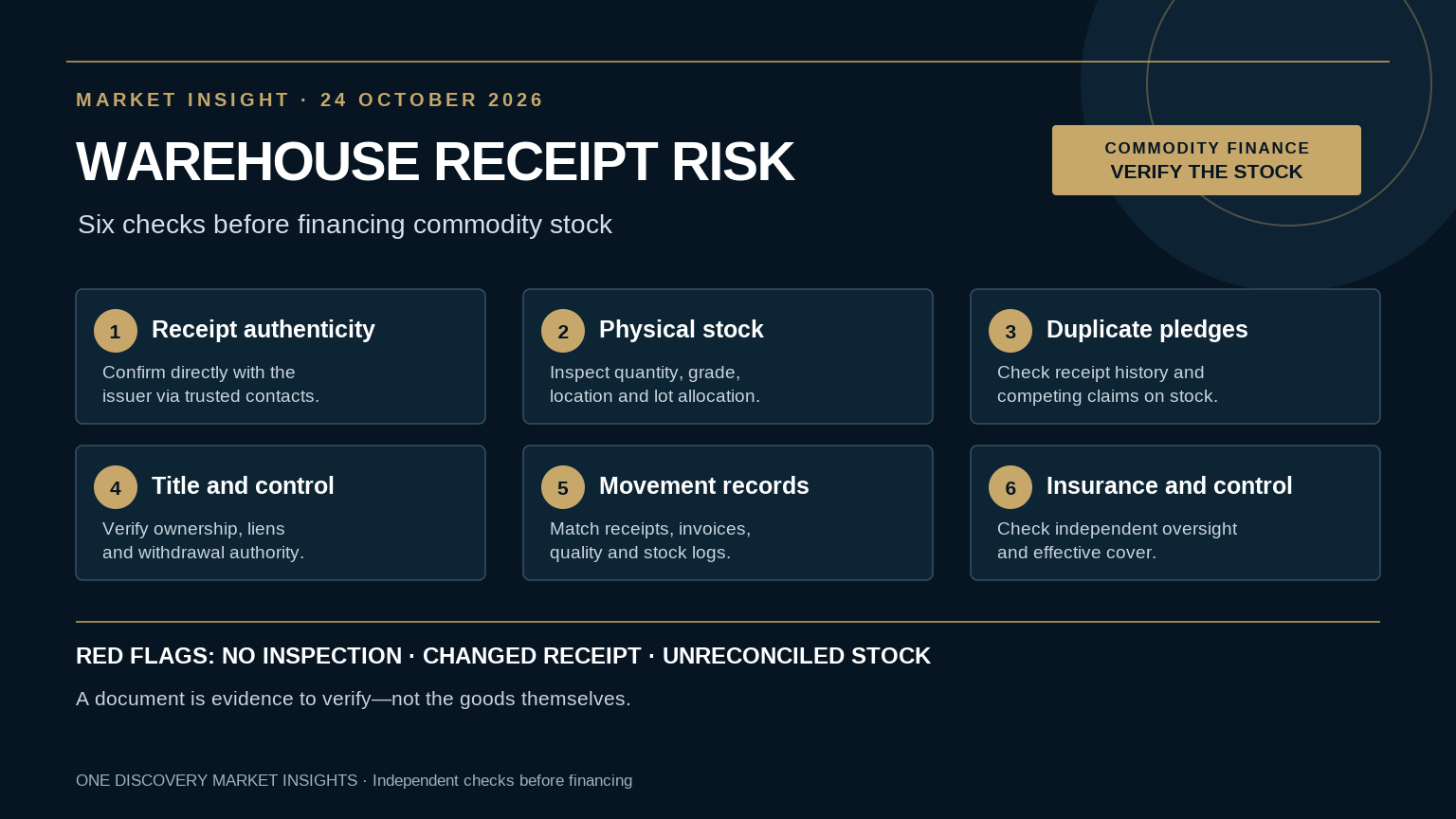
Warehouse receipts are widely used to evidence goods held in storage and, in some structures, support financing against inventory. The risk is that a receipt can be forged, duplicated or left out of date after goods move. A lender may be shown genuine documents while the underlying stock is missing, over-represented, already pledged elsewhere or controlled by another party.
Why the receipt alone is not enough
In its October 2026 commodities briefing, law firm HFW describes warehouse-receipt fraud and duplicate financing as recurring risks across metals, agricultural commodities and energy. The patterns include forged receipts, reuse of genuine receipts to seek financing from multiple lenders, weak physical checks, compromised warehouse operators, commingled goods and manipulated supporting documents.
The structural problem is that in many markets there is no single public registry through which every lender can confirm that a receipt or the same underlying goods have not already been pledged elsewhere. Availability of registries and the legal effect of a receipt vary by jurisdiction. The buyer or lender therefore needs a verification process that connects the document to physical stock, title, control and the relevant contracts. See HFW’s briefing on warehouse-receipt fraud and duplicate financing.
Six checks before financing commodity stock
1. Authenticate the receipt independently
Contact the warehouse through independently sourced contact details—not only the phone number, email address or QR code printed on the receipt. Ask the issuer to confirm the receipt number, issue date, current status, commodity, grade, quantity, location and the person or entity entitled to give instructions. Confirm whether the receipt has been cancelled, amended, replaced or presented before.
Do not treat a PDF stamp, signature, letterhead or successful email reply as conclusive proof. A fraudster may control the communication channel or impersonate the warehouse. Record who confirmed the receipt, how that person’s authority was checked and which fields were verified.
2. Verify that the physical goods exist
Arrange an independent inspection of the actual storage location. The surveyor should verify quantity using an appropriate method for the commodity, check grade and condition, identify the relevant lot or stock position, and reconcile the findings to warehouse records. For bulk or commingled goods, document how the inspected stock is allocated to the receipt and how double counting is prevented.
Where financing continues over time, one inspection at origination may not be enough. Agree risk-based re-inspections, access rights and reporting frequency. An unannounced visit can be useful where contract terms and local law permit it, because a pre-arranged inspection may not reveal short-term stock movements.
3. Test for duplicate receipts and competing pledges
Ask whether the same receipt, stock lot or warehouse account has been used to support another loan, sale, lien or security interest. Check serial numbers, amendment history, endorsements, transfer records and any registry or warehouse system available in the relevant jurisdiction. Where parallel or syndicated financing is involved, agree a controlled process for sharing collateral information between participating lenders.
A warehouse’s confirmation that a receipt is genuine does not automatically prove that the goods are unencumbered. The diligence file should separately record what was checked about prior pledges, competing claims and control of the original or electronic record.
4. Confirm title, liens and who controls release
Review the warehouse contract, receipt terms, sale documents and financing agreement together. Establish who owns the goods, whether the receipt is transferable under the applicable law, what rights the warehouse has to retain or release stock, and whether the lender’s security interest has been properly created and perfected where required.
Obtain written acknowledgement of any release controls that matter to the transaction. For example, specify who may authorize withdrawal, whether the warehouse must obtain lender consent, and how partial releases or substitutions are documented. Legal rights depend on the jurisdiction and the contract; a receipt’s wording should not be assumed to create the same rights everywhere.
5. Reconcile movements and supporting documents
Match the receipt against the purchase invoice, bill of lading or transport record, weighbridge ticket, quality certificate, insurance evidence and warehouse movement log. Check that dates, quantities, grades, lot identifiers and locations are consistent. Follow up on unexplained stock rotations, repeated amendments, quantity changes close to inspection dates or goods that appear to move without corresponding releases.
Verify key documents directly with the issuer or service provider using contact details obtained independently. A consistent document pack can still be fraudulent if all documents were created or routed by the same compromised intermediary, so seek independent confirmation of the critical facts.
6. Test the collateral manager and insurance
Confirm that the collateral manager is operationally independent from the borrower and has the resources, access and authority to perform meaningful checks. Read the scope of its mandate: does it inspect physical stock, monitor movements, reconcile quantities and report exceptions, or does it mainly review paperwork supplied by the borrower?
Confirm insurance directly with the insurer or broker through independently verified channels. Check the insured commodity, location, period, exclusions, insured value, named loss payee or beneficiary and the steps required after a loss. An insurance certificate is evidence to verify, not proof by itself that cover is effective or that the lender is entitled to proceeds.
Red flags that should pause the decision
- The borrower or warehouse resists independent inspection or direct confirmation.
- Receipt numbers, quantities, grades, dates or warehouse locations differ across documents.
- Receipts are repeatedly amended, replaced or reissued without a clear audit trail.
- The warehouse is connected to the borrower and no independent control is demonstrated.
- Stock movements around inspection dates are unusual or cannot be reconciled.
- Verification replies come from lookalike email domains, newly introduced contacts or intermediaries who refuse direct access.
- The stated stock volume or grade is commercially implausible for the facility or the available records.
Any one red flag deserves follow-up; several together should trigger a pause in new funding or release decisions until the facts are independently resolved. Where fraud is suspected, preserve original documents and communication records, notify the relevant internal risk team and insurers as required, and obtain prompt legal advice about protecting the goods and evidence.
Can electronic receipts solve the problem?
Electronic transferable records can improve control and traceability when the system reliably identifies the record, preserves its integrity and ensures that control is not held by multiple parties at once. UNCITRAL’s Model Law on Electronic Transferable Records provides a framework for electronic records that perform functions similar to transferable paper documents, including warehouse receipts. The joint UNCITRAL–UNIDROIT Model Law on Warehouse Receipts also offers a legislative framework for paper-based and electronic receipts.
These model laws are frameworks for jurisdictions to adopt; they do not automatically make every electronic receipt legally effective everywhere. A digital platform is not a substitute for physical inventory verification, independent warehouse controls, clear title rules or checks for prior financing. Buyers should verify the legal status of the specific record, the system’s control and audit features, and the warehouse’s real-world stock process.
For background, consult the official UNCITRAL Model Law on Electronic Transferable Records and the UNCITRAL–UNIDROIT Model Law on Warehouse Receipts.
A practical minimum evidence file
Before approving financing against stored commodities, keep one controlled file containing: the independently confirmed receipt; the latest physical inspection report; the stock and movement reconciliation; evidence of origin and quality where relevant; the warehouse contract and release-control acknowledgement; the legal review of title and security; direct insurance confirmation; and a dated record of checks for duplicate pledges or competing claims.
Set an owner and refresh date for each item. If the collateral remains outstanding for weeks or months, monitor changes to stock, receipt status, warehouse operator, insurance and borrower risk instead of treating due diligence as a one-time formality.
Sources
- HFW — Warehouse receipt fraud and duplicate financing, published 13 October 2026.
- United Nations Commission on International Trade Law — Model Law on Electronic Transferable Records.
- UNIDROIT — UNCITRAL–UNIDROIT Model Law on Warehouse Receipts.
Market information only; not legal, banking or insurance advice. Receipt validity, title, security interests and enforcement depend on the governing law and transaction documents. Obtain independent professional review before advancing funds against commodity collateral.