
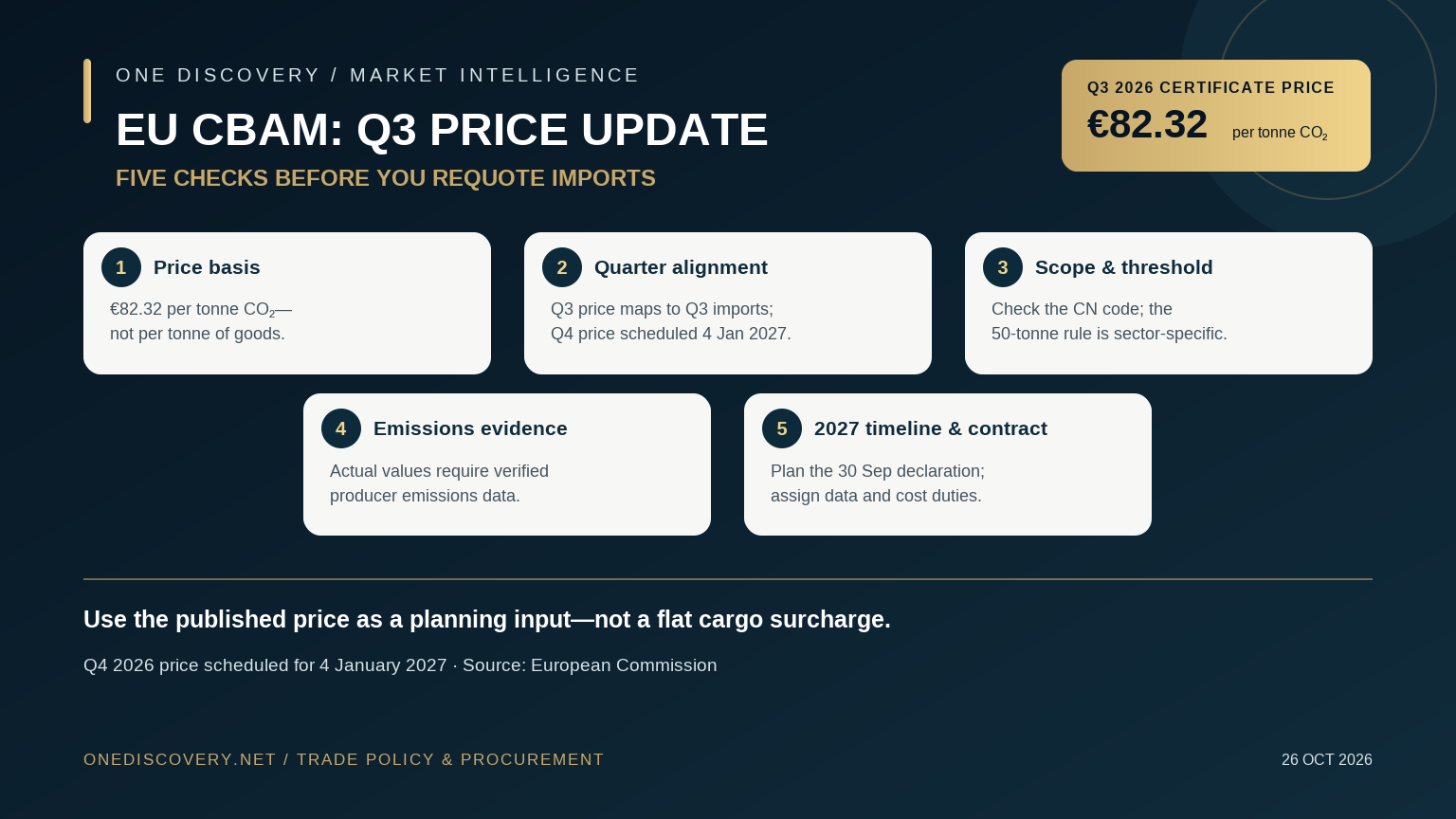
The European Commission published a CBAM certificate price of €82.32 per tonne of CO₂ for the third quarter of 2026 on 5 October. That is €7.04 above the Q2 price of €75.28—about 9.4% higher. For buyers quoting cement, iron and steel, aluminium, fertilisers, electricity or hydrogen into the EU, the update is a reason to refresh assumptions. It is not enough to multiply the price by the tonnes of product on a shipping document.
The Carbon Border Adjustment Mechanism (CBAM) entered its definitive period on 1 January 2026. The price published by the Commission is calculated from auction prices for EU Emissions Trading System allowances. In 2026, the Commission publishes one price for each quarter; from 2027, the published price moves to a weekly basis. The Q3 price corresponds to certificates for emissions embedded in covered goods imported into the EU during Q3.
What the published price does—and does not—tell you
The €82.32 figure is a price per tonne of CO₂ emissions, not per tonne of imported goods. A shipment’s potential CBAM cost depends on its product classification, the embedded emissions calculated under the applicable rules, the relevant certificate obligations and any adjustments that apply to the importer. A price headline alone cannot produce a reliable landed-cost figure.
Timing matters too. The Commission’s published schedule lists 4 January 2027 as the publication date for the Q4 2026 price. It also states that CBAM certificates will be purchased through the common central platform from February 2027 onwards. Treat the Q3 price as a current reference for planning and reconciliation—not as a supplier offer or a final invoice calculation.
Five checks before you refresh an import quote
1. Confirm the product code before applying the rule
CBAM currently covers selected goods in six sectors: cement, iron and steel, aluminium, fertilisers, electricity and hydrogen. The product’s customs classification and the current legal scope matter more than a broad commercial label. Ask for the relevant CN code, specification and country of origin, then check the Commission’s sector guidance before deciding whether the shipment is in scope.
2. Check who is responsible for authorisation
Under the amended CBAM rules, the 50-tonne net-mass exemption is calculated cumulatively per importer per calendar year for covered goods in the cement, iron and steel, aluminium and fertiliser sectors. Electricity and hydrogen are outside this mass-based exemption. The Commission’s general guidance says importers exceeding the applicable threshold must apply for authorised CBAM declarant status. Confirm the exact CN code, sector treatment and responsible declarant; do not use the 50-tonne figure as a blanket rule for every CBAM good.
3. Ask for installation-level emissions evidence
Where an importer reports actual values, the Commission says the producer in the third country must provide verified emissions data for the embedded emissions. Default values are also available under the rules. Buyers should identify which basis will be used, what evidence supports it and whether the data is complete for the specific product and production installation. A generic sustainability statement is not a substitute for the required emissions information.
4. Separate product weight from emissions intensity
Build the model from the quantity and classification of the covered product, the relevant embedded-emissions data and the applicable CBAM calculation rules. Then account for any eligible carbon price already paid during production, where the importer can prove it and the rules allow a deduction. Keep assumptions visible: if supplier data is incomplete, show a scenario range instead of presenting a single precise cost as confirmed.
5. Align the contract with the 2027 compliance timetable
The first annual CBAM declaration for 2026 imports is due by 30 September 2027, with the corresponding certificates to be surrendered. Certificates are scheduled to be purchased on the common central platform from February 2027. Importers should agree in advance who supplies emissions data, who pays for verification, how late or corrected data is handled, how CBAM-related cost changes are allocated and what records each party must retain.
What to request from a supplier now
- The product’s CN code, specification, origin and expected import quarter.
- The producing installation and the emissions-data basis proposed for the covered goods.
- Verified actual-emissions evidence where actual values will be reported, or the documented basis for using default values.
- Any evidence of a carbon price paid in the country of production that may be eligible for deduction under CBAM rules.
- Written agreement on data delivery dates, audit cooperation, correction rights and allocation of CBAM-related costs.
Use the Q3 price of €82.32 as a dated input in your scenario model. Keep Q1, Q2 and Q3 assumptions separate, and do not fill the Q4 line with a guessed value: the Commission lists 4 January 2027 for that publication. Refresh the model when the official figure and the shipment’s verified emissions basis are available.
Sources
- European Commission — Price of CBAM certificates (Q3 2026 price published 5 October 2026).
- European Commission — CBAM definitive regime (scope, authorisation threshold and certificate-price methodology).
- European Union — Regulation (EU) 2025/2083 (scope of the 50-tonne exemption).
- European Commission — CBAM communication and news (2026 threshold assessment, verified emissions and first declaration timetable).
Market and procurement information only; not legal, tax or customs advice. CBAM scope, authorisation, reporting and financial obligations depend on current legislation, product classification and importer circumstances. Verify requirements with the European Commission and qualified advisers before acting.