
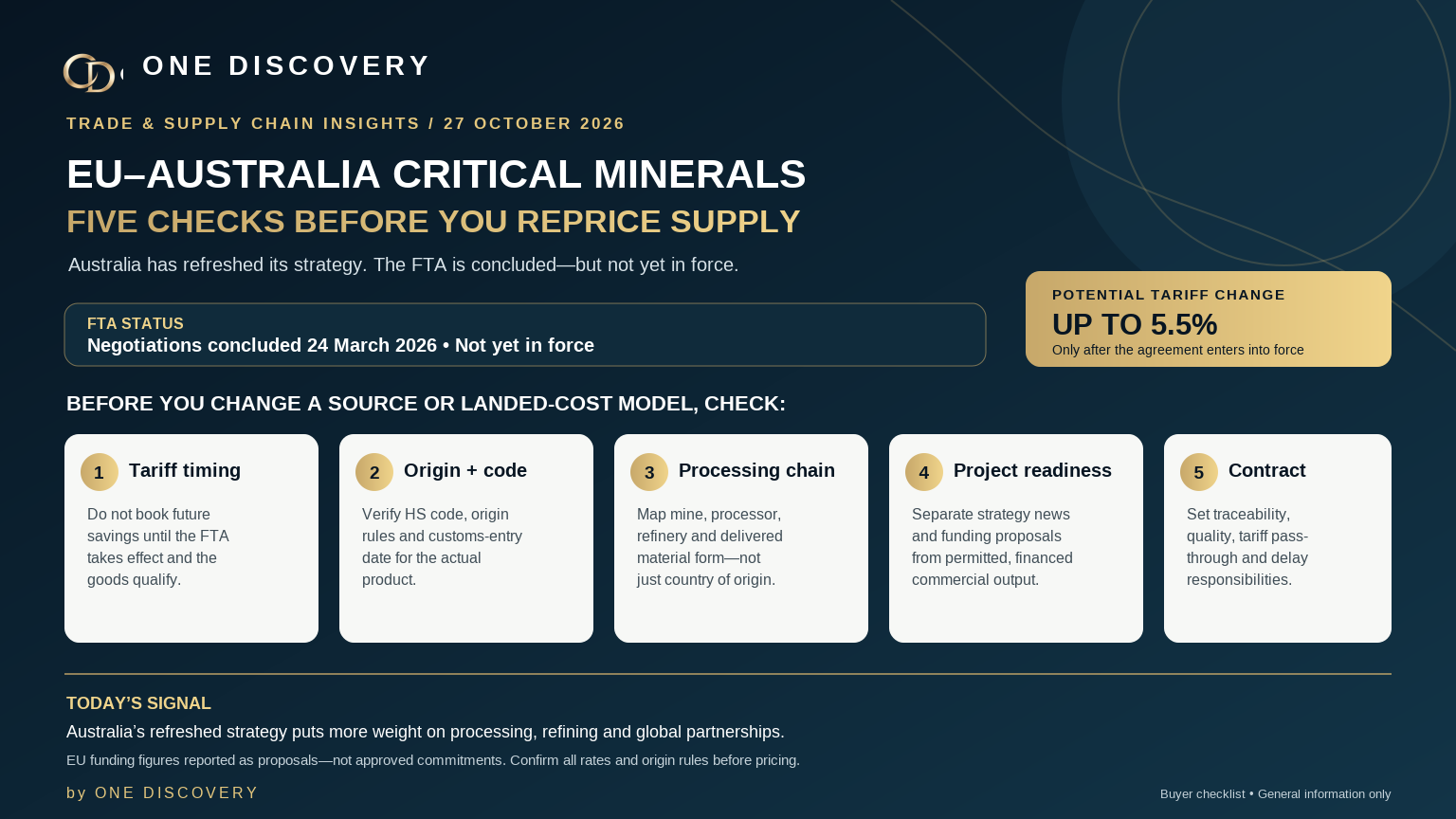
Australia’s government announced a refreshed Critical Minerals Strategy on 27 October 2026, putting greater emphasis on processing and refining, investment and global partnerships. That is relevant to buyers looking beyond mine origin alone: usable supply depends on the processing route, product form, qualification and delivery path as well.
On the same day, Reuters reported that the European Union expects increased investment in Australia’s critical-minerals sector as it seeks to diversify supply chains. The Australia–EU free trade agreement (FTA) concluded negotiations on 24 March 2026, but Australia’s Department of Foreign Affairs and Trade still lists it among agreements not yet in force. Procurement teams should therefore treat tariff savings and future project volumes as scenarios—not current facts.
What is confirmed—and what is still pending?
Australia’s official FTA summary says the agreement is intended to remove EU tariffs on Australian energy and resources exports, including critical minerals that can currently face tariffs of up to 5.5%. The benefit depends on the agreement entering into force and the goods meeting the applicable rules. It is not a blanket promise that every shipment will receive a zero rate.
Reuters also reported that the EU and European Investment Bank were close to a memorandum of understanding and that EU budget proposals included up to €10 billion for critical raw materials within a wider proposed competitiveness fund for 2028–2034. These are proposals and discussions, not a confirmed award or guaranteed financing for a specific project. The report identified gallium, antimony and rare earths as initial areas of interest.
Australia’s refreshed strategy focuses on accelerating strategically important projects, attracting investment and building global partnerships, involving First Nations communities, sustainable production, infrastructure and regulation, and workforce capability. The strategic direction matters, but an announcement does not establish when a particular product will be available in commercial quantities.
Five checks before you change a sourcing decision
1. Verify the tariff timeline and origin rule
Keep the current tariff treatment as the baseline until the FTA’s legal status, entry-into-force date, tariff schedule and product-specific rules are confirmed. Customs treatment can depend on the tariff classification, origin criteria and import-entry date. Do not apply an expected future tariff rate to a purchase order merely because negotiations have concluded.
For each affected line, record the commodity code, origin evidence, current applicable duty, other trade measures and the source used to verify the rate. Ask a customs broker or qualified trade adviser to confirm the treatment before revising landed cost.
2. Map the chain beyond the mine
Ask where the feedstock is mined, where it is processed, which companies operate each step and what material form is actually delivered. A new mine does not necessarily create a new supply route if it relies on the same refinery, toll processor or logistics corridor as the incumbent supplier.
Request a traceable description of the processing chain and document any third-party processing or blending. Distinguish the country of extraction from the country of processing and the origin determination used for customs purposes; they are not automatically the same.
3. Validate specification and qualification
Critical minerals are not interchangeable just because they share a broad product label. Confirm the required chemical or physical form, purity range, impurity limits, packaging, test method and acceptance criteria with engineering and quality teams. For materials such as gallium, antimony or rare-earth products, delivered form and consistency can be as important as mine location.
Request representative certificates of analysis, lot traceability and a clear process for handling out-of-specification material. If an alternative source is proposed, establish whether laboratory tests, production trials or customer approvals are required before it can replace the current material.
4. Separate announced projects from deliverable supply
A policy announcement, investment proposal or project listing is not proof that commercial volumes are available. Before relying on a new source, confirm project stage, permits, financing, construction and commissioning status, planned product form, ramp-up assumptions and the supplier’s ability to allocate material to your contract. Ask for a delivery schedule that can be checked against actual milestones.
Build scenarios for delays in permitting, processing, qualification or logistics. Do not count uncommitted output as a substitute in a continuity plan, and avoid basing an urgent production decision on a target date that has not been substantiated.
5. Put tariff, traceability and change risks into the contract
Review clauses covering changes in law, tariff pass-through, origin representations, documentation, quality remedies, audit rights where appropriate, delivery milestones and substitute materials. State which party must provide origin and processing evidence and who bears costs if the assumed tariff treatment is unavailable or a shipment is delayed.
For a critical input, identify who must notify the buyer if a processor, material form, export route or delivery schedule changes, and what evidence must be supplied before the buyer accepts the change.
A practical scenario model
- Current-rule case: apply the verified tariff treatment and other import costs that apply today.
- FTA-in-force case: model the potential tariff change only after confirming the final agreement, product eligibility, origin rule and effective date.
- Delay case: test the impact if a project or alternative supplier cannot deliver when expected.
For every case, keep the commodity code, origin evidence, freight, insurance, taxes, handling and other applicable measures visible as separate line items. This makes the commercial exposure clear without treating a policy signal as a guaranteed saving.
What procurement teams should do now
- Flag purchase orders and quotes whose economics depend on the possible FTA tariff change.
- Ask suppliers for product form, processing locations, origin evidence and qualification documents.
- Identify whether alternative sources share the same processor or logistics bottleneck.
- Track the agreement’s formal status and specific project maturity separately from policy announcements.
- Update landed-cost models only when the relevant official rules and shipment facts are verified.
The opportunity is worth monitoring, but it is not yet a reason to assume immediate tariff savings or guaranteed new supply. Treat the Australia–EU direction as a sourcing scenario to validate—not a substitute for current customs checks, technical qualification and delivery evidence.
Editorial note: This article summarises public government information and reporting for general business use. It is not legal, tax or customs advice. Confirm current tariff treatment, origin rules, project status and product suitability with competent authorities and qualified advisers before acting.
Sources
- Australian Department of Foreign Affairs and Trade — Benefits for energy and resources under the Australia–EU FTA.
- Australian Department of Foreign Affairs and Trade — FTAs not yet in force.
- Australian Department of Industry, Science and Resources — Critical Minerals Strategy updated to build on strengths.
- Australian Minister for Resources — Critical Minerals Strategy update, 27 October 2026.
- Reuters — EU readying for major Australian resources investment, 27 October 2026.
One Discovery · Critical Minerals and Procurement · 27 October 2026