
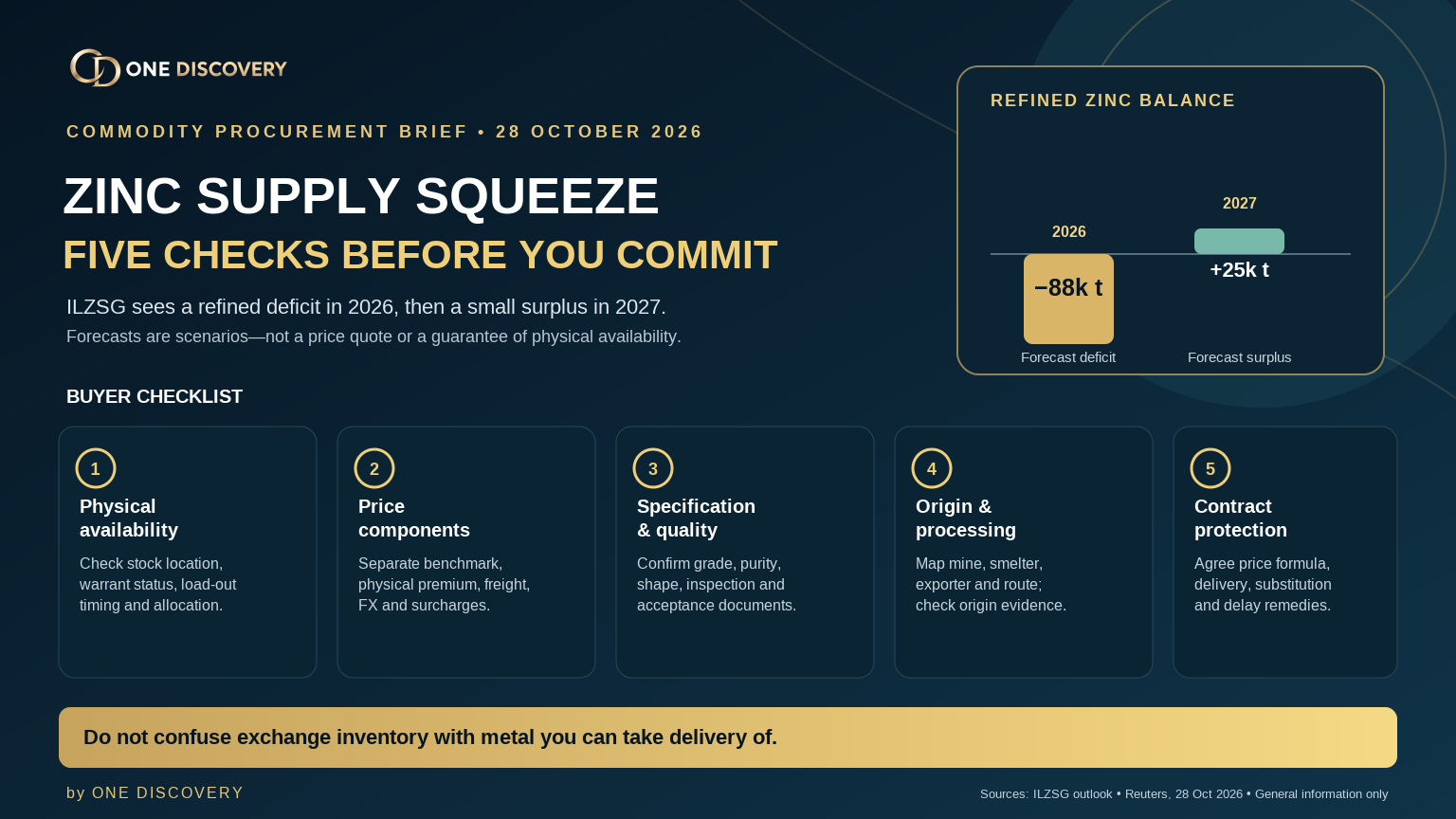
Zinc buyers are facing two different time horizons. The International Lead and Zinc Study Group (ILZSG) expects the global refined zinc market to run an 88,000-tonne deficit in 2026, then move to a 25,000-tonne surplus in 2027. That is a forecast, not a promise of either scarcity or relief. The projected 2027 surplus is small relative to a market measured in millions of tonnes, and it depends on supply recovering as expected.
What changed in the October outlook?
In its 28 October market commentary, Reuters reported that the ILZSG now expects global mined zinc output to fall 2.6% year on year in 2026, after earlier expectations of growth. For 2027, the group forecasts mine supply growth of 3.0%. The revision highlights a practical lesson for procurement: an annual balance estimate can change when mine output, ore grades, smelter economics and disruptions do not match previous assumptions.
The physical market is also uneven by region. Reuters reported that Chinese refined zinc output is expected to rise 3.7% in 2026, while production outside China is expected to fall 2.0%. Chinese exports helped replenish London Metal Exchange (LME) stocks, but nearby metal remained in demand: the reported cash premium over three-month zinc widened to $118 per tonne in the week before the article, and the three-month price rebounded to $3,855 on Tuesday. These are dated market observations, not current executable quotes.
What procurement teams should verify
1. Confirm physical availability—not just headline inventory
Exchange stocks are a useful signal, but not every tonne is immediately available to every buyer. Ask where the metal is stored, whether it is on warrant, whether warrants have been cancelled for load-out, which brands are acceptable and how much can actually be allocated to your shipment window.
Request the warehouse or supplier’s evidence for the specific lot, delivery location and release schedule. If a quote relies on metal that has not been allocated, treat the offer as conditional until allocation and delivery timing are documented.
2. Break the quote into comparable components
Keep the LME benchmark separate from the physical premium and delivery-related charges. Ask the supplier to state the price-fixing period, reference contract, currency, quote validity, freight, insurance, handling, financing and any other surcharge as distinct line items. Do not assume that a higher cash premium applies equally to every location, product form or contract.
For concentrate or smelter-linked contracts, treatment and refining charges are a separate commercial mechanism; they should not be confused with the premium paid for refined metal. Compare like-for-like terms and record the timestamp and source for every market reference.
3. Validate grade, form and acceptance criteria
“Zinc” is not a complete specification. Confirm the required grade and purity, ingot or other physical form, approved brand where relevant, packaging, sampling method, certificate of analysis and inspection procedure. Make sure the delivered material meets the end user’s technical requirements before using a lower quote as a substitute.
Where a supplier proposes an alternative smelter or brand, identify whether laboratory checks, production trials or customer approval are needed. A cheaper lot that fails qualification can create more cost and delay than it saves.
4. Map origin, processing and route risk
Ask where the ore was mined, where it was smelted or refined, which legal entity exports it and which route will deliver it. These are different questions: mine origin, processing location and customs origin are not necessarily the same.
For an alternate source, verify the exporter’s authority, origin documents, applicable import measures, logistics availability and any licence or compliance requirements relevant to the shipment. Avoid treating a regional supply increase as proof that a particular supplier has deliverable metal.
5. Put volatility and delivery remedies in the contract
Write down the benchmark and price-fixing window, the method for adjusting physical premiums, shipment and delivery dates, inspection rights, permitted substitutions, allocation rules and remedies for delay or non-conforming material. Clarify how a change in freight, export restrictions or other applicable rules is handled, and who must notify the buyer when a processor, origin or delivery route changes.
For critical consumption, consider whether a staged call-off, alternate qualified source or agreed buffer is commercially sensible. Any buffer should be based on real lead times and storage constraints, not on a generic claim that the market is short.
Build three scenarios rather than betting on one forecast
- Base case: use the current supplier quote and independently verified delivery terms.
- Tightness case: test a higher physical premium, a longer lead time or a reduced allocation.
- Recovery case: test whether the 2027 supply recovery would change the timing of a new contract—but do not assume it will occur on schedule.
Keep the benchmark, premium, freight, insurance, FX, duties and handling visible in every case. Review the model when the supplier’s allocation, exchange stocks, regional availability or official market outlook changes.
What to do now
- Ask suppliers to confirm the specific lot, location, available quantity and realistic shipment date.
- Request an itemised quote with a clear benchmark, premium, currency and validity period.
- Reconfirm technical specifications and acceptance documents for every alternative source.
- Map mine, processor, exporter and route; collect the relevant origin and shipping evidence.
- Review price adjustment, allocation, substitution and delay clauses before signing.
The current outlook supports careful monitoring, not a one-way price call. Buyers who separate the benchmark from physical availability—and verify the material and contract behind each offer—will be better placed to respond to either continued tightness or a later supply recovery.
Editorial note: This article summarises public market reporting and industry forecasts for general business use. It is not investment, legal or procurement advice. Market prices, stocks and premiums change; verify current exchange data, supplier allocation and contract terms before acting.
Sources
- Reuters — “Polarized zinc becomes a bull-bear battleground,” 28 October 2026.
- International Lead and Zinc Study Group — October 2026 press releases.
- London Metal Exchange — Zinc Commitments of Traders reports.
- London Metal Exchange — Stocks summary.
One Discovery · Zinc Markets and Procurement · 28 October 2026