
What was announced
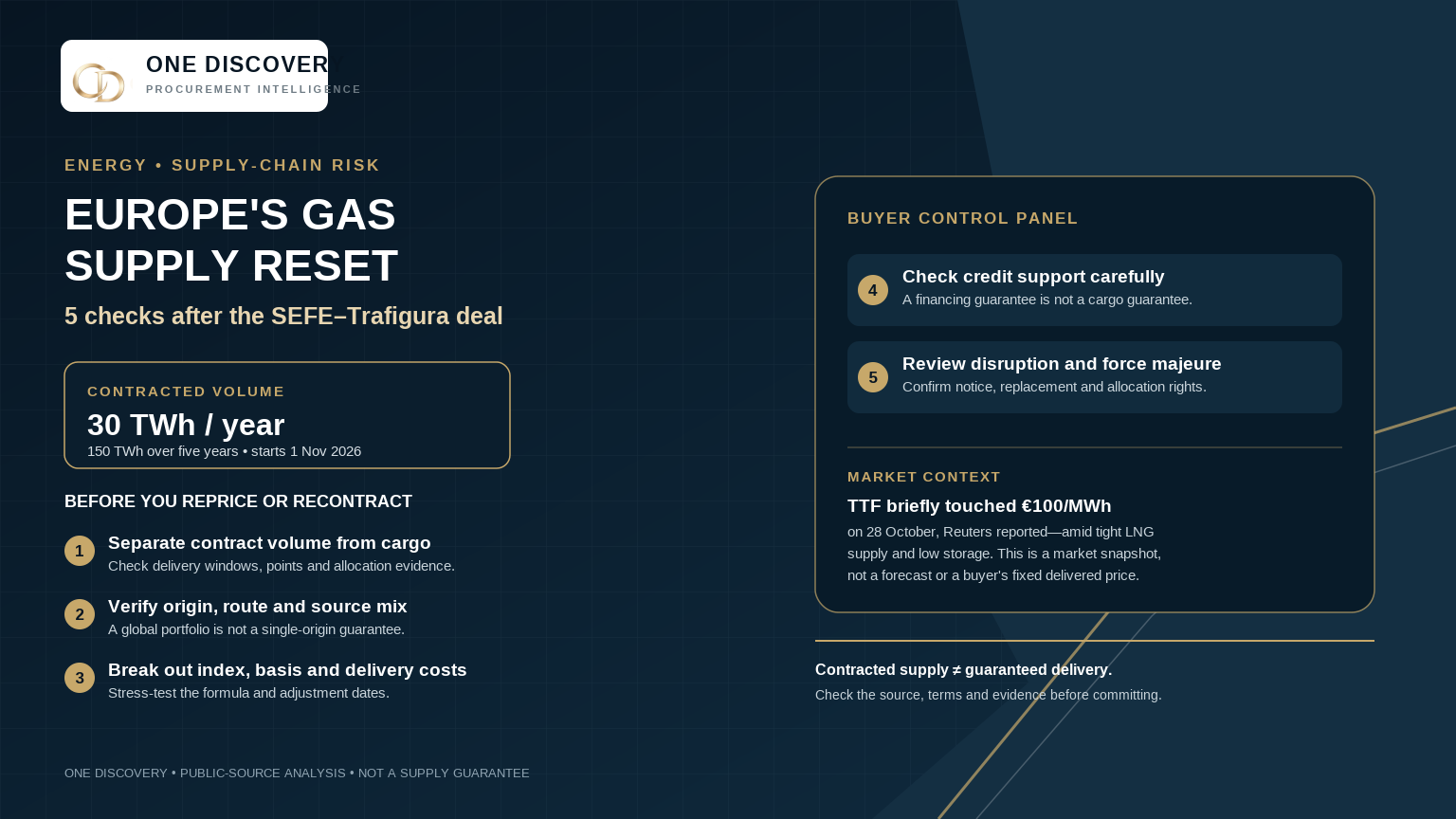
On 29 October 2026, Germany’s state-owned energy company SEFE announced a new natural gas supply contract with commodity trader Trafigura. SEFE says Trafigura will supply 30 terawatt-hours (TWh) per year for five years beginning 1 November 2026, a total of 150 TWh. The agreement follows an earlier contract that provided about 23 TWh annually and is scheduled to run through November 2031. SEFE says the gas will primarily come from Trafigura’s global portfolio. SEFE’s official announcement sets out those contract details.
The context is a tight European gas market. Reuters reported that the Dutch TTF benchmark briefly reached €100 per megawatt-hour on 28 October, its highest level since December 2022, amid disrupted LNG supply and low storage levels. Reuters has also reported that QatarEnergy extended force majeure on some LNG deliveries to certain customers through the end of 2026. These are market and delivery signals, not evidence that every European buyer faces the same shortage or price. Reuters on European gas prices · Reuters on selected LNG delivery disruptions.
Reuters separately reported a five-year, $1.5 billion financing arrangement connected to the supply contract, backed by a syndicate of nine banks and partly supported by a German government guarantee. SEFE says the agreement allows Trafigura to qualify for cover under Germany’s Untied Loan Guarantee Scheme for strategically important commodities. A financing guarantee can support access to credit; it does not, by itself, prove that a specific cargo has been allocated to a particular downstream buyer or that the buyer has a direct claim under the guarantee. Reuters on the financing arrangement.
Why buyers should look beyond the headline volume
A long-term supply contract can strengthen a portfolio and make volumes more visible. It does not remove exposure to delivery points, pipeline or LNG logistics, nomination windows, price formulas, credit terms, operational constraints or force-majeure provisions. Nor does a portfolio-level agreement mean every customer can purchase gas on the same terms. The commercial value depends on what the buyer actually contracts for and what evidence the seller can provide.
For procurement teams, separate four layers in the decision: the underlying supply arrangement; the specific volume and delivery window offered to the buyer; the price and adjustment formula; and the remedies if delivery, quality or timing changes. Treat each layer as a separate verification task.
Five checks before you reprice or recontract
1. Match annual volume to a specific delivery obligation
Ask which delivery point, period, nomination window and quantity are actually covered by your contract or proposed confirmation. A headline volume such as 30 TWh per year is not a shipment schedule for an unrelated buyer. Request a dated allocation or nomination record from the responsible counterparty, then reconcile it with the contract quantity, delivery basis and operational constraints.
Where a supplier offers a cargo or a monthly tranche, distinguish firm obligations from estimates, optional volumes and volumes still subject to confirmation. Do not treat a general portfolio statement as proof that the seller controls an available cargo at the required place and time.
2. Verify origin, route and the hand-off chain
SEFE says the gas will primarily be sourced from Trafigura’s global portfolio. That wording does not identify a single origin for every molecule or every delivery. Buyers should ask what origin and route information is contractually available, which pipeline or LNG chain applies, who is responsible for each hand-off, and what documents are provided at nomination and delivery.
If a supplier proposes a replacement source or route, verify that it meets the contract, regulatory requirements and the buyer’s operational needs. Confirm whether the change affects delivery point, gas quality, capacity booking, balancing responsibilities, transport costs or reporting duties. Do not infer that a diversified portfolio automatically makes every substitute interchangeable.
3. Rebuild the price from its components
Identify the benchmark or index, pricing period, basis or regional differential, transport and capacity costs, balancing charges, applicable taxes and any agreed adjustment mechanisms. Check how currency, index publication dates and nomination timing affect the invoice. If a quote changes after a market move, request a calculation that maps the change to the written formula rather than accepting a headline percentage or an unexplained surcharge.
Stress-test the contract against more than one market path. A benchmark snapshot at €100/MWh is not the same as the buyer’s final delivered cost, and it is not a forecast of future prices. Include the buyer’s own volume profile, hedging policy and tolerance for settlement or collateral calls.
4. Understand the credit support—and who can rely on it
Reuters reported that the financing associated with the SEFE–Trafigura contract involves a bank syndicate and partial support from a German government guarantee. SEFE’s announcement describes eligibility for the Untied Loan Guarantee Scheme. These details matter for understanding the seller’s financing context, but buyers should not assume that the arrangement secures their own payment, performance or cargo rights.
Check the exact contracting entity, its role in the chain, credit support written into your own agreement, payment milestones, security requirements and remedies for non-performance. If someone cites a guarantee, ask for the official instrument or the precise contractual reference and confirm who is covered, what risk is covered, exclusions, duration and claims process. Do not rely on a verbal statement that “the government guarantees the supply.”
5. Read disruption, allocation and replacement clauses before the market tightens
Review force-majeure definitions and notice requirements, planned maintenance, nomination and re-nomination rights, allocation rules, replacement supply, delivery tolerances, take-or-pay or make-up provisions, and the allocation of incremental transport or balancing costs. Confirm which events allow relief, which require mitigation, and what evidence must be supplied.
For a critical industrial load, model at least three cases: delivery as contracted; a delay or partial delivery that can be covered by existing inventory; and a longer disruption that requires a replacement source, demand response or production rescheduling. Use assumptions grounded in the contract and the buyer’s operating data. Do not translate a market headline into an invented number of days of cover.
What the market signal means—and what it does not
The TTF price move reported on 28 October shows how quickly European gas benchmarks can react when LNG availability, storage and weather risk converge. It does not mean that every contract reprices immediately, that every buyer pays the day-ahead benchmark, or that the latest long-term contract fixes prices for the market as a whole.
The European Commission’s gas-storage framework retains a seasonal filling target with flexibility in timing and implementation. Storage is one resilience tool among several, alongside diversified supply, pipeline and LNG infrastructure, demand management and commercial inventory. Buyers should use the latest official storage data and their own contract terms rather than extrapolating from a single reported percentage. European Commission: Gas storage.
Actions for procurement teams this week
- Ask counterparties to identify the exact delivery point, period, nomination window and volume being offered.
- Request the pricing formula and a line-item breakdown of index, basis, transport, balancing and other applicable charges.
- Confirm the source and route information available under the contract, including replacement-supply rights.
- Read the actual credit-support language and identify who can claim under it; do not treat a financing guarantee as a cargo guarantee.
- Run delivery-as-planned, short-disruption and extended-disruption scenarios using verified inventory and operating data.
The takeaway is straightforward: portfolio security and buyer-level delivery are related but different. The SEFE–Trafigura agreement is a meaningful supply development, but every buyer still needs to verify its own allocation, price exposure, counterparty obligations and disruption remedies before changing procurement decisions.
For a related view of how contract terms and logistics interact in volatile energy markets, see our ASEAN LNG procurement checklist.
Editorial note: This article summarises public company announcements, official guidance and news reporting for general business use. It is not legal, investment or procurement advice, a supplier offer, a cargo confirmation or a delivery guarantee. Independently verify counterparties, delivery obligations, price formulas, credit support and contract terms before acting.
Sources
- SEFE — New natural gas supply contract with Trafigura, 29 October 2026
- Reuters — Financing arrangement supporting the SEFE–Trafigura contract, 29 October 2026
- Reuters — European benchmark gas price reaches €100/MWh, 28 October 2026
- Reuters — QatarEnergy extends force majeure on selected LNG deliveries, 27 October 2026
- European Commission — Gas storage framework and seasonal targets
One Discovery · Energy Markets and Procurement · 29 October 2026