
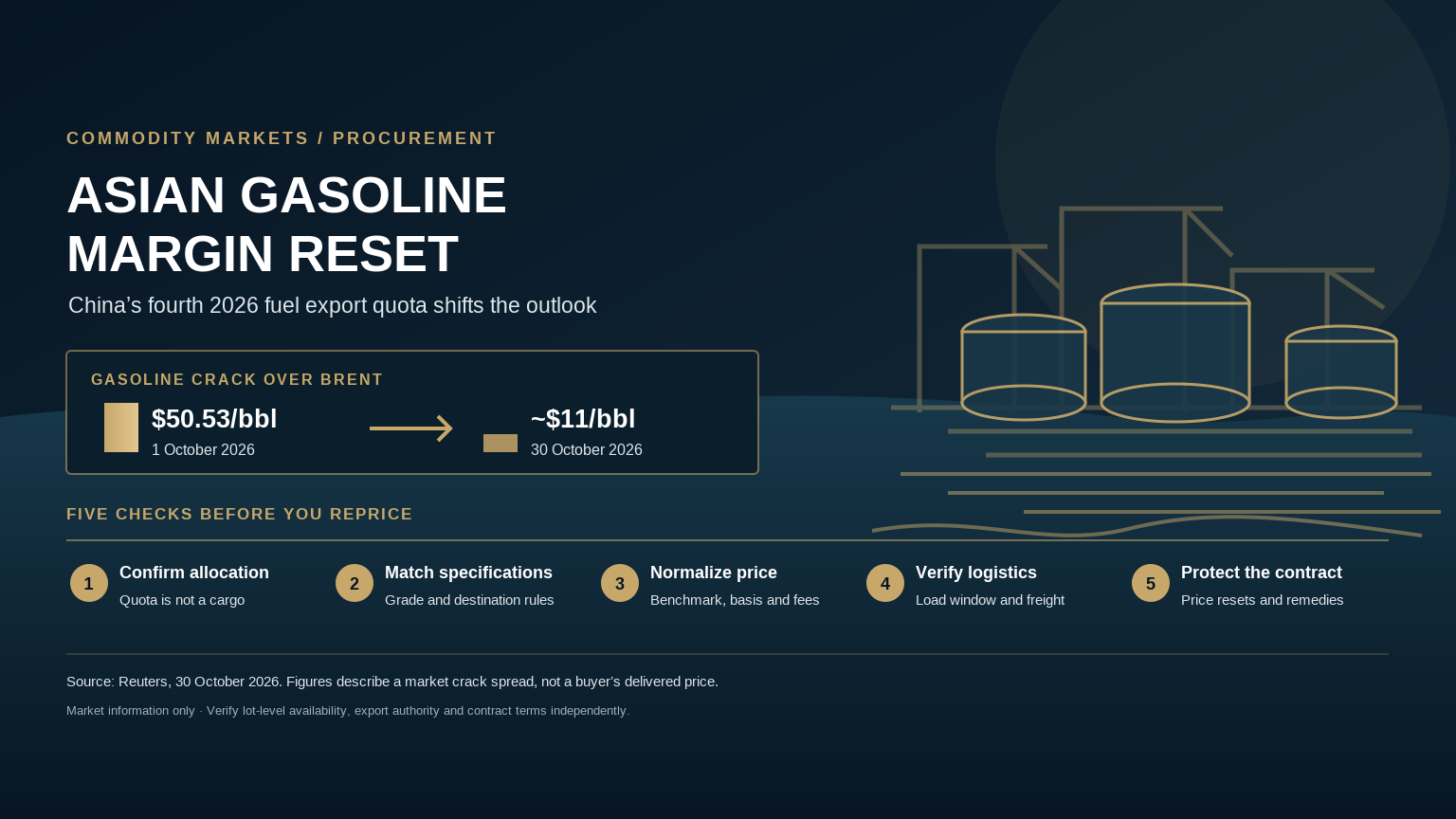
Asian gasoline’s refining crack spread fell to about $11 per barrel over Brent on 30 October 2026, its lowest level since March, according to Reuters. The spread had reached a reported record of $50.53 on 1 October. Reuters linked the reversal to China’s fourth batch of 2026 fuel export quotas and rising inventories at major trading hubs. For buyers, it is a prompt to re-check assumptions—not a forecast of retail prices.
Reuters reported that the new quota lifted China’s annual allowance for gasoline, diesel and jet fuel to 6% above 2025. An analyst’s calculation that fully using the remaining allowance would imply roughly six million tonnes of exports in each of November and December is an implied utilisation scenario—not a confirmed shipment schedule. Buyers should not translate a quota announcement directly into an assumed cargo, arrival date or price.
Singapore’s light-distillate inventories, which include gasoline and naphtha, rose to a two-week high of 11.304 million barrels in the week to 28 October, Reuters reported, citing government data. Gasoline imports more than doubled to 314,000 tonnes while exports fell about 40% week on week to roughly 433,000 tonnes. These hub-level figures do not establish availability for any buyer.
What the margin signal does—and does not—tell buyers
A gasoline crack spread is the difference between the market value of gasoline and a crude-oil benchmark such as Brent. It is a market indicator, not a guaranteed refining profit for every plant and not the same as a buyer’s delivered cost. Refinery configuration, yield, energy use, blending, financing, freight, insurance, taxes and local product specifications all affect the economics of a physical transaction.
The latest move is a reminder that the product side of the market can change faster than a procurement cycle. A seller quoting against a benchmark may update a differential or validity period even when the buyer’s physical delivery window has not changed. Conversely, a lower regional crack does not guarantee that a specific cargo will be offered at a lower price: location, grade, loading date and logistics can dominate the final comparison.
China’s export framework also matters. The Ministry of Commerce’s 2026 export-licence catalogue says refined oil products covered by the rules require quota documentation to apply for an export licence. That official process reinforces a basic distinction: an aggregate allowance is not the same as an approved shipment, a released lot or a confirmed allocation to your order.
Five checks before you reprice or commit
1. Verify the actual lot and export authority
Ask for the product, quantity, loading window, terminal, nominated refinery or supplier, and the status of the lot intended for your order. Where applicable, confirm that the exporter has the required quota documentation and export licence. Match the evidence to the contract and shipment rather than relying on a headline about national quotas or a supplier’s total capacity. Do not treat a forecast of possible exports as proof that the cargo exists.
2. Lock the product specification before comparing offers
Confirm the exact grade and destination requirements: octane, sulphur, vapour pressure, distillation characteristics, permitted blend components, biofuel rules where relevant, test methods and required certificates. Check whether the receiving market accepts the proposed grade and whether any re-blending or additional testing is needed. Two offers labelled “gasoline” may not be commercially comparable if their specifications, quality tolerances or discharge requirements differ.
3. Rebuild the price on a like-for-like basis
Record the reference benchmark, pricing date or averaging window, product differential, currency, premium, taxes and other included charges. Distinguish an FOB offer from a CIF or delivered offer; add freight, insurance, terminal handling, financing, inspection and expected losses where they are not included. Check the quote’s validity and the trigger for any price reset. A lower crack spread is a reason to re-check the formula, not a standalone instruction to demand a fixed discount.
4. Confirm the logistics and delivery window
Verify the loading terminal, vessel or transport arrangement, laycan, expected transit time, discharge capacity, storage availability and documentation cut-offs. Ask which party is responsible for freight and insurance and who bears demurrage, delay or specification-related costs. If a proposed source or route changes, confirm that the destination terminal can receive the product and that the route remains commercially and legally workable. Do not assume extra quota will immediately translate into extra sailings.
5. Make the contract workable in both directions
Review price-adjustment language, quantity tolerances, allocation rules, delivery windows, substitution rights, quality claims, credit terms, force-majeure wording and notice deadlines. Clarify what evidence is required if a seller cannot load the agreed quantity or if the benchmark changes before pricing is fixed. Where the parties can agree, document a process for re-quoting or splitting deliveries instead of leaving the response to informal messages.
Use three scenarios instead of one price assumption
| Scenario | Evidence to request | Buyer response |
|---|---|---|
| Additional exports reach the market | Named lots, confirmed loading windows and current offers | Compare delivered cost and specification; do not assume all grades or destinations benefit equally |
| Quota is used more slowly than implied | Updated exporter allocation, refinery status and shipping nominations | Keep a tighter supply case until physical availability is evidenced |
| Policy or regional logistics tighten again | Current export approvals, terminal notices, freight and insurance terms | Re-test alternative origins and contractual remedies before changing the order |
These scenarios are decision aids, not forecasts. Use current supplier evidence and the buyer’s actual delivery schedule when setting inventory or price limits.
Questions to ask a supplier this week
- Is the quoted volume a named, available lot or a portfolio-level estimate?
- Which export authorisation and product-quality documents apply to this shipment?
- What benchmark, differential and validity window determine the final price?
- Which freight, insurance, terminal and delay costs are included—and which are not?
- What written remedy applies if the nominated quantity or loading window changes?
The practical takeaway is to separate the market signal from the execution evidence. China’s latest quota and the sharp fall in Asian gasoline cracks are useful prompts to revisit assumptions. They are not substitutes for a verified lot, a comparable delivered-cost calculation or a contract that explains what happens when supply, price or timing changes.
Market information only. This article is not a price forecast, supplier offer, legal opinion or delivery guarantee. Independently verify product specifications, export authority, counterparties, shipment status, applicable rules and contract terms before acting.
Sources
- Reuters — Asian gasoline margin falls to a six-month low, 30 October 2026
- China Ministry of Commerce — 2026 Export Licence Catalogue, Announcement No. 89 (2025)
- Reuters — Singapore oil-product inventories and trade flows, 29 October 2026
- Reuters — China’s October fuel-export suspension and its effect on Asian supply, 2 October 2026
One Discovery · Refined Products and Procurement · 31 October 2026