
Tokenized assets are moving closer to established financial and commodity workflows. On 24 September 2026, the U.S. Commodity Futures Trading Commission (CFTC) announced updated staff FAQs addressing tokenized forms of permitted investments and the use of blockchain technology for regulatory recordkeeping. Separately, the World Gold Council’s October digital-gold report described growing interest in digital products while identifying trust, redemption and pricing as barriers to wider adoption.
Neither development means that every token labelled “gold-backed” is equivalent to warehouse stock, an allocated bullion position or eligible collateral. For procurement teams, the practical question is narrower: what enforceable right does the token give the holder, and can that right be exercised when the transaction is under stress?
What the regulatory signal does—and does not—mean
The CFTC’s 24 September announcement says staff updated FAQs concerning tokenized forms of investments that are already permitted under applicable rules and blockchain-based recordkeeping. The distinction matters. The guidance addresses how existing requirements may apply to a tokenized form; it does not make every tokenized asset permissible, certify a product, or establish that a particular issuer owns sufficient metal.
A September 25 legal analysis by Lowenstein Sandler also cautions that the FAQs are staff interpretive guidance, not binding law or a new safe harbour. Its explanation highlights the continuing need to assess the underlying asset, legal and economic rights, custody, controls and ability to preserve and produce records. Buyers should therefore avoid treating a regulatory headline as product-level approval.
The World Gold Council’s 19 October report, “Digital Gold: Unlocking a $700-Billion Opportunity,” likewise frames trust and accessible physical redemption as important conditions for adoption. Its market estimates are projections, not guarantees. The useful operational lesson is that a digital interface cannot replace evidence about what is held, who controls it and how the holder can exit.
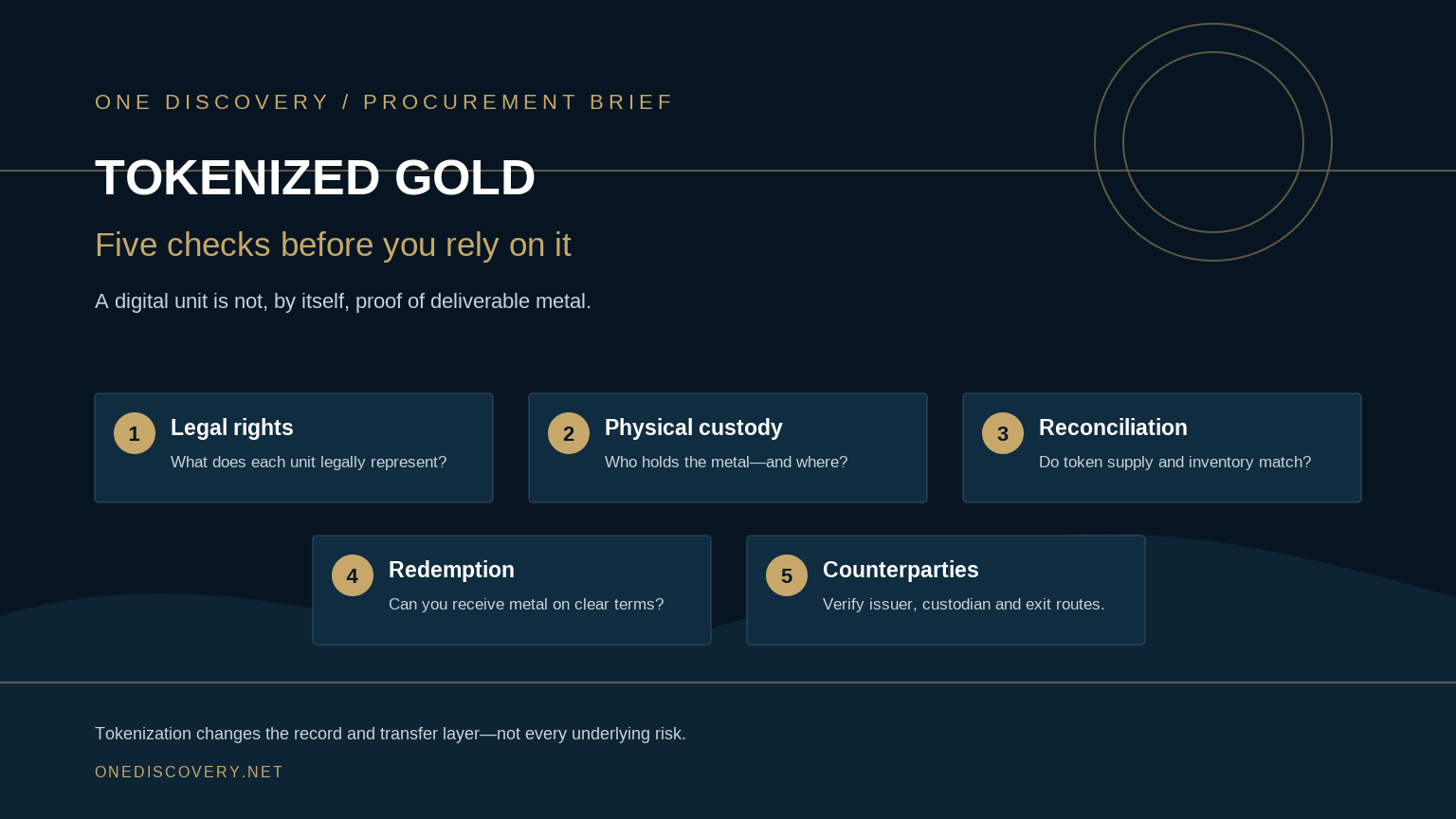
Five checks before relying on a token
1. Identify the legal claim behind each unit
Read the issuer’s terms, not only the token description. Does one unit represent allocated bars, a beneficial interest in pooled metal, an unsecured claim against an issuer, or simply price exposure? Establish who is legally recognised as the owner, whether the interest can be transferred, and what happens in insolvency. If the documents do not define the holder’s rights clearly, do not treat the token as equivalent to physical inventory.
2. Verify custody and independent assurance
Ask for the named custodian, vault jurisdiction, allocation method, audit or attestation scope, report date and exception process. Determine whether the evidence identifies specific bars or only an aggregate balance. Confirm that the assurance provider is independent and that the report covers the relevant issuer, product and date. A wallet balance proves that tokens exist on a ledger; by itself, it does not prove the underlying metal is present, unencumbered or available to this holder.
3. Reconcile token supply with physical records
Establish how issuance, transfers, burns and redemptions are reconciled against the physical inventory ledger. Ask how quickly discrepancies are detected, who can pause issuance, and how exceptions are investigated. Check whether the records remain accessible during a chain outage, custodian disruption or provider failure. The CFTC’s recordkeeping discussion is about meeting applicable requirements; it should not be read as a blanket endorsement of any particular ledger or control design.
4. Read redemption mechanics as a delivery contract
Confirm minimum redemption sizes, fees, notice periods, eligible destinations, assay or handling costs, delivery insurance, and the party responsible for transport. Check whether redemption is a contractual right or subject to issuer discretion, market conditions or additional verification. For procurement, specify whether the requirement is physical bars delivered to a named location, cash redemption, or transferable financial exposure. Those are different outcomes and should not be priced as interchangeable.
5. Check counterparties, restrictions and exit routes
Identify the issuer, custodian, redemption agent, liquidity providers and any intermediary responsible for settlement. Verify each entity through independent sources and confirm that the proposed transaction is permitted in the relevant jurisdictions. Review transfer restrictions, wallet controls, dispute resolution, fees and secondary-market depth. A quoted token price does not guarantee that a buyer can execute a large sale or redeem on the same terms during volatility.
How to use tokenized gold in procurement decisions
Use a simple evidence gate. First, define the commercial requirement: physical delivery, custody-backed investment, collateral or short-term price exposure. Second, map that requirement to the legal instrument and its redemption terms. Third, collect current custody and reconciliation evidence from independent sources. Finally, compare total cost—including spread, custody, transfer, redemption, assay, insurance and logistics—with the conventional alternative.
If the intended outcome is metal delivered to a manufacturing site, a token should not replace the ordinary purchase contract, specification, title-transfer terms, inspection arrangements and delivery documents unless legal counsel has confirmed that the token structure creates the required rights. If the intended outcome is financial exposure, assess issuer and market risks as you would for any financial product rather than describing it as immediately deliverable commodity stock.
Practical checklist
- Document the exact legal right represented by each token.
- Obtain current, independent evidence of custody and backing.
- Reconcile issued units with physical inventory and outstanding claims.
- Test redemption steps, costs, timing and delivery limits before committing material value.
- Keep token exposure, collateral eligibility and physical procurement as separate decisions.
Tokenization may make records and transfers easier to coordinate. It does not remove counterparty, legal, custody, liquidity or logistics risk. Buyers should assess the underlying rights and operational path—not the technology label.
Sources
- U.S. Commodity Futures Trading Commission — Updated FAQs on tokenized investments and blockchain recordkeeping, 24 September 2026
- World Gold Council — Digital Gold: Unlocking a $700-Billion Opportunity, 19 October 2026
- Lowenstein Sandler — CFTC Divisions Update FAQs on Crypto Assets and Blockchain Technologies, 25 September 2026
Market information only. This article is not legal, investment or compliance advice. Independently verify product terms, custody, regulatory treatment and delivery obligations before acting.