
China’s Ministry of Commerce (MOFCOM) has renewed two trade-remedy measures on n-propanol originating in the United States for another five years, effective 6 November 2026. MOFCOM published separate final expiry-review decisions on 5 November: one for anti-dumping duties and one for countervailing duties. The product is also known as 1-propanol or n-propyl alcohol and is listed under China tariff code 2905.12.10.
The ruling is product- and origin-specific. It does not create a blanket tariff on all alcohols, all U.S. chemicals or finished goods that happen to use a chemical input. For buyers importing the covered product into China, however, the published duty rates are high enough to require a fresh landed-cost and supplier review.
Buyer takeaway: Check the chemical identity, customs origin and named exporter before pricing a shipment. The two notices publish separate anti-dumping and countervailing rates, so a single generic “U.S. chemical duty” assumption is not enough.
What MOFCOM decided
MOFCOM concluded that removing the measures could allow dumping and subsidisation of U.S.-origin n-propanol to continue or recur, with potential further injury to the Chinese industry. It therefore kept both measures in place for five years from 6 November 2026. The anti-dumping decision is Announcement No. 54 of 2026; the countervailing-duty decision is Announcement No. 55 of 2026.
The rates differ by named U.S. exporter:
- The Dow Chemical Company: 254.4% anti-dumping duty and 37.7% countervailing duty.
- OQ Chemicals Corporation: 267.4% anti-dumping duty and 34.2% countervailing duty.
- Other U.S. companies: 267.4% anti-dumping duty and 37.7% countervailing duty.
These are separate trade-remedy measures, not alternative rates. Both notices calculate the relevant duty ad valorem on the customs-determined import value. The importer should not select a rate based only on the seller shown on the invoice: confirm the actual exporter, manufacturer, legal entity and the rate customs will apply. Ordinary customs duty and import VAT must also be modelled under the current tariff and tax treatment.
Why this input reaches more than one supply chain
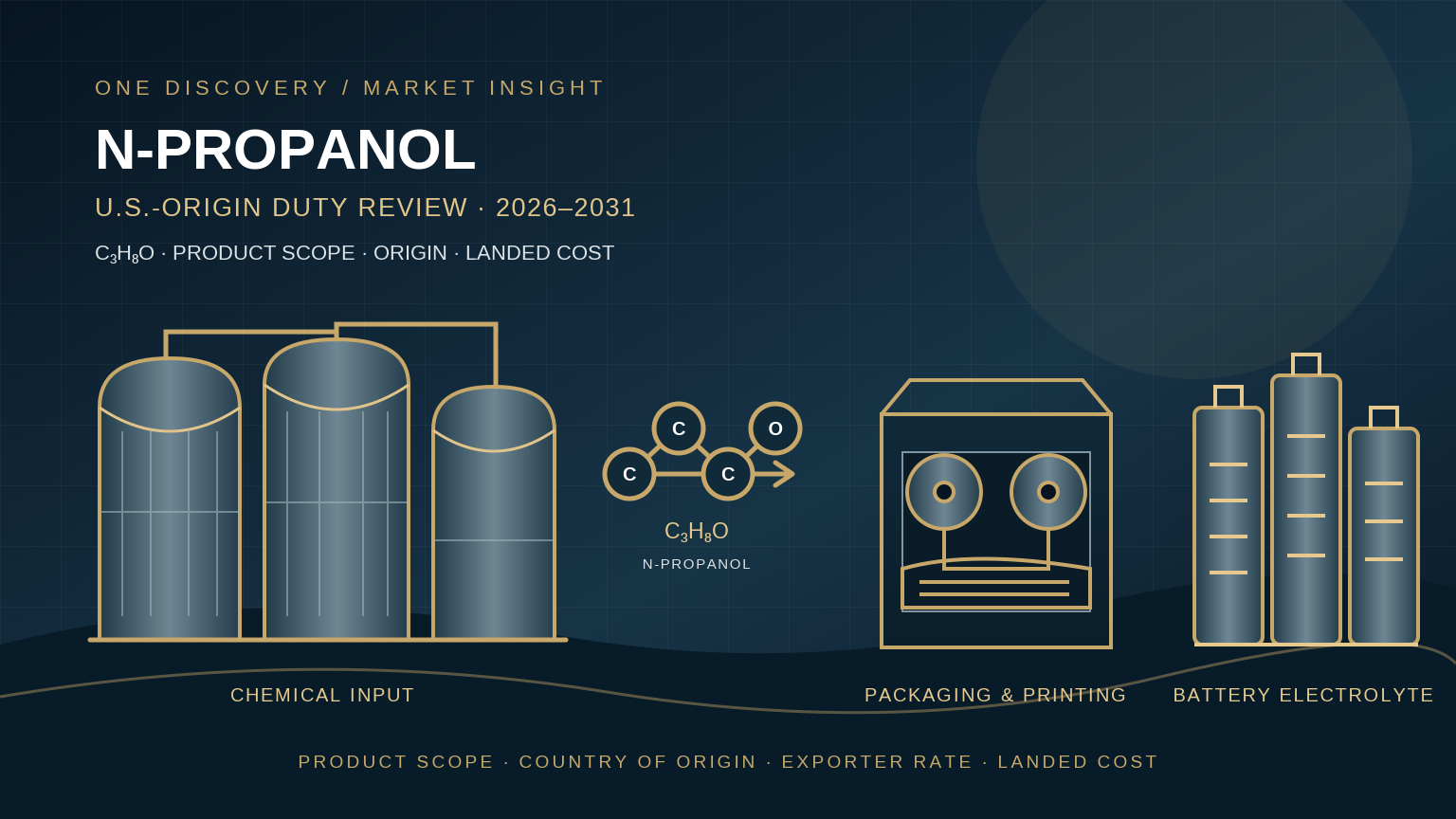
MOFCOM describes n-propanol as a chemical used directly and as an intermediate. It is used in food-packaging production and as a solvent for printing inks used on food packaging. It can also be esterified into n-propyl acetate; the notice identifies that acetate as an important component of electrolyte used in new-energy-vehicle lithium batteries.
The distinction matters. The measure covers the defined n-propanol product, not every downstream packaging film, printed package, battery cell or finished vehicle. But a packaging converter, ink maker, chemical formulator or battery-material supplier may still have indirect exposure if its process relies on the covered input or on n-propyl acetate made from it. MOFCOM also lists uses in pharmaceutical production, chemical intermediates, coatings, paints, adhesives, cosmetics and plastics.
Five checks for importers and procurement teams
- Confirm the chemical identity and tariff scope. Match the purchase specification, safety data sheet, product name and composition against n-propanol (1-propanol; n-propyl alcohol). Use tariff code 2905.12.10 as a cross-check, not as a substitute for a classification review. Do not confuse n-propanol with another alcohol or assume that a similar commercial name has the same scope.
- Establish customs origin, not just the shipping route. Record the actual manufacturing site, producer, exporter and country of origin. A shipment routed through a third country or invoiced by an overseas distributor is not, by itself, proof that the product has ceased to be U.S.-origin. Keep production and origin evidence and obtain a customs assessment where processing or repacking may affect origin.
- Verify the exporter-specific rate before approving the purchase. The notices name Dow Chemical and OQ Chemicals separately and provide a rate for other U.S. companies. Confirm the exact legal entity and producer covered by the entry documents. Do not assume an affiliate, trading company or reseller automatically inherits another company’s rate.
- Rebuild the landed-cost model. Show the anti-dumping and countervailing measures as separate lines, then add the ordinary customs duty, import VAT, freight, insurance, handling and financing cost as applicable. Ask the customs broker to confirm the customs value, both trade-remedy rates and the tax base before issuing a purchase order. Avoid a single blended percentage that hides which legal measure is being applied.
- Map direct and indirect exposure. Ask production, quality and R&D teams where n-propanol or n-propyl acetate appears in bills of material, formulations and approved process routes. If an alternative source is considered, compare specification, impurity profile, consistency, qualification time, capacity, lead time and change-control requirements. A cheaper quote is not a substitute for technical approval or origin diligence.
What the decision does not mean
The notices do not impose a general duty on all U.S.-origin chemicals. They do not, on their face, apply the n-propanol rates to finished packaging, ink, battery electrolyte or battery products simply because those products use the chemical somewhere in the supply chain. Those goods require their own classification, origin and trade-remedy analysis.
Nor should buyers treat the five-year period as a reason to stop monitoring the measure. Trade-remedy scope, rates, company names and customs interpretation can change through later notices or administrative action. Keep the decision and its supporting documents in the supplier file, and recheck the official MOFCOM record before each material change in sourcing or import structure.
A practical sourcing response
For the next purchase cycle, create a short exposure register with four fields: product identity and code, country of origin and producer, applicable AD/CVD rate, and the affected production line or customer. Ask suppliers to disclose the manufacturer and origin evidence in the quotation pack, and require a prompt notice if either changes.
If U.S.-origin n-propanol is already in the pipeline, separate shipments by customs entry date and confirm with the broker how the 6 November 2026 effective date applies to the specific entry. For future orders, compare a fully costed U.S.-origin scenario with technically qualified alternatives, but do not change origin declarations or supplier paperwork to obtain a lower rate. The defensible decision is the one supported by product, origin and customs evidence.
Sources
- MOFCOM — Announcement No. 54 of 2026: final expiry-review decision on anti-dumping measures for U.S.-origin n-propanol (5 November 2026).
- MOFCOM — Announcement No. 55 of 2026: final expiry-review decision on countervailing measures for U.S.-origin n-propanol (5 November 2026).
- Reuters — China to keep anti-dumping, anti-subsidy tariffs on U.S. n-propanol imports for five more years (5 November 2026).
General trade and procurement information only; not legal, customs, tax or technical advice. Confirm product scope, origin, classification, rates and tax treatment with the relevant customs authority or qualified adviser before importing or changing a supply source.