
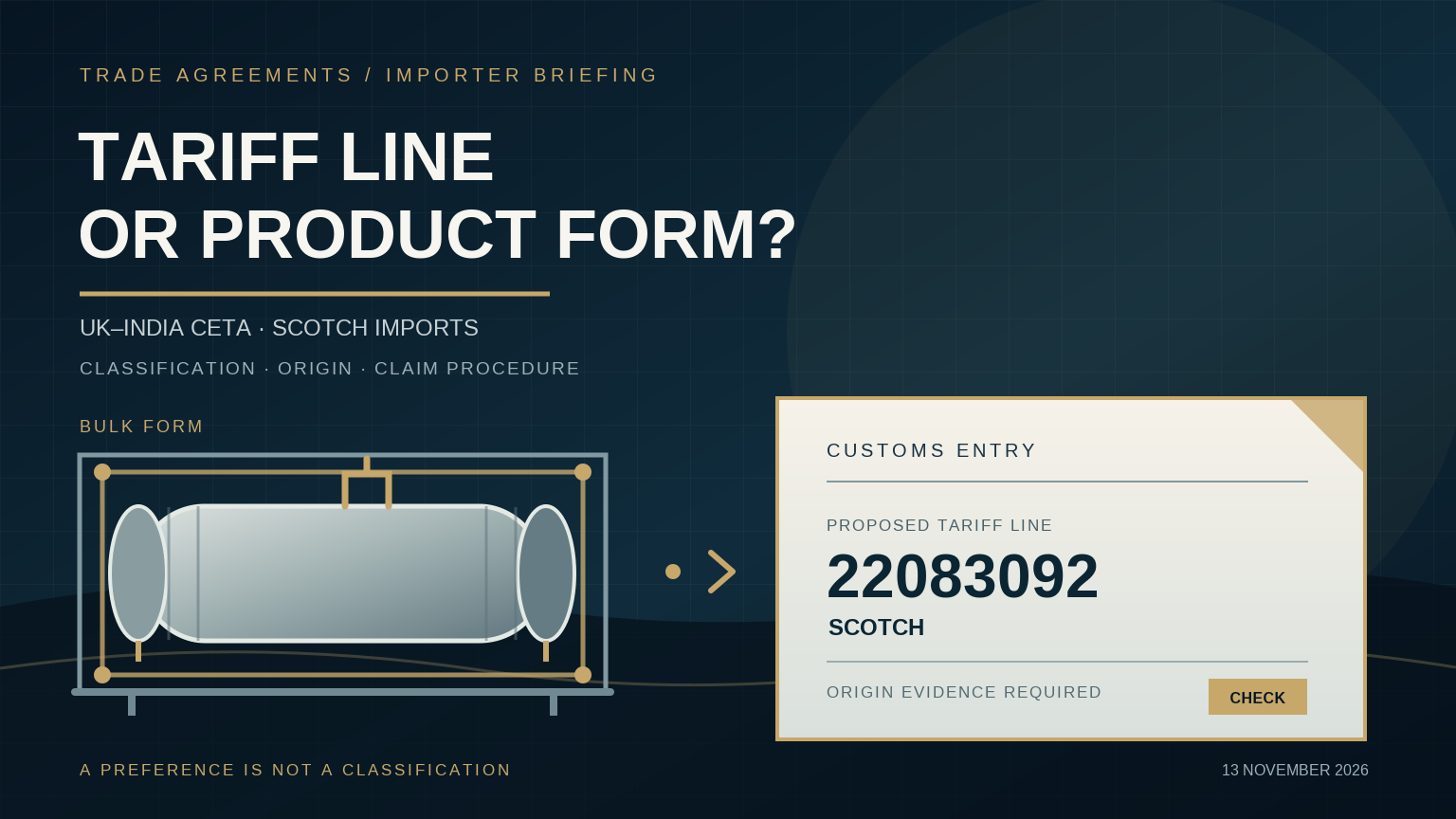
India’s CETA preference for Scotch is not an automatic discount for every shipment described as Scotch. The tariff schedule lists HS 2022 code 22083092 as “Scotch”, with a 75% staging rate falling to 40% in Year 10 against a 150% base rate. Reuters reported on 11 November 2026 that Indian customs was holding dozens of bulk Scotch containers while investigators argued that some concentrates for further manufacture should instead be treated as compound alcoholic preparations and assessed at 150%. This remains a reported dispute, not a final published ruling.
The CETA entered into force on 15 July 2026. The procurement lesson is to separate three questions before shipment or entry: tariff classification, preferential origin and the procedure for claiming the preference.
What the tariff schedule establishes
The official India tariff schedule in Appendix 2A-a identifies HS 2022 code 22083092 as “Scotch”. Its base rate is 150%, and its staging category reads “75%, R10 to 40%”. This is the treaty schedule entry buyers should start from when checking a qualifying Scotch shipment.
The schedule does not settle every product-form question. A product marketed with a Scotch brand or containing Scotch whisky is not automatically classified under the Scotch line. Customs assesses the goods presented using their composition, condition and processing stage. The live dispute concerns whether certain bulk imports fit the Scotch line or another category of alcoholic preparation.
Buyers should not price a shipment on the 75% figure until the product classification and origin file have been reviewed.
Why bulk form is the point of friction
Reuters reported that investigators were treating certain bulk Scotch concentrates as compound alcoholic preparations because they undergo further manufacturing after import. The report said a 4 November memo from India’s Directorate of Revenue Intelligence asked customs commissioners to apply a 150% rate. It also reported that the Commerce Ministry had told industry executives on 2 November that the pact would be honoured and the dispute resolved, while a senior finance-ministry source said the ministries were discussing a resolution.
Those are reported positions, not a final public determination. Reuters said the Finance Ministry, Commerce Ministry and revenue directorate did not respond to its queries. It also reported that about 80% of Scotch shipped from Britain to India by volume arrives in bulk before being used in Indian-made spirits. If representative, that makes the classification issue relevant beyond a small number of bottled imports.
For buyers, the risk is not limited to a higher duty. A customs query can tie up working capital and create storage, demurrage and production-planning costs. The impact depends on the shipment and contract, so it should be modelled rather than assumed.
Keep classification, origin and procedure separate
The CETA documents create three distinct checks:
- Tariff classification: Does the product fit “Scotch” at HS 22083092, or does its composition and condition place it under another heading?
- Preferential origin: Does the product meet CETA rules of origin? Chapter 3 requires goods to be wholly obtained or sufficiently transformed in the UK or India.
- Claim procedure: Has the exporter prepared the prescribed origin declaration and completed the authentication needed before the importer claims the preference in India?
An origin declaration does not settle tariff classification. Using the correct tariff code does not prove that goods meet the CETA origin rules. Treat each test as a separate document and approval step.
Five checks before booking or clearance
- Obtain a product-specific classification review. Document the product’s composition, alcohol strength, production stage, packaging, intended use and proposed HS code. Do not rely on a brand name or generic invoice description. For bulk concentrates or compound preparations, obtain written advice from a qualified Indian customs professional before loading.
- Build the origin file independently. Confirm where the whisky was distilled, blended and produced, and retain supplier and production records. Shipment from a UK port alone does not establish UK origin. Review Chapter 3 and the product-specific rules for the actual goods.
- Complete the CETA origin declaration early. UK Government guidance requires the exporter or producer to use the CETA template, complete it in English and send it to India for authentication before a preferential claim. A UK origin declaration applies to one shipment and is valid for 12 months from completion. Align it with the invoice, packing list, bill of lading and customs entry.
- Model duty and delay scenarios. Calculate landed cost using the preferential rate only where classification and origin are supportable. Also model the cash exposure if customs challenges the tariff line. Include applicable taxes, freight, insurance, storage, demurrage, financing and possible production interruption. A scenario is not a prediction of the final customs decision.
- Allocate dispute costs in the contract. State who handles classification advice, origin evidence, customs queries, additional duty, storage, demurrage, re-export and delayed delivery. Set document deadlines and escalation steps before the cargo moves. Contract clauses cannot override customs law, but they can clarify commercial responsibility if a claim is challenged.
What importers should monitor now
As of 13 November 2026, the latest detailed public account reviewed for this briefing was Reuters’ 11 November report, which described the matter as unresolved. Importers should check for a subsequent CBIC, Finance Ministry or Commerce Ministry instruction and obtain shipment-specific advice before filing an entry or assuming the preference will be accepted.
For cargo already afloat or held at port, reconcile the bill of lading, product specification, origin declaration, invoice and customs classification before changing the landed-cost forecast. The CETA concession is a tariff-schedule commitment; whether a particular product in the form imported qualifies must still be established.
Sources
- UK–India CETA, Appendix 2A-a: India’s tariff commitments (official tariff schedule)
- GOV.UK — CETA Chapter 2: Trade in Goods
- GOV.UK — CETA Chapter 3: Rules of Origin
- GOV.UK — UK–India CETA origin declaration guidance
- Reuters — India holds bulk Scotch shipments as investigators seek higher tariff, 11 November 2026
Market information only. This article is not legal or customs advice. Classification, preferential origin and import procedures must be confirmed for the actual goods and entry with qualified advisers and the competent customs authority.