
The 29 October 2026 Binance incident is not breaking news. Its operational consequences remain current. On 14 November, Reuters reported that Binance had reopened withdrawals for 87 networks during the week and aimed to restore the remaining networks and assets by the end of the following week. That is a target, not a guarantee that every asset or route is available now.
For over-the-counter (OTC) buyers, sellers and virtual asset service providers (VASPs), a platform balance, wallet screenshot, video call and blockchain transaction prove different things. None replaces counterparty identity checks, wallet-control evidence, transaction screening and a written settlement sequence.
What changed after the 29 October incident
The FBI attributed the theft of more than US$6 billion in virtual assets from Binance on or about 29 October to a North Korean operation it calls TraderTraitor. Binance described approximately US$6.3 billion in affected assets. North Korea has denied responsibility, according to the Associated Press; the attribution should be described as the FBI’s finding, not a court judgment.
On 12 November, the U.S. Department of Justice (DOJ) said government agencies and private-sector partners had frozen more than US$2.7 billion linked to the theft. The department had court authorization to seize or restrain more than US$1.2 billion of that amount. Frozen assets are not necessarily forfeited, returned to customers or available for settlement. Tracing, restraint and forfeiture are different stages.
Binance said on 12 November that it had completed coverage of affected assets and published a Proof of Reserves snapshot covering 198 tokens. It said the full zero-knowledge proof would take approximately 40–50 hours and withdrawals were still reopening in phases. Reuters reported on 14 November that 87 networks had reopened that week, with the remaining networks and assets targeted for the following week. Asset coverage, a reserve snapshot and live withdrawal availability are separate operational questions.
The DOJ also described a separate scheme called FaceStealer. The FBI said it had caused more than US$400 million in cryptocurrency theft over the previous 18 months. The scheme used hijacked messaging accounts and imposter video meetings, then directed targets to fake technical fixes that installed malware. This was separate from the Binance exchange incident.
Why this matters to OTC settlement
OTC settlement depends on more than whether a token exists on-chain. A buyer must establish who controls the sending wallet, whether the counterparty is authorized, whether the asset can be delivered on the agreed network, and whether the transfer creates unacceptable exposure for the receiving institution. A test transfer proves that a transaction moved; it does not establish identity, beneficial ownership or legitimate source of funds.
The FBI’s 31 October alert urged VASPs and infrastructure operators to block transactions with or derived from addresses associated with TraderTraitor laundering activity. That alert is operational guidance, not a substitute for each business’s own risk assessment, legal obligations or escalation process. Screening tools can be incomplete or probabilistic; investigate a match or near-match rather than treating it as a final legal conclusion.
FaceStealer adds an identity risk. A familiar face on a video call or a message from a known account does not prove that the person is genuine or controls the offered wallet. The FBI’s 12 November advisory recommends official meeting applications, confirming invitations through a second channel, and never running scripts or terminal commands supplied as a supposed meeting fix.
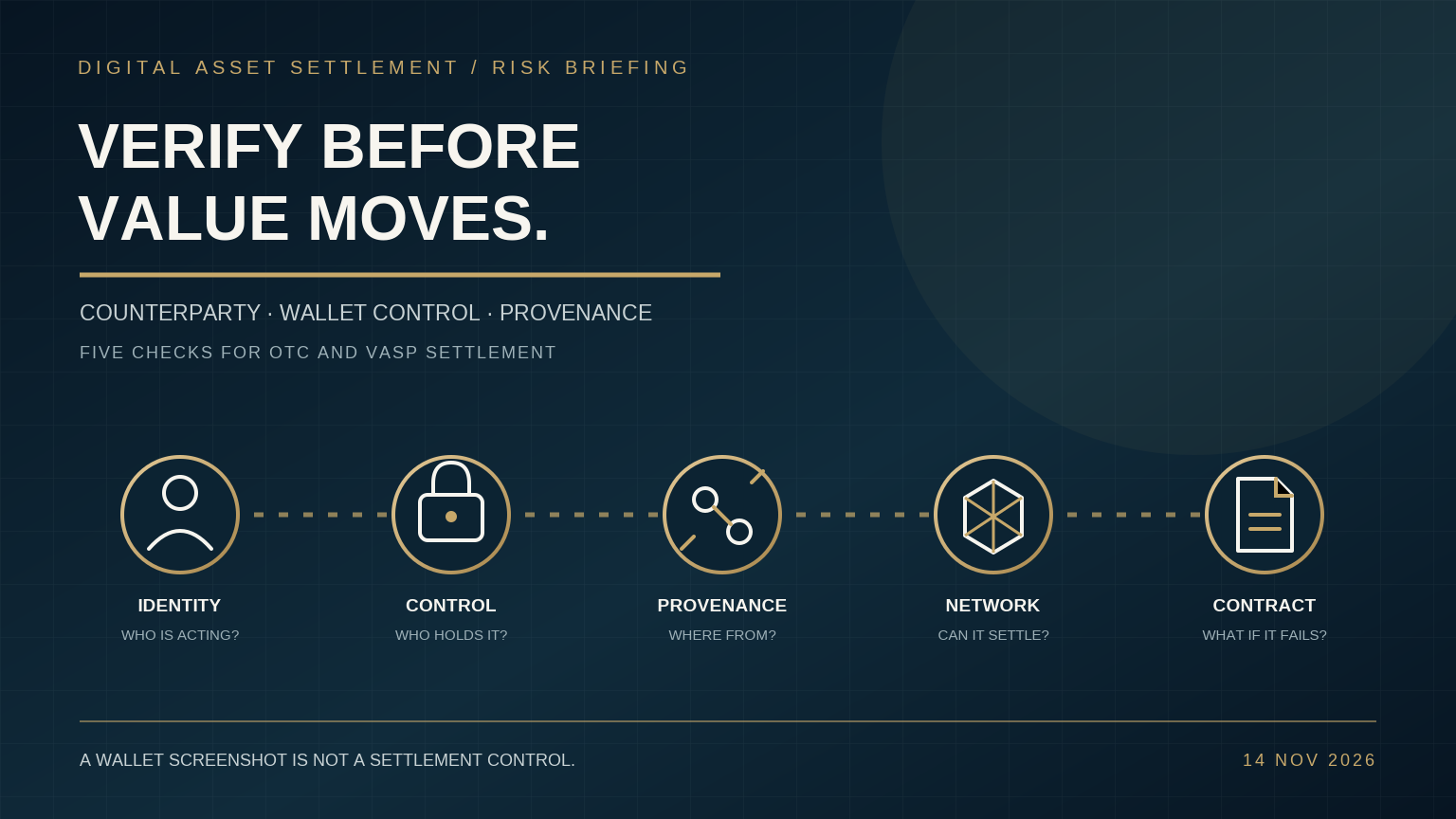
Five checks before a digital-asset settlement
- Verify the legal counterparty and authority. Confirm the contracting entity, relevant registration details, authorized signatory and the person’s authority to act. Call back through a previously verified number or channel. Do not rely only on a new Telegram, WhatsApp, LinkedIn or email conversation, even if the account looks familiar.
- Prove wallet control without exposing secrets. Use a cryptographic message-signing challenge where supported, or another agreed method that does not disclose a seed phrase or private key. Never request recovery words, remote-access software or code execution during a verification call. A small test transfer can confirm routing and receipt, but not identity, title or source of funds.
- Review provenance at transaction level. Record the sending address, network, token contract and transaction hash. Screen the address and relevant history against current official alerts and reputable blockchain-risk data. Check direct and indirect exposure, including bridges, where supported. Preserve the screening timestamp and escalate uncertain results. Do not circulate sensitive wallet data in open chat groups.
- Confirm deliverability on the agreed route. Match the token, contract, chain and receiving network exactly. Confirm that the receiving institution supports the asset and that deposits and withdrawals work on that network. Agree confirmation requirements, cut-off times, fees and the process if a token, bridge or exchange pauses service. A general asset-coverage statement does not prove every withdrawal route is open.
- Write the settlement sequence and failure path. Identify the parties, asset, network, amount, settlement window, required evidence, escrow or custodian role if used, and the point at which payment and delivery become final. Allocate fees, delays, failed transfers, frozen assets, compliance holds and disputes. Set a stop condition and return-of-funds procedure. A video call, screenshot or informal handshake is not an executed agreement.
A practical pre-settlement record
Before funds move, keep a controlled record of the counterparty’s identity and authority, wallet-control evidence, asset and network details, source-of-funds material, screening results and timestamp, receiving-side confirmation, signed instructions and fallback process. Restrict access and use secure channels for sensitive documents.
The Binance recovery process shows why status must be checked at the asset-and-network level. The DOJ actions show that tracing and restraint can continue after a theft. The FaceStealer advisory shows why identity checks cannot depend on one communication channel. A disciplined settlement process is more useful than calling a wallet “clean,” “verified” or ready to trade.
Sources
- U.S. Department of Justice — Actions to disrupt North Korea’s cryptocurrency theft schemes (12 November 2026)
- FBI — North Korea Responsible for $6 Billion+ Binance Attack (31 October 2026)
- FBI / IC3 — FaceStealer cryptocurrency theft scheme advisory (12 November 2026)
- Reuters — Binance targets full reopening of withdrawals by next week (14 November 2026)
- Binance — Completes coverage of assets impacted in security incident; publishes new Proof of Reserves (12 November 2026)
- Associated Press — FBI says US has seized $1.2 billion worth of cryptocurrency stolen from Binance (12 November 2026)
Market and operational information only. This article is not legal, investment or compliance advice. Independently verify counterparties, asset provenance, network availability and applicable requirements before any transaction.