
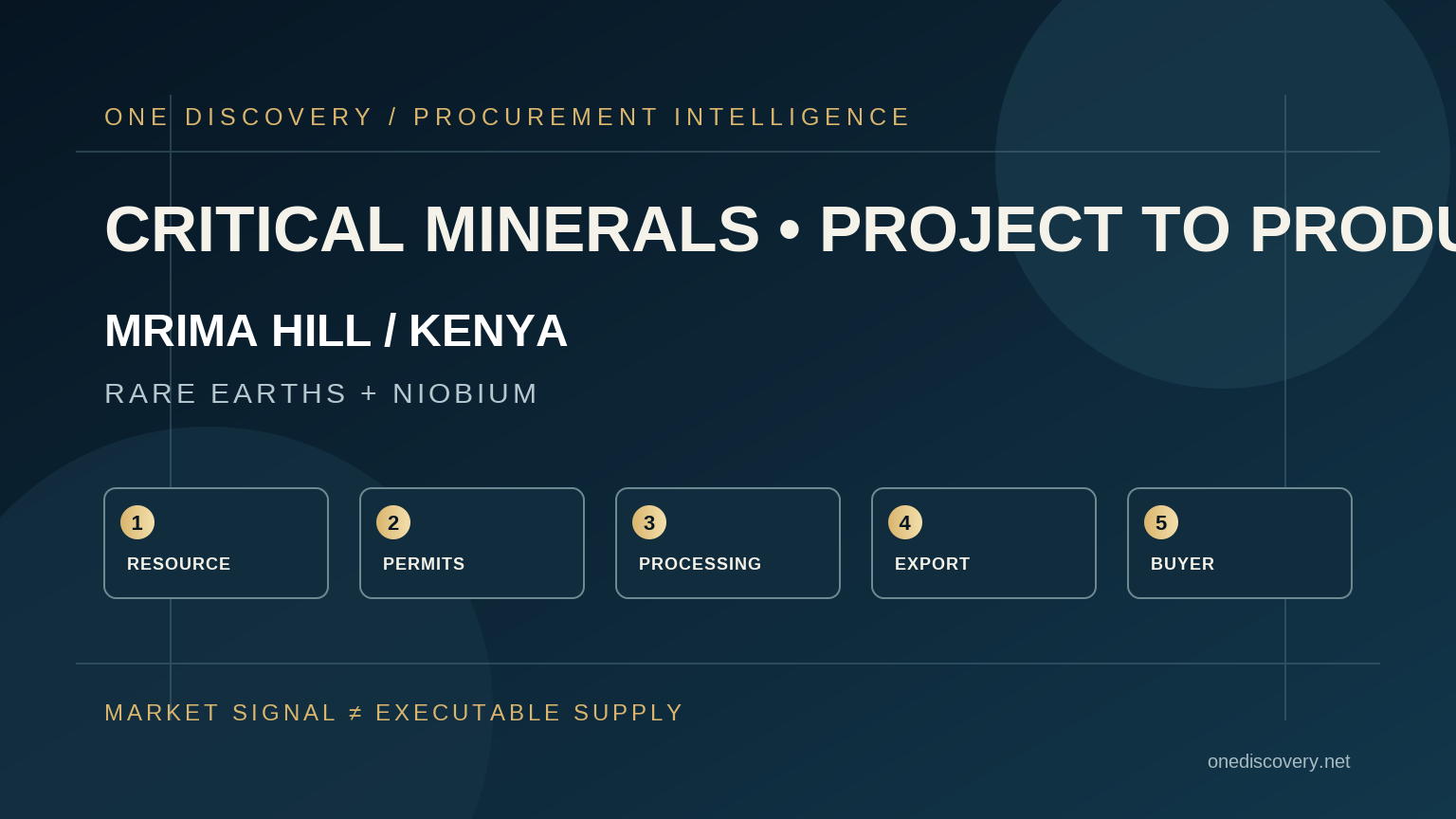
Kenya’s selection of a U.S.-led consortium for the Mrima Hill rare-earth and niobium project is a strategic sourcing development—but it does not create a new source of immediately available material. On 19 November 2026, Kenya News Agency reported that the Ministry of Mining had issued Notices of Intention to Award for three strategic mineral projects, including Mrima Hill in Kwale County. The selected Frontier Minerals Consortium comprises Frontier Minerals LLC, Bunker Hill Mining, ReElement Technologies and American Resources.
The distinction between a tender outcome and an operating mine matters. The Associated Press reported that the notice is not a mining licence: the consortium must engage local communities, obtain required consent and apply for a prospecting licence. Residents and community representatives have raised concerns about land, consultation and the cultural significance of the Mrima Hill site. Those issues are project-development conditions, not peripheral public-relations matters.
For buyers, the announcement is best treated as an early-stage diversification signal. It does not establish a commercially recoverable reserve, a completed feasibility study, a construction schedule, a product specification, a separated-oxide output or an offtake allocation. A consortium’s stated processing capability and strategic relationships are not the same as demonstrated production.
What the award does—and does not—mean
The government’s 19 November announcement covers a competitive tender process and a notice of intention to award. The Associated Press reported that this notice is not a mining licence: the consortium must engage local communities, secure required consent and apply for a prospecting licence. The project’s next steps therefore remain subject to permitting, consultation and technical work.
Mrima Hill is therefore not yet a qualified alternative source for a buyer’s purchase order. Buyers should distinguish between geological potential, mineral resources, economically mineable reserves, pilot-scale recovery, permitted construction, commissioning and consistent commercial output. Each stage requires separate evidence.
Five checks before treating the project as a supply option
- Verify the legal and permitting stage. Obtain the official notice of intention to award, the final award instrument when issued, the prospecting-licence application and the applicable approval timetable. Confirm which entity will hold each licence and whether any conditions precedent remain. Do not describe the consortium as a licensed producer or quote a production start date unless the relevant authority has confirmed it.
- Ask for product-level technical evidence. “Rare earths” is not a purchase specification. Identify the target elements, expected mineralogy, grade, impurity profile, recovery assumptions and proposed product form—concentrate, mixed rare-earth carbonate, separated oxide or metal. For niobium, require its own mineralogical, metallurgical and product specification. Buyers should not treat an in-situ resource estimate as saleable product.
- Test the community and environmental pathway. Request the project’s stakeholder-engagement plan, land-access status, environmental and social impact assessment process, water and tailings plan, biodiversity controls and grievance mechanism. The AP report highlights local concerns and the site’s cultural significance. A project schedule that ignores consent, heritage protection or environmental approvals is not a credible supply schedule.
- Map the processing chain, not just the mine gate. Confirm where beneficiation, cracking, separation, refining and waste treatment would take place; which steps are proven at the proposed scale; and which technology providers are contractually committed. Ask for mass-balance assumptions, recoveries, reagent and power requirements, residue management and independent test-work. A mine can produce a concentrate while still depending on another country for the value-adding separation step.
- Require bankable commercial evidence. Before including future tonnes in a sourcing plan, ask for financing status, definitive consortium agreements, construction milestones, logistics routes, export permissions, quality-control arrangements and a draft offtake framework. Any proposed volume should be conditional on commissioning, product qualification and delivery performance. Do not pay deposits or grant exclusivity against a press release or an unverified allocation letter.
How buyers should use the announcement
For procurement teams exposed to rare-earth magnets, electronics, defence-related components or niobium-bearing alloys, the immediate action is to map concentration risk in existing supply—not to replace an incumbent supplier with an undeveloped project. Record which elements and grades are critical, where separation currently occurs, what inventory cover exists and how long an alternative qualification would take.
Then place Mrima Hill on a monitored pipeline with explicit stage gates: licence and consent, independent resource and metallurgical work, feasibility, financing, construction, commissioning and repeatable product qualification. Advance it only when evidence clears each gate. This gives buyers visibility into a potential future source without mistaking a tender announcement for a shipment.
The commercial opportunity may be meaningful if Kenya can establish a responsible, technically sound and financeable project with local value addition. The near-term procurement conclusion is narrower: the project is a strategic development to monitor, not supply that can yet be booked.
Sources
- Kenya News Agency — Kenya awards three strategic mineral projects to investors (19 November 2026)
- Associated Press — Kenya picks U.S. consortium for critical minerals project as residents seek answers (19 November 2026)
General market and procurement information only. This article is not investment, legal, geological or technical advice. Verify licences, resource statements, environmental approvals, product specifications, financing and offtake authority independently before making sourcing commitments.