
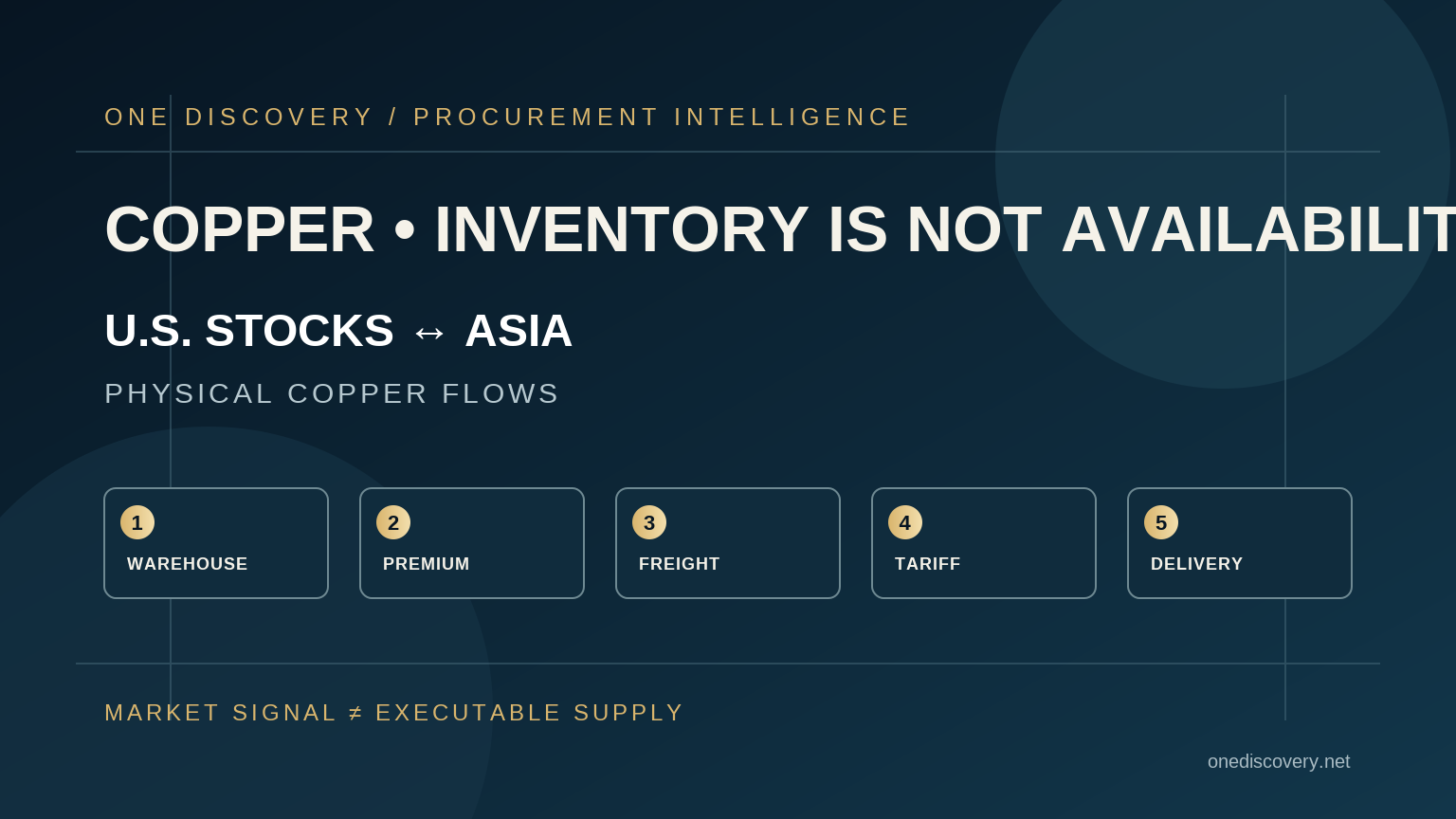
Copper’s November market is sending two signals at once: futures prices have weakened sharply, while nearby physical metal in China remains expensive. The International Copper Association Australia’s 19 November weekly brief reported that LME cash copper had fallen to US$12,750 per tonne on 18 November, its lowest settlement since April, while China’s Yangshan import premium had reached US$360 per tonne. The same brief showed a pronounced split between U.S.-held exchange stocks and low Shanghai Futures Exchange inventories.
This is not simply a bearish price story or a confirmed global shortage. It is a location-and-delivery problem. Metal accumulated in the United States while the market anticipated a possible U.S. refined-copper tariff. As the price incentive for holding metal in the U.S. weakened and Chinese physical premiums rose, market participants began reassessing whether some U.S.-held metal could return to international markets. The 19 November brief described a possible redistribution of U.S.-held stocks as the tariff outlook shifted, but noted that any movement would be gradual and dependent on the price spread, logistics and U.S. domestic demand. The policy outcome remained uncertain.
Why the inventory split matters
ICAA’s 19 November brief cited COMEX stocks of 730,697 tonnes and LME stocks of 327,600 tonnes on 17 November; about 240,650 tonnes of the LME total were in U.S. warehouses. It also reported Shanghai Futures Exchange stocks of 27,642 tonnes on 14 November, down 18% in a week and the lowest since December 2023. The Yangshan premium rose from US$290 per tonne on 16 November to US$360 on 18 November.
These figures have different scopes and dates. COMEX, LME and SHFE stocks are exchange-monitored inventories, not a complete census of all refined copper in the world. Warehouse location does not by itself prove that metal is unencumbered, available for prompt sale or suitable for a particular buyer. A high import premium can reflect local scarcity and the cost of attracting metal, while a lower futures price can reflect fund positioning and macroeconomic expectations.
The U.S. tariff question is also unresolved. ICAA reported that a proposed 15% duty on refined copper from January 2027 still awaited a presidential decision as of 19 November. Buyers should not model a tariff as either certain or cancelled until an authoritative decision is published.
Five checks before changing a copper purchase programme
- Separate exchange inventory from deliverable supply. Ask where the cathodes are physically held, whether they are exchange-warranted or off-warrant, who controls release, and whether the lot is already committed. Confirm brand registration, grade, packaging, warehouse release requirements and title. A headline stock total is not a supplier allocation.
- Compare the full regional basis. Rebuild the delivered-cost calculation from the relevant benchmark, regional premium, freight, insurance, financing, taxes, handling and any warehouse or port charges. Compare the same pricing period and currency. The Yangshan premium is a market indicator, not a quote for a specific port, brand, shipment date or buyer.
- Put transit time and timing risk into the decision. Metal leaving the U.S. West Coast and metal leaving the Gulf or East Coast do not have the same voyage duration, port options or inland costs. Confirm vessel booking, loading window, route, transshipment exposure and arrival range. A temporary arbitrage can close before a cargo arrives, leaving the buyer with a more expensive replacement cost or a seller seeking to renegotiate.
- Stress-test the tariff and contract clauses. Review the exact tariff classification, country of origin, customs value, importer of record and any applicable exclusion or effective date. Make sure the contract allocates the cost of a new duty, regulatory change, delayed clearance and route diversion. Do not assume that a proposed tariff is law or that a policy headline automatically changes a shipment already in transit.
- Match the material to the plant and payment terms. Verify cathode brand and specification, impurity limits, physical condition, sampling and inspection rights, and the process for resolving off-spec material. Align payment milestones with title transfer, warehouse release and shipping documents. Where a supplier offers a discounted price against a prompt shipment, confirm that the seller has authority and control over the specific lot.
What to monitor next
Track the U.S. tariff decision, daily COMEX and LME warehouse reports, SHFE inventory changes, Yangshan premiums and the actual movement of export cargoes. Also watch copper concentrate availability and smelter treatment charges: a refined-metal inventory shift does not resolve the upstream question of whether smelters can secure enough concentrate.
For buyers, the useful conclusion is not “copper is cheap” or “China is out of metal.” It is that benchmark price, physical premium and inventory location are diverging. Procurement teams should price the delivered unit they can actually receive, at the time they need it, with tariff and quality exposure assigned in the contract.
Sources
- International Copper Association Australia — Copper Weekly Brief, 19 November 2026
- S&P Global — China copper premium hits record as market weighs U.S. stock shift (6 November 2026)
- CME Group — Metals market data and exchange information
General market and procurement information only. This article is not trading, financial or legal advice. Prices, premiums, inventories and tariff proposals can change; verify current exchange data, cargo status, origin, specifications and customs treatment before committing.