
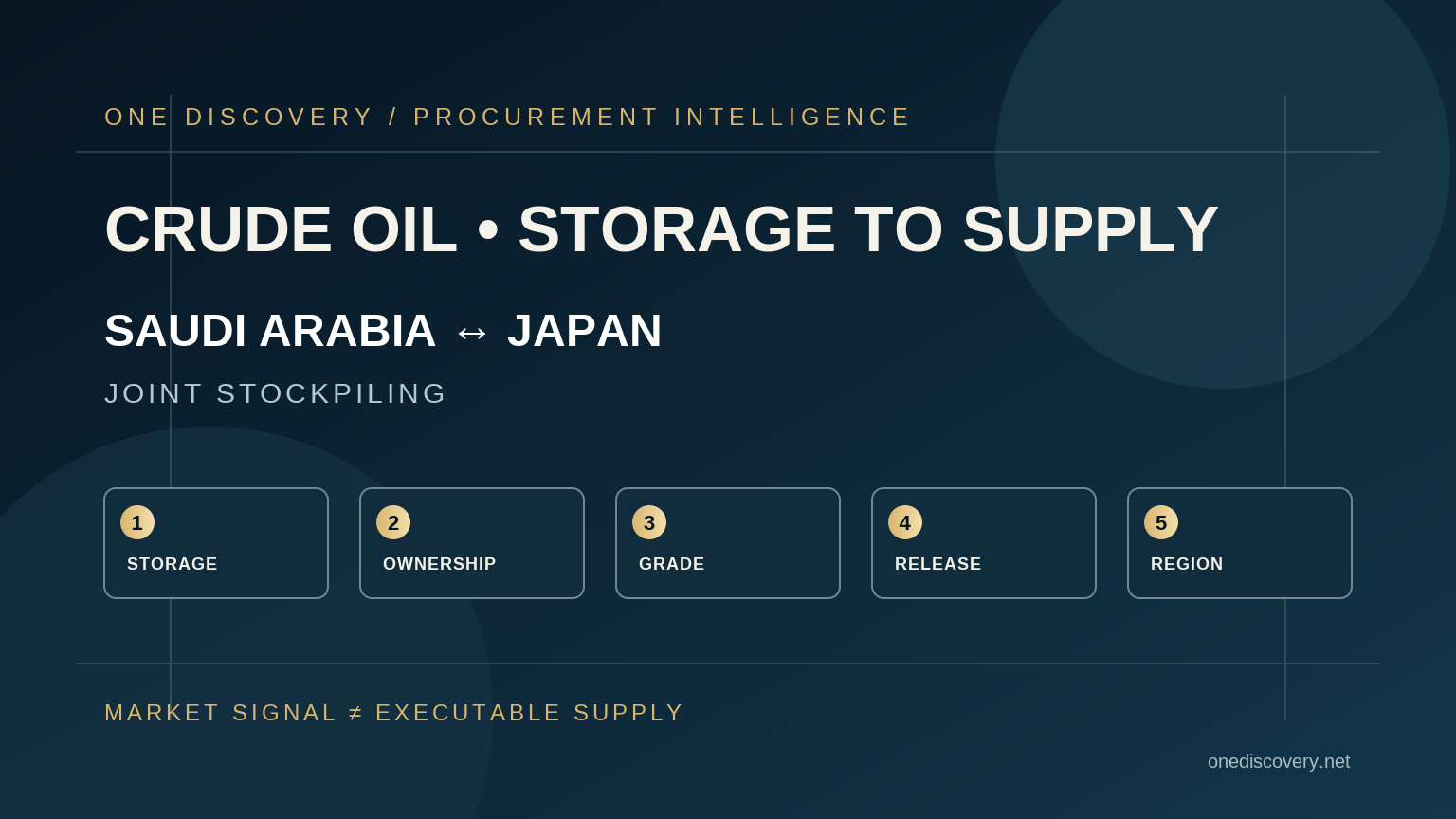
Saudi Arabia and Japan are expanding a crude-oil storage arrangement that could strengthen the resilience of Asian supply chains. In a statement dated 20 November 2026, the Saudi Press Agency said Japan intends to provide an additional 16 million barrels of storage capacity for Saudi crude in Japanese national facilities, on top of the existing 8 million barrels under the joint stockpiling arrangement. Japan also intends to buy up to 8 million barrels of Saudi crude for its national reserves, subject to favourable market conditions and completion of domestic procedures.
The two elements should be kept separate. Additional storage capacity is not the same as a purchase of crude, and a conditional purchase ceiling is not a confirmed order or delivery schedule. The Saudi statement also says Saudi Arabia has begun replenishing the joint-stockpiling tanks in Japan. Buyers should therefore read the announcement as a strategic storage and cooperation measure, not as proof that 24 million barrels of new supply have entered the market.
What the arrangement changes
The Saudi Press Agency said the existing joint storage project began in 2010 and that the additional 16 million barrels would be made available for a limited period within Japan’s national storage facilities. The arrangement is intended to support stable and reliable crude supply to Japan. The two governments also referred to the POWERR Asia initiative and future cooperation on oil-storage infrastructure, producer-country partnerships and emergency response coordination.
For Asian buyers, the strategic significance is the location of inventory and the relationship between producer-held crude, host-country storage and national emergency planning. Storage close to consuming markets can improve response options, but the commercial value depends on who owns the barrels, who can draw them, which grades are held, how quickly they can be loaded and what happens when market conditions are stressed.
Five checks for buyers and energy planners
- Identify ownership and drawdown rights. Establish whether the crude is held as Saudi-owned commercial inventory, part of a producer-country joint stockpile or a national reserve purchase. Confirm who may authorize a release, which entity has title, what notice is required and whether emergency access differs from ordinary commercial lifting. Storage capacity alone does not establish that a third-party buyer can access the barrels.
- Confirm the grade and refinery fit. Ask which Saudi crude grades may be stored, the relevant assay, sulphur and density characteristics, and whether the barrels are compatible with the intended refinery slate. A national stockpile volume measured in barrels does not reveal product yield, refinery suitability or the availability of a particular grade at a specific loading date.
- Model the physical route and release time. Confirm the storage site, tank availability, pipeline and terminal connections, loading capacity, vessel access and expected time from release instruction to export. In a disruption, berth congestion, vessel availability, insurance, port restrictions and regional shipping conditions can matter as much as the nominal inventory figure.
- Keep the proposed purchase separate from the storage expansion. Japan’s intention to buy up to 8 million barrels is conditional on favourable market conditions and completion of domestic procedures. Buyers should wait for a formal purchase decision, grade, pricing basis, delivery window and allocation details before treating that volume as a confirmed transaction. Do not infer a spot-market sale or a change in Saudi production policy from the announcement.
- Translate regional resilience into contract controls. Review supply-diversion rights, destination flexibility, nomination windows, force-majeure language, emergency allocation rules, freight and insurance responsibilities, and the treatment of delays. For importers outside Japan, the arrangement may improve regional options over time, but it does not confer automatic access or priority. Build alternative supply and inventory plans on contracted rights, not on regional headline capacity.
What to monitor after the announcement
Watch for implementation details from the Saudi and Japanese authorities: the duration of the additional capacity, the specific storage facilities, grade and volume schedules, operational access rules and any formal decision on Japan’s proposed purchase. The POWERR Asia work programme may also clarify whether this bilateral arrangement becomes part of a wider regional storage network.
For importers and procurement teams, the practical takeaway is straightforward. Strategic storage can improve the resilience of a supply system, but only if the inventory is technically suitable, legally accessible and operationally releasable. Until the purchase and access terms are confirmed, treat the 16-million-barrel expansion as capacity and the up-to-8-million-barrel purchase as a conditional intention—not as immediately available cargo.
Sources
- Saudi Press Agency — Saudi–Japan energy meeting and crude-oil joint storage statement (20 November 2026, Arabic)
- Japan Ministry of Economy, Trade and Industry — Minister Akazawa holds online meeting with Saudi Energy Minister (8 May 2026)
- Saudi Gazette — Japan plans additional 16 million barrels of Saudi oil storage and purchase of up to 8 million barrels (20 November 2026)
General market and procurement information only. This article is not investment, legal or energy-planning advice. Confirm ownership, drawdown rights, grade, facility access, purchase approvals and delivery terms with the relevant authorities and counterparties.