
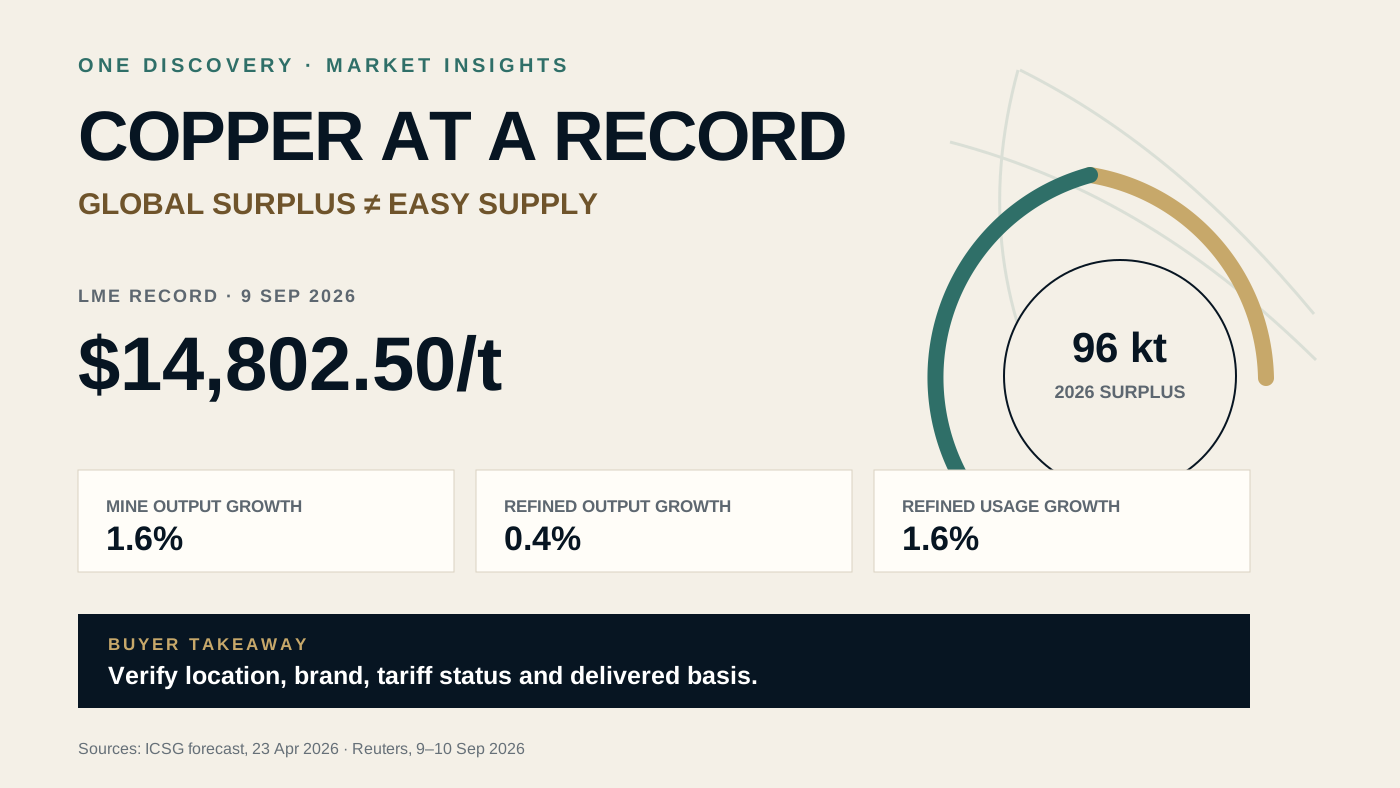
Copper reached a record $14,802.50 per metric tonne on the London Metal Exchange on 9 September 2026, even though the International Copper Study Group still projects a small refined-copper surplus for the year. The apparent contradiction matters to industrial buyers: a global balance can look comfortable while deliverable metal is concentrated in the wrong warehouse, brand, region or tariff position.
The procurement lesson is not to assume that a forecast surplus guarantees accessible supply—or that a record price proves the world has physically run out of copper. Buyers should separate the global balance from the metal that actually meets their specification, exchange eligibility, delivery location and customs requirements.
What the official 2026 copper balance says
ICSG’s April forecast expects world copper mine production to grow 1.6% in 2026, below the 2.3% growth anticipated in its October 2025 forecast. The group cited downward revisions for the Democratic Republic of Congo, Chile and Indonesia, including continued constraints at the Grasberg and Kamoa operations after major incidents in 2025.
The refined side is even slower. World refined copper production is forecast to rise only 0.4% in 2026 because limited concentrate availability restricts primary electrolytic production. Growth in solvent-extraction/electrowinning and secondary production from scrap provides a partial offset.
ICSG projects refined usage growth of 1.6%. On its China apparent-usage basis, that leaves a refined surplus of about 96,000 tonnes in 2026. The group explicitly cautions that actual balances can differ because of unforeseen disruptions and because its China calculation does not capture changes in unreported inventories.
This is a narrow cushion in a market exceeding 28 million tonnes of annual refined usage. More importantly, the headline balance says little about where inventory sits or whether a particular buyer can use it.
Why copper can be scarce in one region and abundant in another
Reuters reported in August that expectations of possible U.S. tariffs had pulled refined copper into American warehouses. COMEX inventories reached a record 675,185 tonnes after traders moved metal toward the higher-priced U.S. market. At the same time, withdrawal orders reduced available London Metal Exchange inventory.
That movement can create a regional availability problem without changing the amount of copper in the world. Metal stored in the United States may be duty-paid, committed, uneconomic to re-export or simply too far from a buyer’s required delivery point. A global surplus therefore cannot be treated as a pool that every consumer can access at the same basis and lead time.
Policy uncertainty reinforces the distortion. Reuters reported on 10 September that the White House had not made a final decision on possible tariffs for refined copper. The prospect of a future duty had already encouraged inventory building, but an eventual decision could change price spreads and trade incentives quickly. Procurement teams should avoid making a long-term sourcing decision on the assumption that one tariff outcome is certain.
The benchmark price is only the start of the purchase
For a physical buyer, “copper price” is not one number. The payable amount and execution risk depend on several layers:
- Benchmark and quotation period: LME cash, three-month or another agreed reference, plus the averaging window.
- Regional premium or discount: the adjustment for location, local availability and market conditions.
- Brand and specification: cathode grade, producer brand, exchange registration and the buyer’s technical approval.
- Logistics and insurance: warehouse release, inland movement, ocean freight, handling and transit risk.
- Tariff and tax position: origin, customs classification, duty-paid status and destination rules.
- Payment and timing: currency, credit terms, title transfer, inspection and the cost of financing inventory.
A lower headline premium may be misleading if the brand is not approved for the buyer’s process, if the material cannot be delivered within the shutdown window, or if tariff treatment remains uncertain. The correct comparison is a verified delivered cost for substitutable material—not two offers that merely cite the same exchange benchmark.
How industrial buyers should respond
The record-price environment argues for tighter purchase discipline rather than panic buying.
- Map exposure by month and plant. Identify the requirements that cannot tolerate a delay, specification change or supplier substitution.
- Confirm acceptable brands and forms. Make technical approval explicit before comparing price. Exchange eligibility alone does not guarantee suitability for a specific manufacturing process.
- Locate the inventory. Request the warehouse, country, duty status and realistic release schedule. Do not treat an inventory headline as proof of available material.
- Normalize the price basis. Compare benchmark period, premium, freight, insurance, duties, financing and delivery terms on one landed-cost sheet.
- Model the policy branches. Test at least a no-tariff case and a tariff case where U.S. exposure is relevant. Treat both as scenarios, not predictions.
- Verify the seller and documents. Confirm authority, title, producer documentation, inspection terms, sanctions screening, payment route and transfer procedure before commitment.
These checks complement the fuel and freight risk framework. High energy and transport costs can amplify the regional copper premium, particularly when material must be repositioned across longer routes.
What would change the copper signal
Three developments deserve close attention. First, a clear U.S. tariff decision could release or further anchor metal now concentrated in the American market. Second, stronger mine and concentrate performance could allow smelters to lift primary refined output from the unusually low 0.4% growth forecast. Third, weaker manufacturing demand could rebuild visible stocks and reduce urgency.
The reverse is also true. Additional mine disruption, delayed warehouse releases or continued tariff uncertainty could keep the market tight outside the regions holding inventory, even if the annual global balance remains positive.
The One Discovery view
BUYER SIGNAL
A global surplus is not the same as available metal. Location, brand, tariff status and delivery time determine whether inventory is commercially usable.
The record copper price is best read as a warning about distribution and optionality, not proof of one simple worldwide shortage. ICSG’s projected 96,000-tonne surplus and the simultaneous regional scramble can both be true because metal is not instantly interchangeable across location, brand, tariff status and delivery time.
Qualified buyers should secure alternatives before they are needed, but every alternative must be technically acceptable and commercially executable. The strongest procurement position is not the largest unverified inventory claim. It is a documented set of approved brands, origins, warehouses and routes that can be priced on the same landed basis.
Sources
- International Copper Study Group, Copper Market Forecast 2026–2027, issued 23 April 2026
- Reuters, U.S. tariff threat reshapes copper availability, 25 August 2026
- Reuters, White House copper tariff plan remains undecided, 10 September 2026
- Reuters reporting via MarketScreener, copper reaches a record on 9 September 2026
Discuss a qualified sourcing requirement or market opportunity.
Contact One Discovery