
Oil’s latest move above $100 a barrel is not only a crude-price story. The International Energy Agency’s September 2026 Oil Market Report shows a sharper squeeze in diesel, tanker capacity and physical supply, which means procurement teams should review freight, fuel clauses and delivery assumptions—not simply update a crude benchmark.
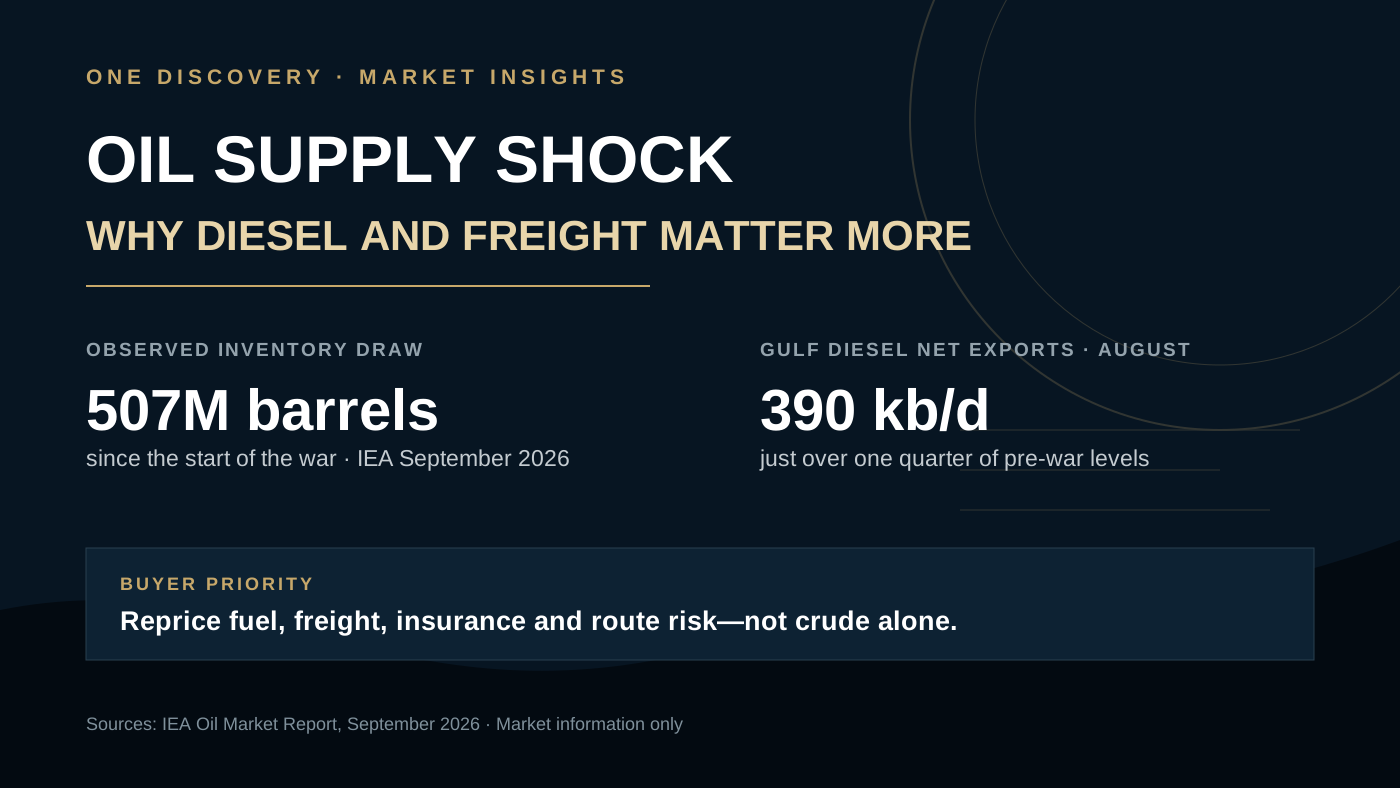
The most important signal is execution risk. IEA estimates that observed global oil inventories fell by 95 million barrels in August and by 507 million barrels since the Middle East war began. At the same time, Gulf diesel exports remained far below pre-war levels and tanker costs rose with security risks. For buyers of commodities, industrial inputs and finished goods, those pressures can reach landed cost through several channels at once.
Why diesel is tighter than the crude headline suggests
IEA reported that ICE Brent futures were around $105 a barrel when its September report was written, up $21 since the start of August. But refined products had moved more dramatically. U.S. diesel prices exceeded the equivalent of $200 a barrel in early September, while Europe and Asia were not far behind, according to the agency.
That gap matters because diesel powers trucks, agricultural machinery, mining equipment and many backup generators. Marine fuel economics are not identical to road diesel, but both are affected by refinery availability, crude quality, regional product balances and shipping disruption. A procurement budget built only around a Brent assumption can therefore understate the cost pressure facing the physical supply chain.
The underlying trade flow is unusually constrained. IEA estimates Gulf-country diesel and gasoil net exports averaged 390,000 barrels a day in August—just over one quarter of their pre-war level. Disruption to Russia’s refining system compounded the loss. Together, Gulf and Russian net diesel exports were 1.6 million barrels a day lower than in February, even though those origins had represented almost 45% of global seaborne diesel trade at that time.
Inventories are cushioning the shock, but the cushion is shrinking
Inventories have kept consumption and supply from separating more sharply. IEA’s estimated 507-million-barrel draw since the start of the war is equal to an average decline of 2.8 million barrels a day. August alone accounted for 95 million barrels, while oil held on water fell by 65 million barrels as tanker traffic from the Middle East faced renewed attacks.
The U.S. Energy Information Administration reached a similar direction in its September outlook. Reuters reported that EIA raised its 2026 Brent forecast to about $91 a barrel after estimating that global inventories had already fallen by roughly 400 million barrels this year and would continue declining through year-end. The two agencies use different observation sets and reporting periods, so their inventory figures should not be treated as identical. Both nevertheless describe a market relying heavily on stock draws while regional output and exports remain impaired.
This is why a buyer should avoid treating a single futures quote as the complete price signal. Futures can move immediately on news. Physical differentials, bunker costs, war-risk insurance, vessel availability, refinery margins and inland fuel surcharges can remain elevated—or move on a different timetable.
What the oil shock changes for procurement teams
The practical effect depends on the contract and route. An FOB commodity purchase leaves the buyer more exposed to ocean freight than a delivered contract, but delivered pricing may include wider risk premiums or shorter quote validity. A fixed trucking rate may offer temporary protection, while a fuel-adjustment formula can pass increases through quickly.
Procurement teams should separate four cost layers:
- Commodity or product price: the value of the goods before logistics.
- Ocean freight and insurance: vessel, bunker and route-risk costs, including any war-risk premium.
- Port and inland movement: terminal handling, storage, trucking or rail, and possible congestion costs.
- Financing and timing: additional working capital when transit times lengthen or suppliers shorten payment terms.
This framework is especially relevant to grain. The September corn and wheat sourcing analysis showed that crop availability and origin choice were already diverging. Higher fuel and route costs can change which origin produces the lowest landed cost even when its headline commodity price is cheaper.
A contract and logistics checklist for volatile fuel markets
- Reprice the complete lane. Ask for current ocean freight, insurance, bunker treatment and inland delivery rather than applying one percentage increase to an old landed-cost model.
- Read the fuel clause. Confirm the benchmark, base date, adjustment frequency, trigger and any cap or floor. A vague “fuel surcharge applies” term is not sufficient for comparison.
- Check route assumptions. Confirm whether the quoted route depends on the Strait of Hormuz, Bab el-Mandeb or another constrained passage, and identify any alternative route’s time and cost.
- Validate quote duration and laycan. In a fast market, an attractive rate may expire before the cargo or vessel can be fixed.
- Stress-test delivery. Model a higher-fuel case, a longer voyage and a delayed discharge. The purpose is not to predict one outcome but to find the point where margin or service commitments fail.
- Verify counterparties and documents. Confirm authority, insurance, vessel and sanctions screening, banking route, product documentation and destination requirements before accepting commercial terms.
The One Discovery view
EXECUTION SIGNAL
The physical system is tighter than the crude headline alone suggests. Inventory draws, reduced diesel exports and higher tanker risk can combine into a larger landed-cost shock.
The central procurement signal is not simply “oil is above $100.” It is that the physical system is losing inventory while refined-product exports and tanker movements are constrained. Diesel, freight and insurance may therefore transmit a larger cost shock than the crude headline alone implies.
Buyers should respond by shortening the distance between market monitoring and contract execution. Refresh landed-cost models, make surcharge formulas explicit, compare alternative origins and routes, and protect delivery windows where interruption would be most expensive. A lower commodity offer is not the better transaction if its logistics cannot be fixed on acceptable, verifiable terms.
Sources
Discuss a qualified sourcing requirement or market opportunity.
Contact One Discovery