
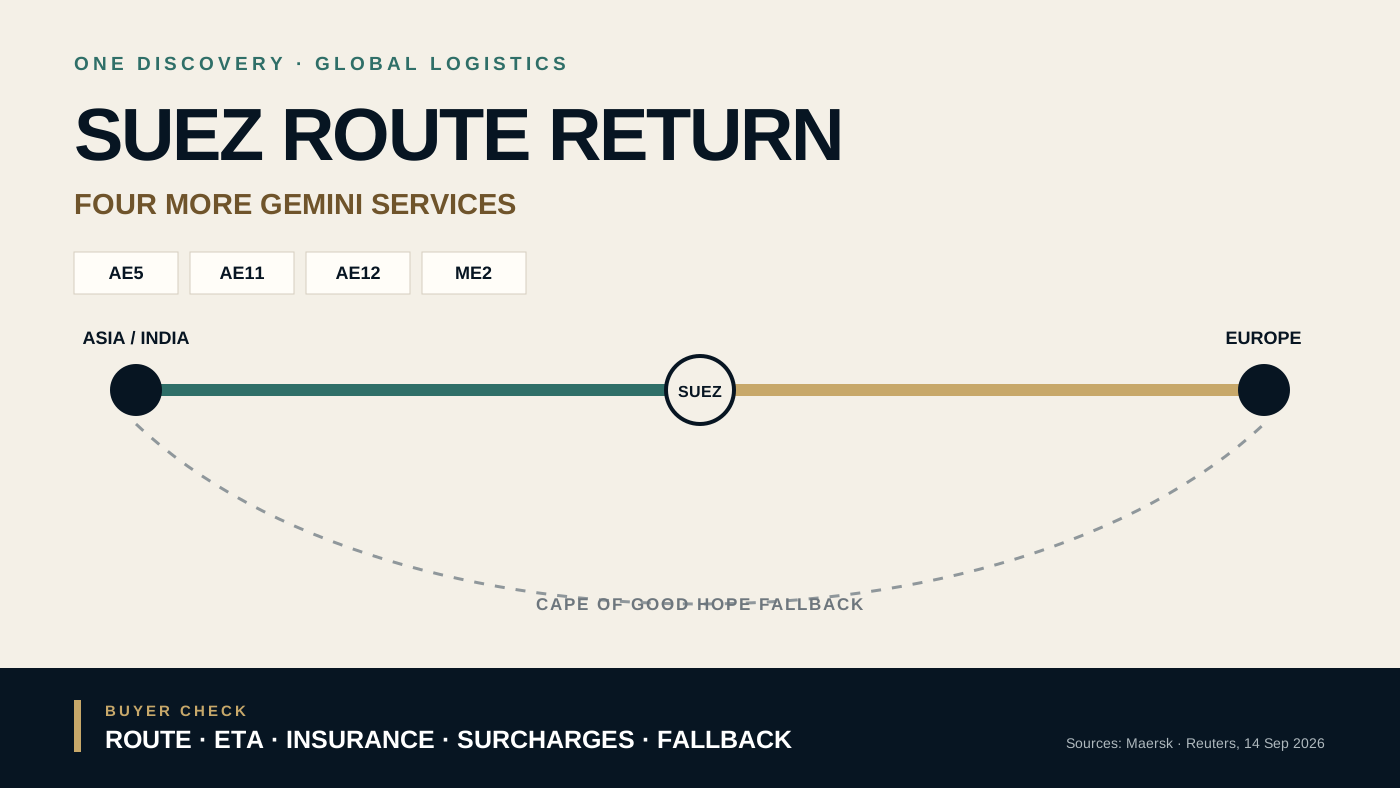
Maersk and Hapag-Lloyd are shifting four more Gemini Cooperation services—AE5, AE11, AE12 and ME2—from the Cape of Good Hope route to the Red Sea and Suez Canal. The move is meaningful for Asia–Europe logistics, but it does not mean global container shipping has returned to normal.
An important distinction comes first: the Suez Canal itself was not generally closed. Many major container carriers diverted services around southern Africa because of security risk in the Red Sea. This announcement is therefore a carrier- and service-level routing change, not proof that every sailing, carrier or shipment will now use Suez.
What changed in the Gemini network
The four returning services cover several important trade lanes:
| Service | Main trade lane | Buyer relevance |
|---|---|---|
| AE5 | Asia–Northern Europe | Faster routing potential for North European imports and exports |
| AE11 | Asia–Mediterranean | More direct access to major western Mediterranean gateways |
| AE12 | Asia–Mediterranean | Suez routing for a second Asia–Mediterranean loop |
| ME2 | India–Europe | Shorter routing potential between the Indian subcontinent and Europe |
They join AE15 and AE19, two Gemini services already using Suez routing. Maersk’s advisory states that implementation will be phased by sailing and that the first AE12 sailing will be communicated later. That detail matters: a network announcement does not automatically change every booking or every estimated arrival date on the same day.
Reuters reported that Maersk and Hapag-Lloyd will continue to monitor the Middle East security situation and that further service changes depend on regional stability and the absence of conflict escalation. Buyers should read the return as conditional operational progress.
Why the Suez route matters for buyers
For cargo moving between Asia, the Mediterranean and Northern Europe, Suez normally offers a much shorter route than sailing around the Cape of Good Hope. The potential benefits extend beyond headline transit time.
A shorter voyage can reduce fuel consumption and vessel days. It can also release shipping capacity that was absorbed by longer Cape rotations. For importers, a more direct route may reduce inventory in transit, improve working-capital planning and narrow the buffer required between purchase, production and delivery.
Those benefits are real only when the booked service actually follows the published route and keeps its schedule. A theoretical Suez transit does not help a buyer if the vessel is rerouted, the booking is rolled, a connection changes or the cargo misses a production window.
Why supply chains are not yet normal
The return of additional services removes one source of delay, but it does not eliminate execution risk.
Security remains the first condition. Carriers can change routing when they judge that crew, vessel or cargo safety requires it. A new escalation can therefore affect a sailing even after a buyer has planned around a shorter route.
Schedules will change in stages. Each service has a first applicable vessel and voyage. Cargo booked before or around the transition may still move via the Cape or follow a mixed schedule.
Insurance and surcharges may not normalize immediately. War-risk exposure, carrier surcharges, bunker adjustments and insurance terms can move differently from the physical route. Buyers should obtain the applicable charge basis for the specific booking rather than assume that a shorter route automatically produces a lower final freight cost.
Ports and connections still matter. Congestion, missed transshipments, blank sailings, equipment availability and inland transport can erase part of the time saved at sea. An ETA should be tested against the full origin-to-destination movement.
This is the same execution principle discussed in the One Discovery fuel and freight risk framework: a favorable headline is not yet a delivered-cost result.
How to compare Suez and Cape routing scenarios
Procurement teams should keep two live scenarios until the new pattern proves stable.
For the Suez scenario, record the service, vessel, voyage, planned canal transit, published transit time, insurance basis, applicable surcharges and arrival buffer. Confirm whether the carrier’s routing change applies to the exact booking.
For the Cape scenario, model the longer transit, additional inventory days, later delivery window, possible fuel-related cost exposure and the effect on downstream production or customer commitments.
The comparison should not stop at ocean freight. Buyers should calculate total landed and operational exposure: cargo value tied up in transit, safety stock, storage, demurrage risk, production interruption and the cost of an urgent substitute shipment.
A slightly higher freight offer may be commercially better if it provides a more credible route, connection and delivery window. Conversely, a lower quote built around an uncertain ETA can become expensive when the buyer must add emergency inventory or premium transport.
Practical procurement checklist
- Confirm the actual service and voyage. Do not rely only on a general carrier announcement.
- Ask which route supports the quoted ETA. Record whether the booking is planned via Suez or the Cape of Good Hope.
- Check the change clause. Understand what happens to price, ETA and notice obligations if the carrier reroutes.
- Separate base freight from risk costs. Review war-risk insurance, emergency surcharges, bunker adjustments and other route-related charges.
- Protect critical delivery windows. Maintain alternative ports, origins, suppliers or inventory buffers for cargo that cannot tolerate delay.
- Reconfirm before operational milestones. Check routing at booking, documentation cutoff, loading and departure—not only when the quotation is accepted.
- Communicate scenarios internally. Procurement, production, finance and customers should understand both the preferred plan and the fallback.
The One Discovery view
BUYER SIGNAL
Route availability is not execution certainty. Verify the named service, vessel, voyage, ETA, insurance and fallback for the actual booking.
The four-service return is a constructive logistics signal. It can shorten important Asia–Europe and India–Europe routes and improve network efficiency if the transition holds.
But route availability should not be confused with execution certainty. The procurement question is not simply whether Suez is “open.” It is whether the named vessel and voyage will use Suez, whether the ETA includes realistic connections, and whether freight, insurance and contingency costs have been verified for that booking.
A shorter route is valuable—but only when it remains safely and consistently executable.
Sources
- Reuters, Maersk and Hapag-Lloyd to sail more container ships through the Suez Canal, 14 September 2026
- Maersk, AE19 Trans-Suez service structural change, 10 August 2026
- Hapag-Lloyd, current statements and updates on Red Sea and Suez routing
- DataPortuaria, structural changes to AE5, AE11, AE12 and ME2 Gemini services, 14 September 2026
Discuss a qualified sourcing requirement or route-sensitive delivery plan.
Contact One Discovery