
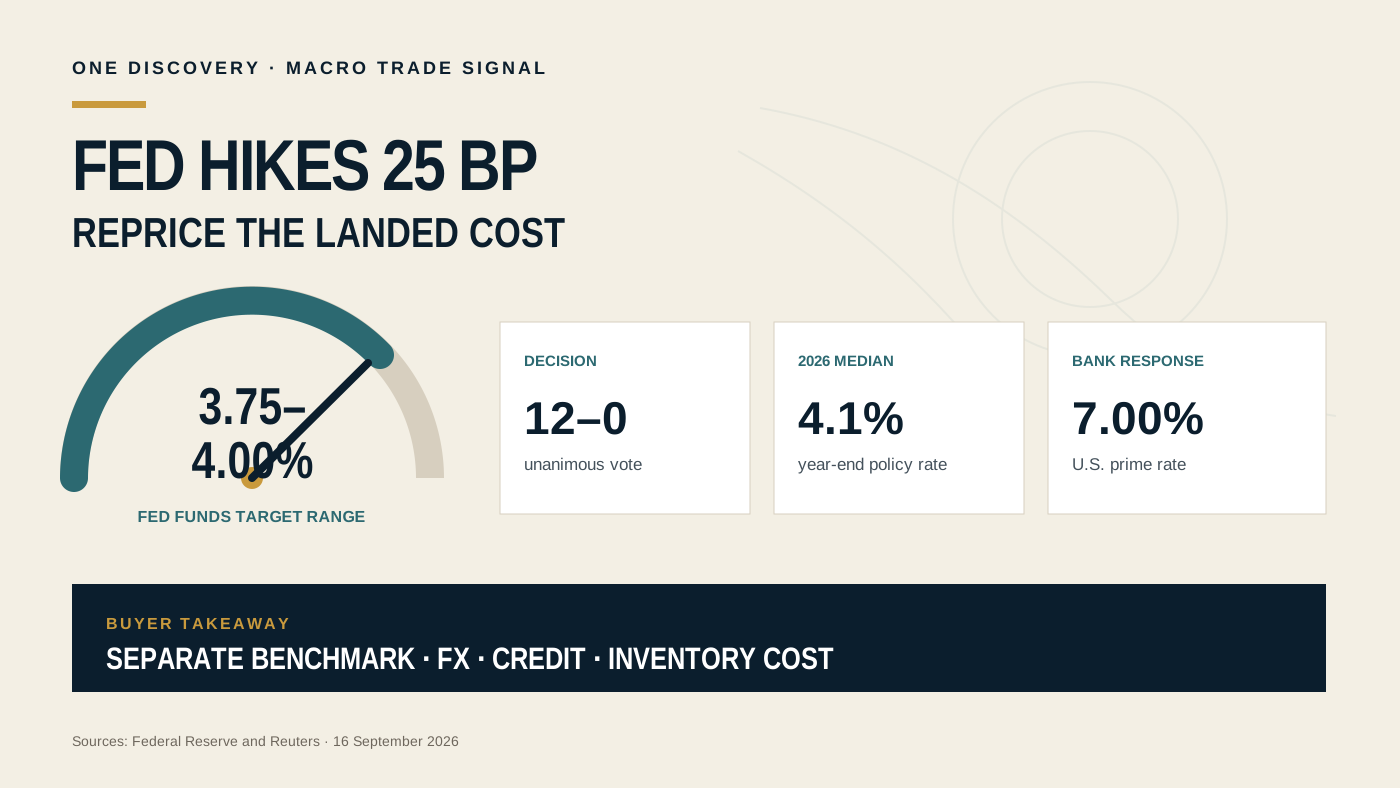
The Federal Reserve raised its target range by 25 basis points to 3.75%–4.00% on 16 September 2026. For commodity procurement teams, the immediate question is not whether every commodity price will fall or rise. It is which parts of the delivered cost now need to be recalculated: the dollar conversion, trade-finance rate, inventory carrying cost and supplier credit terms.
The decision was unanimous, and the Fed’s median projection put the policy rate at 4.1% at the end of both 2026 and 2027. That is a policy signal, not a guaranteed path. Buyers should therefore build scenarios around the current rate and currency environment instead of treating one market reaction as a durable forecast.
What changed at the September Fed meeting
The Federal Open Market Committee voted 12–0 to lift the federal-funds target range by one-quarter percentage point. The statement said economic activity was expanding at a solid pace while inflation remained elevated. The accompanying projections showed median 2026 PCE inflation of 3.7%, real GDP growth of 2.3% and a 4.1% year-end federal-funds rate.
Markets repriced quickly. Reuters reported that the dollar index rose 0.3% to its highest level in nearly five weeks after the decision. Major U.S. banks also announced that their prime lending rates would rise to 7.00% from 6.75% effective 17 September.
Those moves affect procurement through different channels. A stronger dollar changes the local-currency value of dollar invoices. A higher reference rate changes the cost of credit, letters of credit and inventory finance. Neither tells a buyer what the physical commodity itself must do next.
Separate the commodity price from the currency price
Many internationally traded commodities are quoted in U.S. dollars. A buyer whose functional currency is the Philippine peso, euro, yen or another currency therefore has two exposures: the commodity benchmark and the exchange rate.
A lower dollar-denominated commodity price can still produce a higher local-currency cost if the buyer’s currency weakens enough. The reverse is also possible. Procurement reports should show these components separately:
- benchmark price and quotation period;
- supplier premium or discount;
- freight, insurance, duty and handling;
- dollar-to-functional-currency conversion; and
- finance cost from payment date to cash recovery or consumption.
This separation prevents teams from attributing an FX-driven cost increase to the supplier or mistaking a lower benchmark for a cheaper delivered purchase.
Higher rates change the economics of holding inventory
When funding costs rise, the decision to buy early becomes more expensive. The relevant comparison is not simply today’s offer versus an expected future price. It is the cost of securing material now, including financing, storage, insurance, quality loss and working-capital use, versus the operational risk of waiting.
For a critical input, holding additional stock may still be rational if disruption would stop production. For a substitutable or readily available input, the higher carrying cost may favour smaller or more frequent purchases. The correct buffer therefore varies by lead time, supply concentration, production criticality and the company’s actual borrowing rate.
Procurement should work with treasury rather than apply the Fed’s 25-basis-point change directly to every transaction. Corporate credit spreads, bank fees, tenor, collateral and country risk can make the buyer’s effective funding change larger, smaller or delayed.
Do not assume a stronger dollar will suppress every commodity
Higher U.S. rates and a firmer dollar can weigh on dollar-priced commodities by making them more expensive for non-dollar buyers and by increasing the opportunity cost of holding inventory. But that relationship is not mechanical.
Supply disruption, freight constraints, tariffs, sanctions, weather and producer policy can dominate the currency effect. The recent regional copper availability analysis showed why a global balance and a buyer’s accessible supply can diverge. The same principle applies after a macro policy shock: a broad financial signal does not erase product-specific execution risk.
Buyers should therefore use the Fed decision as an input to landed-cost and financing scenarios—not as a standalone instruction to delay purchasing or speculate on lower prices.
Reprice these five procurement controls
- FX basis. State the invoice currency, fixing source, fixing time and responsibility for conversion. Compare spot and approved forward-cover scenarios without assuming either is automatically cheaper.
- Credit cost. Recalculate letters of credit, supplier financing, receivables programmes and revolving facilities using the applicable contractual reference rate and margin.
- Inventory horizon. Update carrying costs for safety stock, goods in transit and early purchases. Test the result against the cost of a production interruption.
- Quote validity. Shorten or clarify validity periods when benchmark, currency and funding inputs are moving quickly. Record which components remain open until shipment or payment.
- Counterparty resilience. Review whether suppliers or customers with floating-rate debt may seek shorter payment terms, larger deposits or price adjustments.
The analysis should use the company’s real cash-flow dates. A shipment priced today but paid after inspection may have a different FX and financing exposure from a documentary-credit purchase funded before loading.
What procurement teams should monitor next
The Fed’s median rate projection is conditional and participants’ forecasts are not commitments. Future inflation, labour data and geopolitical developments can change the path. Procurement teams do not need to predict every meeting; they need trigger points that force a cost model to be refreshed.
Useful triggers include a material currency move, a change in the buyer’s bank spread, a supplier’s revised credit terms, a new freight surcharge or a significant shift in the underlying commodity benchmark. Assign an owner for each input and preserve the rate, timestamp and source used in every major bid comparison.
The One Discovery view
BUYER SIGNAL
The rate increase adds a second price tag to commodity purchasing: the cost of money. Separate the benchmark, FX, credit and inventory duration.
The September rate increase adds a second price tag to commodity purchasing: the cost of money. Buyers who compare only the physical benchmark can miss the effect of currency translation, credit and inventory duration on the final delivered cost.
The practical response is not to make a directional bet on the dollar or commodities. It is to separate every cost layer, run a small number of documented scenarios and ensure quotation, finance and delivery dates use the same assumptions. That creates a purchase decision that can still be explained when markets move again.
Sources
Discuss a documented sourcing requirement or landed-cost comparison.
Contact One Discovery