
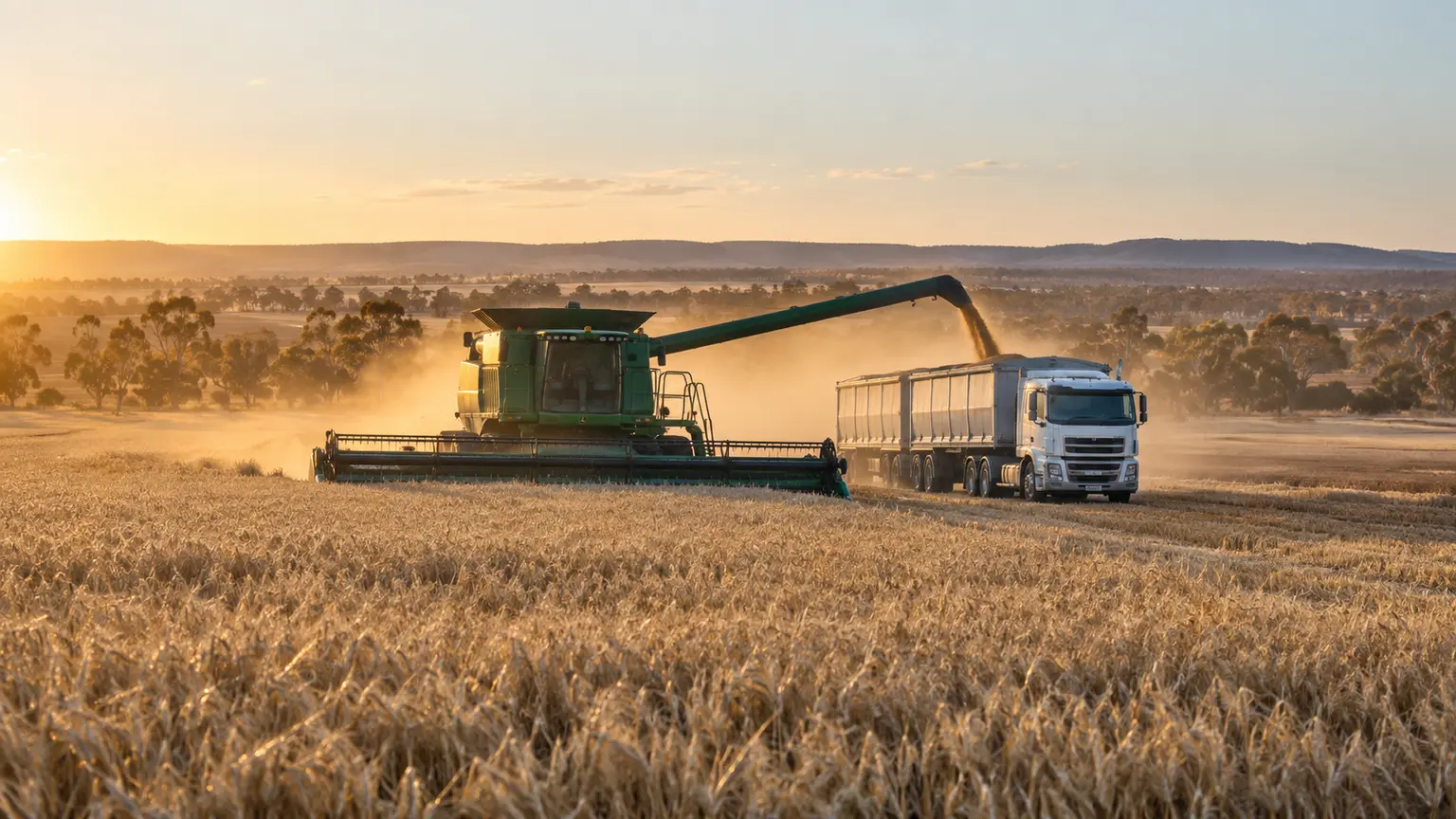
Australia’s official crop outlook still points to a large 2026–27 wheat harvest, but new working-holiday visa rules have created a separate execution question: will enough seasonal labour be available at the right time to move grain from field to storage and export channels?
For importers, the correct response is not to assume an Australian supply failure. It is to distinguish crop availability from harvest and logistics performance, then verify the shipment window, origin, quality and contingency plan behind each offer.
What the official crop forecast says
The Australian Bureau of Agricultural and Resource Economics and Sciences (ABARES) forecasts wheat production of 29.9 million tonnes in 2026–27. That is 17% below the previous season, mainly because planted area is estimated to be 11% lower, but it remains 3% above the ten-year average.
The national number also hides regional variation. ABARES reports excellent conditions in South Australia, Victoria and southern New South Wales, while conditions are weaker in northern New South Wales and Queensland. Victoria’s winter crop is forecast at a record level, whereas New South Wales wheat output is expected to fall sharply year on year.
ABARES separately expects both the value and volume of wheat exports to decline in 2026–27. Its outlook says Australian production should remain above historical averages even as production falls across most major exporters. That combination supports Australia’s continued importance as an export origin, but it does not make every delivery window equally secure.
What changed in seasonal labour policy
On 17 September, Australia’s Home Affairs Minister announced changes to the Working Holiday Maker programme. Applicants for a second year will still need 88 days of eligible regional work, but access will move to a ballot capped at 45,000 places. The government said 57,000 people qualified in the previous year. Third-year access will be capped at 5,000 places, compared with 31,000 people in that group last year, while the six-month regional-work requirement remains.
The same announcement added agriculture to a priority list for visa processing and said normal processing speed would be restored for primary Working Holiday Maker applications tied to regional requirements. The policy therefore contains two different signals: faster processing for some initial applications, but tighter numerical control over extensions.
Reuters reported that Australian farm groups are concerned the changes could reduce the pool of experienced seasonal workers ahead of harvest. The report cited an industry estimate that backpackers fill roughly one in seven farm jobs. The government rejects the claim that the policy will necessarily cause higher food prices and points to priority processing and other labour programmes.
Those positions should be presented as a live policy and industry debate, not as proof that grain will remain unharvested. The immediate procurement issue is operational uncertainty during a time-sensitive harvest.
Why harvest timing matters to an overseas buyer
Grain can exist in the field without being ready for an export contract. A seller still needs harvesting capacity, trucks, storage, grading, fumigation or treatment where required, port intake and vessel coordination. A labour constraint at one stage can move the practical shipment window even when the national crop estimate remains healthy.
The commercial effect will not be uniform. Large operators may rely more heavily on mechanisation and contracted crews. Labour sensitivity may differ by region, farm size, storage access and the mix of crops being harvested at the same time. Buyers should therefore avoid applying a national headline mechanically to every Australian wheat offer.
This is consistent with the broader lesson in One Discovery’s analysis of shifting global grain origins: a national balance sheet does not confirm that a particular parcel, port and delivery window are executable. The same principle applies when comparing Australia with the wider wheat balance discussed in the September WASDE buyer analysis.
What grain buyers should verify now
- Name the producing region and load port. National output is too broad for execution planning. Confirm the crop zone, storage pathway, port and expected intake window.
- Separate crop estimate from allocated supply. Ask what evidence supports the quantity, grade and shipment period. Do not treat an official national forecast as proof of seller inventory or authority.
- Test the harvest-to-port schedule. Confirm the expected harvest start, handling capacity, storage access, quality testing and latest feasible shipment date.
- Define quality and substitution rights. Set the wheat class, protein, moisture, test weight, foreign matter and other required specifications, plus an agreed inspection method and remedy for non-conformity.
- Check logistics dependencies. Review inland haulage, terminal nomination, port congestion, vessel laycan and demurrage allocation. The lowest FOB number may not produce the lowest reliable landed cost.
- Maintain an origin alternative. Compare another Australian region or a commercially suitable origin before urgency removes negotiating room. Any substitute must be tested for quality, phytosanitary, customs and sanctions requirements.
- Use contract dates that match evidence. Delivery promises should be tied to realistic harvest, storage and vessel milestones, with clear notice obligations if conditions change.
ONE DISCOVERY VIEW
An above-average national crop does not remove execution risk. The buyer still needs evidence that the required wheat can be harvested, graded, positioned and shipped inside the operating window.
The verified facts support a measured conclusion. Australia is still forecast to produce an above-average wheat crop, while the government has changed the rules governing an important seasonal labour channel. Industry groups see a harvest risk; the government says priority processing and alternative programmes should limit disruption.
One Discovery’s analysis is that buyers should not price in a nationwide supply shock without transaction-specific evidence. They should, however, require more precise confirmation of origin, harvest timing, logistics capacity and contractual fallback. The risk is less about whether Australia has wheat in aggregate and more about whether a specific cargo can meet the required quality and delivery window.
Sources
- ABARES — Australian Crop Report, September 2026
- ABARES — Agricultural Commodities Report, September 2026
- Australian Minister for Home Affairs — National Press Club speech, 17 September 2026
- Reuters — Immigration crackdown puts Australia’s wheat harvest at risk, industry groups say, 18 September 2026
Review a documented grain requirement or logistics-sensitive international transaction.
Contact One Discovery