
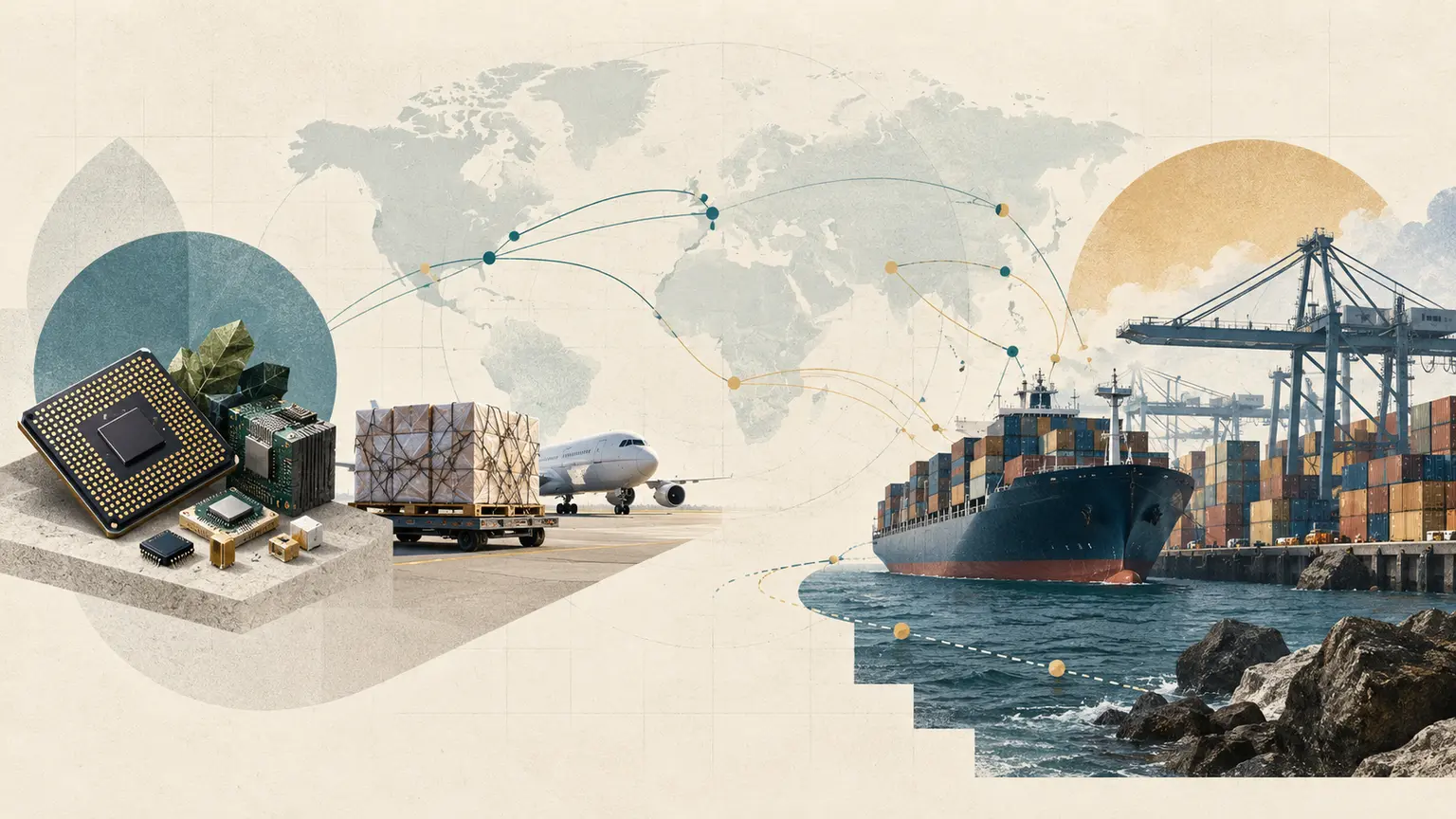
The World Trade Organization’s latest Goods Trade Barometer points to above-trend merchandise trade in the third quarter of 2026. The composite index reached 102.0 in July, up from 101.7 in June, while export orders, electronic components, air freight and agricultural raw materials were all above their common trend baseline.
That is constructive, but it is not a signal that every supply chain is becoming easier. Container shipping was the only component below trend at 99.6, and current freight markets show why buyers should separate demand momentum from route execution. Procurement teams should read the barometer component by component, then validate capacity, landed cost and delivery risk for the route that will actually carry the goods.
What the 102.0 reading means
The Goods Trade Barometer is a leading indicator designed to show how merchandise trade is moving relative to recent trends. A value above 100 is associated with above-trend trade volumes; a value below 100 points to below-trend conditions. It is not a price forecast and it does not measure whether a particular shipment will arrive on time.
The WTO’s 9 September release put the July composite reading at 102.0. Electronic components led at 104.9, reflecting demand for goods connected with artificial-intelligence investment. Export orders strengthened to 103.5, while international air freight reached 102.8 and agricultural raw materials 102.6. Automotive products were modestly above trend at 101.5.
Those readings support the factual conclusion that global goods trade retained momentum in mid-2026. The WTO also cautioned that disruption around the Strait of Hormuz would be captured more fully when second-quarter trade data become available. The barometer is therefore a timely signal, but it is not a complete account of current disruption.
The divergence matters more than the headline
The gap between electronic components at 104.9 and container shipping at 99.6 is commercially important. It suggests that demand and order activity can strengthen even when one of the principal physical transport channels is not expanding at the same pace.
This is where interpretation becomes necessary. A strong composite reading may be concentrated in selected products and modes rather than evenly distributed across origins, ports and commodities. AI-related electronics can support the global headline, while buyers of bulk commodities, industrial inputs or containerised consumer goods face very different capacity and cost conditions.
Reuters reported on 17 September that the off-contract China–US East Coast spot rate had climbed sharply as higher bunker costs and pre-holiday demand put pressure on the route. That route-specific evidence should not be generalised to every lane, but it illustrates the difference between expanding trade demand and executable transport capacity.
What procurement teams should test
1. Match the indicator to the product
Start with the component closest to the purchase. Electronic-component strength may matter directly to technology hardware and indirectly to air-cargo capacity. The agricultural raw-materials index is more relevant to certain commodity flows, but it still does not replace origin-specific crop, port and freight analysis.
2. Price the route, not only the goods
Confirm the nominated port pair, mode, transshipment plan and carrier before treating freight as fixed. A supplier’s commodity price can remain attractive while fuel, war-risk cover, congestion or capacity makes the delivered transaction less competitive.
One Discovery’s analysis of the Panama Canal pressure explains why route availability and secured capacity are different questions. The same discipline applies to any lane exposed to congestion or diversion.
3. Separate forecast signals from executable facts
Export orders at 103.5 point to continued trade momentum, but an order is not a loaded vessel. Buyers should verify production allocation, cargo readiness, export documents, terminal acceptance and confirmed booking. Each step can fail independently of the broader trade cycle.
4. Recalculate landed cost under more than one scenario
Build a base case and at least one disruption case. Test fuel surcharges, insurance, demurrage, detention, alternative ports, longer transit times and the working-capital cost of inventory in transit. Do not apply a single global freight assumption across different lanes.
5. Align inventory buffers with replacement difficulty
The right buffer depends on the consequence of delay. A standard input with several approved origins may require less protection than a qualified component with a long revalidation cycle. Use the barometer as a prompt to review the exposure, not as a universal instruction to increase stock.
A practical decision framework
Before approving a purchase in an above-trend but uneven market, procurement teams should answer five questions:
- Which barometer component is most relevant to this product and route?
- Is the freight quotation backed by confirmed capacity and a stated validity period?
- Have fuel, insurance, congestion and diversion costs been included in landed cost?
- Can another origin, port or mode meet the specification and delivery window?
- Which documents and approvals must be complete before cargo movement begins?
If the answers are uncertain, the buyer has market exposure even when the global indicator is positive. This is consistent with the broader trade-fragmentation procurement checklist: commercial decisions should be tested against origin, tariff, route and documentation facts before price is accepted.
The buyer’s takeaway
The WTO data supports a cautiously positive view of global goods trade. Momentum is above trend, export orders are strengthening and AI-related demand is providing material support. The data also shows that this strength is not uniform.
ONE DISCOVERY VIEW
A positive global indicator does not guarantee easy execution. Identify the component driving the signal, then verify the supplier, cargo, route, capacity, documents and delivery window.
One Discovery’s inference is that procurement teams should avoid translating a strong global headline into a broad assumption of easier supply. Trade can be resilient in aggregate while a particular transaction remains difficult to execute.
Sources
Stress-test the route and evidence behind a sourcing requirement.
Contact One Discovery