
France has asked the European Commission to push back a 2027 methane requirement for imported energy. That request has not changed the law. EU importers of crude oil, natural gas and coal should continue preparing for the current 1 January 2027 milestone while watching for a formal legal change.
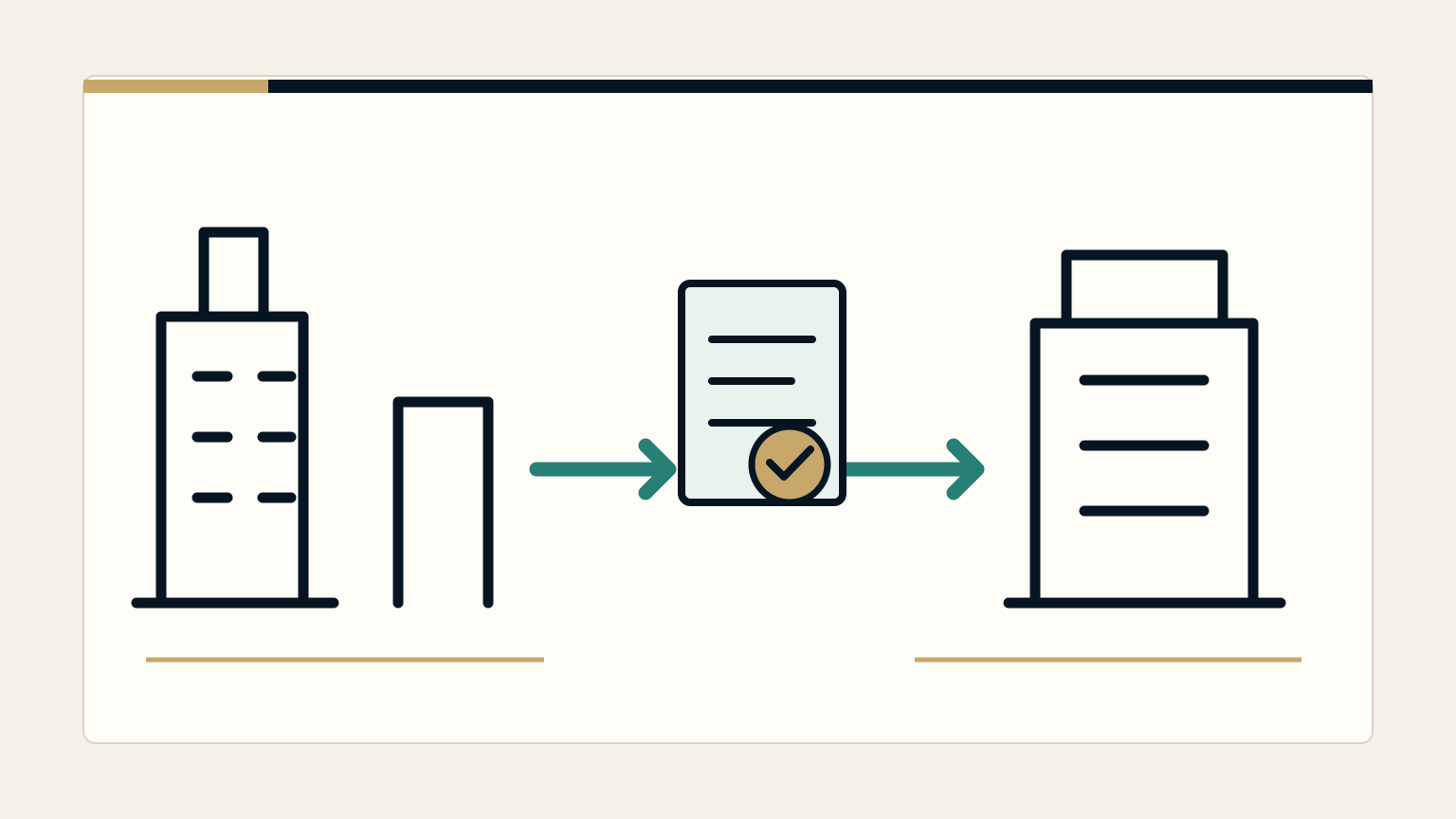
The practical question is whether an importer can connect a supply contract and the delivered product to producer-level methane monitoring, reporting and verification (MRV) evidence. The answer depends partly on when the contract was concluded or renewed. A general sustainability statement or a promise to supply later is unlikely to resolve that documentary question by itself.
What happened this week?
Reuters reported on 22 September 2026 that French President Emmanuel Macron wrote to the Commission asking for the new import requirements to be delayed by a year, to 1 January 2028, because of concerns about energy supply and legal risk for importers. According to Reuters, the Commission said it would analyse the proposal; officials had not decided to reopen the law.
A request by one government, even one supported by others, is a policy signal rather than an amendment. The published EU regulation still gives 1 January 2027 as the start of Article 28's equivalence obligation. Procurement teams should separate three documents in their files: the binding regulation, any later formal amendment, and non-binding guidance or political correspondence.
There is another source of confusion. In July 2026 the Commission issued recommendations on optional model contract clauses and on the application of penalties to importers. Reuters described the penalty recommendation as non-binding and noted that it did not amend the regulation. The Commission's own methane page also describes the two measures as recommendations. A recommendation about enforcement should therefore not be read as proof that the underlying reporting duty has vanished.
Which contracts fall under the 2027 test?
Article 28(1) of Regulation (EU) 2024/1787 says that, from 1 January 2027, importers must demonstrate and report that contracts concluded or renewed on or after 4 August 2024 for crude oil, natural gas or coal produced outside the EU cover products subject to equivalent producer-level MRV measures. The exact evidentiary route can differ: Article 28 describes producer measures with independent third-party verification and a route based on an equivalent third-country regulatory framework.
For contracts concluded before 4 August 2024, Article 28(2) uses a different standard. Importers must make all reasonable efforts to require equivalent producer-level MRV, and from 2027 they must report the results of those efforts annually. The regulation explicitly mentions contract amendment as one possible effort. An older contract is therefore not simply invisible to the rule; the required showing differs.
Article 27 already requires annual importer information under Annex IX. That annex asks, among other things, for exporter and producer identities, production and transit locations, information on measurement and verification, relevant reports and methods, and the basis for claiming equivalence. The responsible legal or compliance team should check the full annex against its own products and supply chain rather than rely on a short vendor declaration.
Why this matters to a buyer outside the EU
A non-EU producer or trader may not be the formal importer, yet an EU customer may need data from that upstream party to complete its filing. The commercial friction can appear before the legal deadline: a tender may ask for the producer's name, origin, methane report, verification method and a contract clause allocating responsibility for missing records.
This is an operational inference, not a claim that every shipment needs the same certificate. The required pathway depends on the product, the contract date, the producer's system, the producing country's framework and decisions by the relevant national authority. A buyer should avoid treating one familiar logo, voluntary membership or generic emissions figure as automatically sufficient.
The distinction also affects resales and blended supply. When a cargo moves through intermediaries, the EU importer still needs to understand what was produced where and which producer-level evidence supports the product placed on the EU market. If a supplier cannot identify the producer or explain the chain of custody, that is a question to resolve before fixing a delivery window. It does not, by itself, establish non-compliance or fraud.
A workable contract and evidence checklist
- Record the original contract date, every renewal date and the products covered; ask counsel which Article 28 pathway applies.
- Identify the actual producer, exporter, origin and transit route for the material expected under the contract.
- Request the latest relevant methane MRV report, verification details and quantification method, then map each item to Annex IX.
- State who must supply updated data, in what format, by when, and what happens if the producer or origin changes.
- Preserve a written record of requests and follow-ups, especially for pre-August 2024 contracts where reasonable efforts matter.
- Check whether the competent authority has issued local filing instructions and whether a third-country equivalence decision or other applicable route changes the evidence needed.
- Recheck any announced delay against the Official Journal or an amended legal text before changing internal deadlines.
The same discipline applies to other documentation-heavy trade decisions. Our EU–Philippines trade preparation guide distinguishes a negotiated agreement from an operative trade preference. Our CBAM supplier-data checklist focuses on getting usable information from counterparties before a filing deadline arrives.
The decision for procurement teams
There is a genuine policy debate about timing and energy security. Buyers should follow it closely. But as of 26 September 2026, a French request and Commission recommendations are not a published postponement of Article 28. The useful move now is a contract-by-contract evidence inventory, with legal review of gaps and a way to update the plan if the law changes.
Treat the 2027 date as a planning baseline, not as a prediction that enforcement will be identical in every EU country. That keeps commercial discussions specific: which producer, which contract, which evidence, which authority and which delivery period?
ONE DISCOVERY VIEW
A request for delay is a planning signal. The current legal text remains the baseline until a formal change is published.
Sources
Make documentation part of the sourcing decision before a deadline or delivery window closes.
Contact One Discovery