
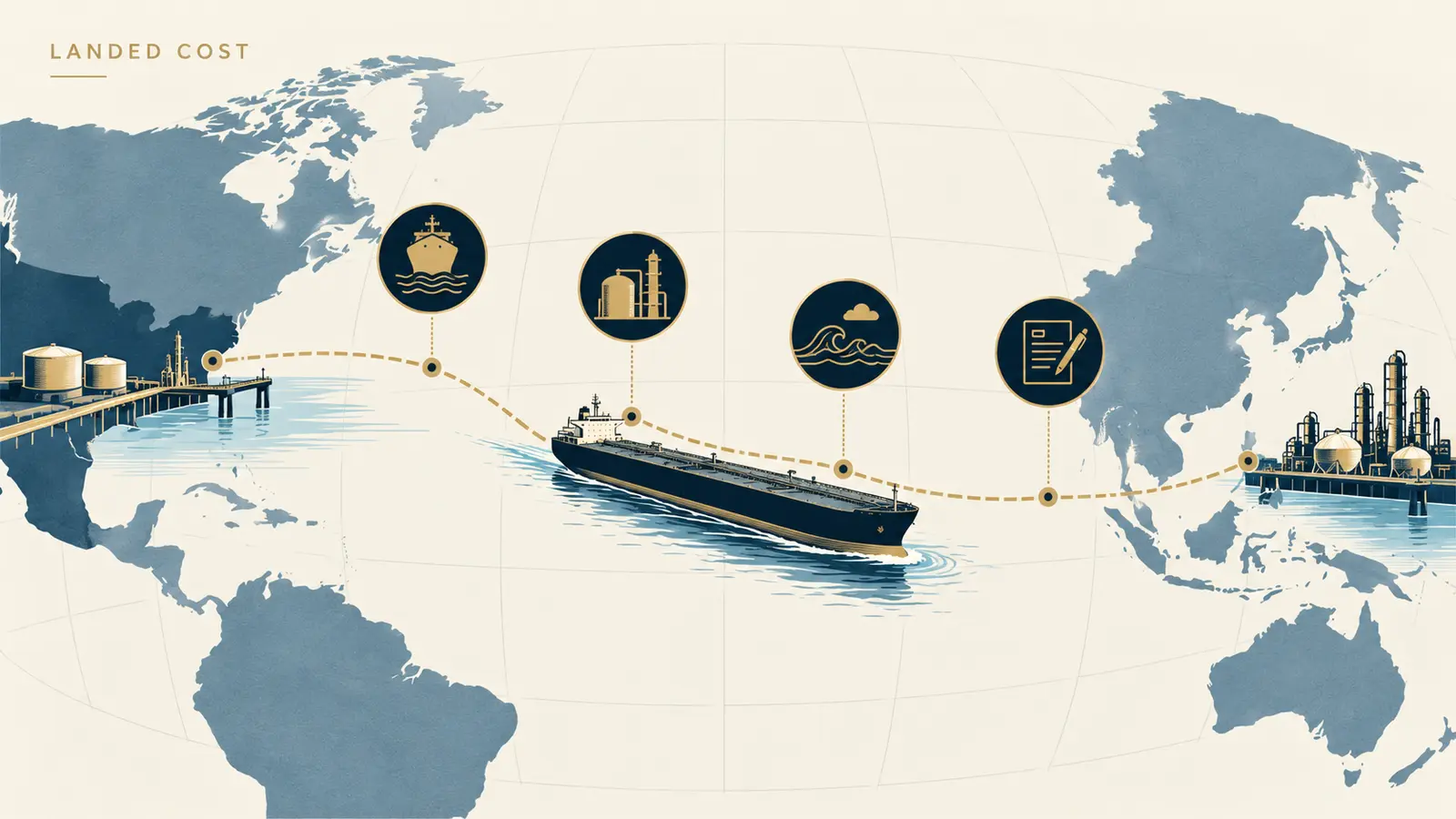
Asian refiners comparing U.S. crude with Middle Eastern or Latin American grades now need to treat freight as a first-order sourcing variable, not a line item added after the barrel price. Reuters reported on 9 October that the cost of chartering a very large crude carrier for a two-million-barrel U.S. Gulf Coast-to-China voyage had reached a level that closed the usual arbitrage for some buyers.
That does not mean U.S. crude has stopped moving or that every Asian buyer should change origin. U.S. Energy Information Administration data released on 7 October still showed 4.112 million barrels per day of U.S. crude exports for the week ended 2 October. The practical conclusion is narrower: a headline export volume does not prove that a specific long-haul cargo is commercially workable for a particular refinery and delivery window.
What changed in the delivered-cost comparison
The Reuters report said tanker freight had risen sharply as longer and less efficient routes absorbed vessel capacity. A VLCC voyage carrying roughly two million barrels from the U.S. Gulf Coast to China was quoted at about $80 million for November loading. That figure came from market participants and shipbroking data reported by Reuters; it is a current market observation, not a One Discovery offer or forecast.
The effect is easy to understand even without relying on a single spot quote. When freight rises faster than the difference between crude grades, a nominally cheaper barrel at the loading port can become more expensive at the refinery gate. Timing also matters: a longer voyage ties up working capital, increases exposure to demurrage and raises the cost of replacing a delayed cargo.
Official EIA data provides useful context but should not be over-read. Weekly U.S. crude exports were 4.112 million barrels per day for the week ended 2 October, up from 3.775 million barrels per day the previous week. Weekly estimates are volatile and cover all destinations. They show that export capacity remains active; they do not establish the economics, destination, quality or availability of a proposed shipment.
Why origin switching is not a simple substitution
Reuters reported that some Asian refiners were looking more closely at Middle Eastern and Latin American alternatives as U.S.-Asia freight became harder to absorb. That is a commercial response, but changing origin requires more than comparing FOB prices.
Refinery fit comes first. Crudes differ in density, sulfur, yield pattern and contaminants. A replacement barrel can change the value of the products a refinery produces, its hydrogen requirement, blending needs and operating constraints. The relevant comparison is therefore the refinery-specific netback or margin after freight, quality adjustments, financing and expected product yields—not the headline crude differential alone.
Route resilience is the second issue. The International Energy Agency has recently warned that oil-market pressure remains acute and that refined-product flows are still constrained even as Middle Eastern crude exports recover. Its broader energy-security work also emphasizes that Asian importers remain exposed to major maritime chokepoints. One Discovery inference: buying a geographically closer barrel may reduce voyage distance, but it does not automatically remove route, insurance or disruption risk.
Earlier One Discovery analysis on VLCC orders and longer oil routes explains why additional ships do not immediately create available capacity. Our review of crude-origin diversification also shows why freight must be assessed together with refinery fit and compliance.
A buyer checklist for long-haul crude offers
Before treating any U.S.-to-Asia offer as executable, procurement and trading teams should test the whole delivered-cost chain:
- Confirm the pricing basis. Identify the benchmark, differential, pricing dates, quality adjustments and whether freight is fixed, floating or buyer-nominated.
- Rebuild the voyage economics. Use the intended load port, discharge port, vessel class, laycan, canal or routing assumptions, expected port costs and realistic demurrage terms.
- Check refinery compatibility. Compare API gravity, sulfur, total acid number, metals and expected yields with the refinery's actual operating envelope.
- Verify logistics evidence. Confirm terminal access, nomination status, vessel acceptance process, loading window and the party responsible for each document.
- Stress-test delay and diversion. Model a slower voyage, higher insurance, a missed laycan and an alternative discharge port before approving the cargo.
- Separate market data from an offer. A published freight assessment or national export statistic is not proof that a seller controls a cargo, vessel or allocation.
What buyers should ask suppliers now
A serious comparison should use a common delivered-cost worksheet for every origin. Ask suppliers to provide the exact crude grade, load terminal, quantity tolerance, laycan, Incoterm, pricing mechanism and documentary sequence. If the seller controls freight, request the vessel-nomination process and the assumptions behind the freight component. If the buyer controls freight, obtain current indications from more than one broker or owner.
The same discipline applies to alternative origins. A shorter route can still be unattractive if the grade reduces refinery yields, the loading program is uncertain or payment terms create excessive exposure. Conversely, a long-haul cargo can remain workable when quality value, contractual flexibility or supply diversification offsets freight.
The practical takeaway
The current tanker market is not a signal to abandon U.S. crude. It is a signal to stop treating origin and freight as separate decisions. The best cargo is the one that fits the refinery, survives a realistic voyage calculation and arrives under terms the parties can document and execute.
For buyers, the immediate action is to refresh delivered-cost comparisons using current freight, not last month's assumptions. For suppliers and intermediaries, the priority is to present verifiable cargo details and a transparent logistics basis rather than quoting a headline differential without the route economics.