
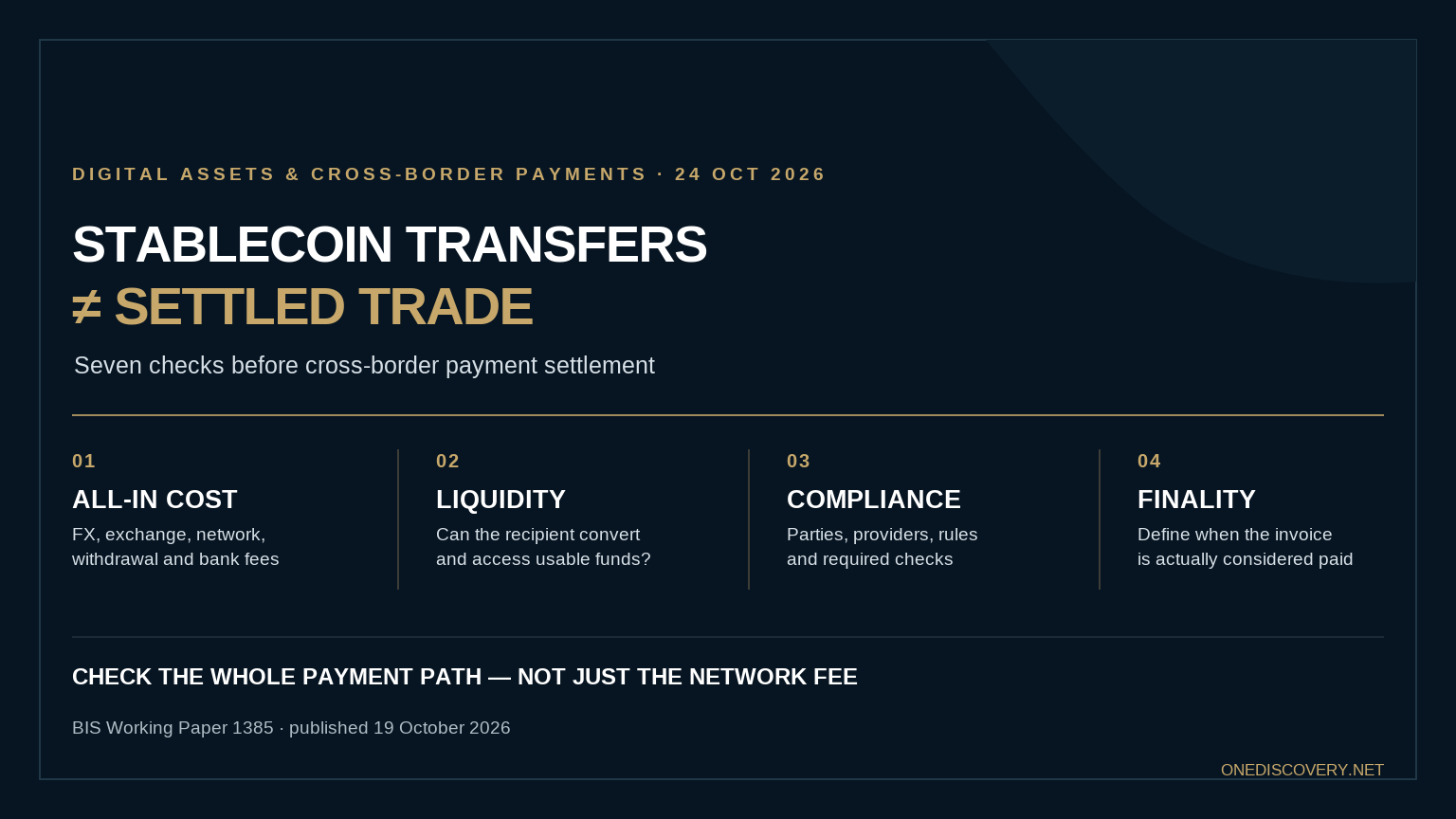
Stablecoins can move value between digital wallets, but they do not remove the hard parts of cross-border settlement. A recipient may still need to convert the token, find liquidity, use an exchange or other intermediary, and wait for a bank withdrawal. A blockchain confirmation is not, by itself, proof that a supplier has been paid under the contract.
That distinction matters in commodity and international trade, where timing, currency conversion, compliance and responsibility for a failed payment can matter as much as the transfer fee.
What the latest research says
On 19 October 2026, the Bank for International Settlements (BIS) published Working Paper 1385, “Competing rails for crossborder payments: banks, fintechs, and stablecoins.” It compares traditional bank wires, fintech money-transfer operators and stablecoin-based transfers. The authors find that stablecoin routes still involve fiat-to-token and token-to-fiat conversions, intermediary costs and potential delays before recipients can access funds in bank accounts. They also note that liquidity between US-dollar stablecoins and non-US currencies is generally thin.
The paper reports foreign-exchange markups of roughly 2% to 4.7% in its small sample of bank transactions, before explicit wire fees. That is not a benchmark for every trade payment. It illustrates why buyers should compare the full cost of each route using the same currency pair, amount, timing and destination.
The Financial Action Task Force (FATF) separately highlighted illicit-finance vulnerabilities linked to stablecoin transfers between unhosted wallets and to cross-chain activity that may be difficult for issuers to control. These findings do not make every wallet transfer suspect; they reinforce the need to understand the parties, intermediaries and applicable rules.
Seven checks before using a stablecoin for a trade payment
1. Match the legal parties and beneficiary
Confirm the exact legal names of the contracting parties, invoice issuer, payer and beneficiary. Check that the payment instructions match the signed contract and the entity that is actually entitled to receive funds. Verify any change through a previously established contact channel—not only a new email, chat account or phone number supplied with the change.
2. Define the token and network precisely
Record the accepted asset and network in the contract or approved payment procedure. Confirm supported networks and deposit requirements through the provider’s official documentation. Similar token names or ticker symbols do not prove that two assets are interchangeable. A transfer sent on an unsupported network may be delayed, unrecoverable or subject to a separate recovery process.
3. Calculate the all-in cost
Compare more than the blockchain transaction fee. Include the fiat-to-token conversion spread, exchange trading charges, network fee, any intermediary fee, token-to-fiat conversion, withdrawal charges and the recipient bank’s fees. Capture the quote time and expiry, and state which party bears each cost. A low on-chain fee can be outweighed by conversion or cash-out costs.
4. Test liquidity and the exit route
Confirm that the recipient can lawfully and practically convert or use the asset in the relevant jurisdiction. Check liquidity for the intended amount and currency pair at the time of the quote, not only the displayed price for a small trade. A token designed to track a currency does not guarantee that every exchange or off-ramp will provide immediate conversion at par. Agree a fallback if liquidity or withdrawal access changes.
5. Check the compliance perimeter
Identify the service providers, jurisdictions and entities involved in the payment path. Confirm applicable anti-money-laundering, sanctions, licensing and reporting requirements with qualified compliance advisers. Rules differ by country and by the role performed by each provider. Do not route a payment through an unrelated person or private wallet to avoid screening, documentation or a provider’s controls.
Regulatory implementation is also evolving. For example, the U.S. Treasury issued a proposed rulemaking on 17 August 2026 concerning payment-stablecoin issuance, offering and sale under the GENIUS Act. That is a U.S.-specific proposal, not a universal rule for international trade. Check the current requirements in every relevant jurisdiction before approving a route.
6. Agree what counts as payment
The contract should specify the accepted asset and network, the exchange-rate source and timing, the required confirmation standard, the party responsible for fees, and the point at which the invoice is considered discharged. Address what happens if a transfer is delayed, frozen, rejected by an exchange, sent to an unsupported network or received but not convertible. The legal effect depends on the contract and applicable law; an on-chain event does not automatically settle every commercial obligation.
7. Verify evidence and the recovery path
Reconcile the transaction record to the invoice: asset, amount, timestamp, network and recipient account should match the agreed instructions. Use the provider’s official transaction records and independently verified contact channels. A screenshot, screen-share or displayed wallet balance is not proof by itself of asset ownership, authority to sell, or cleared payment.
Before releasing goods or documents, agree who handles a delayed credit, rejected deposit, compliance hold or dispute. Set an escalation contact and preserve the transaction reference and relevant records. If a controlled test transfer is part of an approved process, define it in writing and complete independent counterparty checks first.
Red flags that should pause settlement
- Payment instructions change shortly before funds are sent, without independent confirmation.
- The counterparty asks to use a different token or network from the one in the contract.
- A “zero-fee” or guaranteed instant cash-out promise is not supported by a written, all-in quote.
- Someone asks the parties to skip compliance checks or route payment through an unrelated individual.
- A screenshot or screen-share is presented as the only evidence of funds, ownership or authority.
If any of these appear, pause and verify through established channels. Do not let a short deadline replace independent checks.
Compare payment routes on the same basis
Before approval, compare a bank wire, a regulated payment provider and a stablecoin route for the same corridor, amount and settlement window. Record the all-in cost, recipient access time, compliance requirements, failure handling and contractual recognition of payment. The BIS research is a useful reminder that the cheapest-looking rail is not always the cheapest usable route.
For the counterparty and document checks that should happen before any payment method is chosen, see our commodity supplier-offer verification checklist.
Stablecoins may be one available payment rail, but the risk moves across conversion, liquidity, compliance and contract design. Treat the blockchain transfer as one step in the payment chain—not the whole settlement.
Sources
- Bank for International Settlements — “Competing rails for crossborder payments: banks, fintechs, and stablecoins,” Working Paper 1385, 19 October 2026.
- Financial Action Task Force — “Targeted report on Stablecoins and Unhosted Wallets: Peer-to-Peer Transactions,” 3 March 2026.
- U.S. Department of the Treasury — Proposed rulemaking on payment stablecoins under the GENIUS Act, 17 August 2026.
Market information only; not legal, financial, tax or compliance advice. Verify current local rules, provider terms and transaction documents independently before using a payment rail.