
The signal: a border bottleneck, not a confirmed mine shutdown
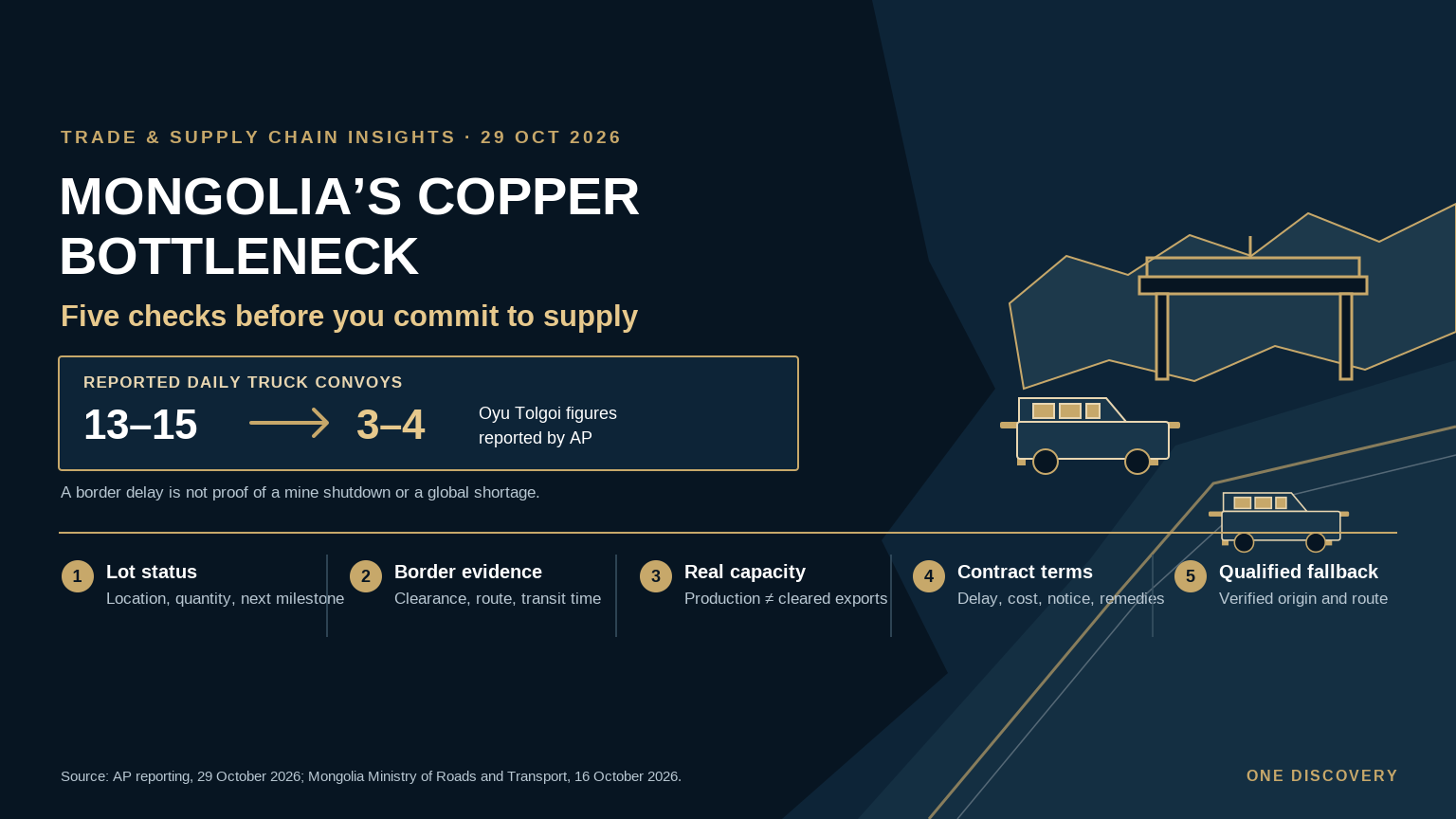
On 29 October, the Associated Press reported that Oyu Tolgoi said copper concentrate exports from Mongolia to China had fallen by about 70% over the previous two weeks. Daily truck convoys crossing the Gashuunsukhait–Ganqimaodu border point had dropped from around 13–15 to three or four. The report attributes the slowdown to infrastructure and technology upgrades on the Chinese side. Mongolian officials told AP they knew of no political motive.
That is a material logistics signal for buyers who rely on this corridor. It is not, by itself, proof that the mine has stopped producing, that every contracted shipment is delayed, or that the global copper market has moved into a structural shortage. The distinction matters: a border bottleneck can delay exportable material even when mining and stockpiling continue.
What the report confirms—and what it does not
The latest numbers are company-reported figures carried by AP, not a customs dataset covering every copper shipment. They describe truck movements over a recent two-week period. They should be treated as a warning to verify specific cargoes, not as a universal delivery forecast for all Mongolian copper.
The operational chain is longer than the mine gate. Concentrate must be produced to specification, sampled and assayed, stockpiled, loaded, transported, cleared at the border, accepted by the next logistics or smelting stage, and moved onward under the relevant contract. A delay at one interface can change arrival timing and working capital without changing the underlying grade or the mine’s production capacity.
For buyers, the first task is to establish where a named lot is now, which step it has completed, and what evidence supports the next milestone. “The mine is operating” and “the cargo can be delivered on the contracted date” are different statements.
Five checks before committing to copper supply
1. Confirm the status of the specific lot
Ask for a shipment-level status with a date and a responsible party: produced, sampled, stockpiled, loaded, dispatched, presented at the border, cleared, or delivered to the next facility. Match the lot reference to the assay, weight records, packing or transport documents and the contractual quantity. Do not accept a general production update as evidence that a specific parcel has been allocated to you.
If the material is still inland, ask for the realistic loading window and the conditions that must be met before dispatch. If it is already at the border, request the latest documented clearance status and the party responsible for resolving any hold.
2. Verify border and route evidence
Confirm the exact crossing, transporter, planned crossing date and current transit estimate. Ask which documents are already accepted and which remain outstanding. For a delay, distinguish a queue or processing issue from a customs hold, missing permit, documentation discrepancy or a transport-equipment constraint. Those problems require different remedies.
Do not assume a nearby crossing or alternate route is a ready substitute. A route change can require new permits, transport capacity, handling arrangements, insurance terms and customer approval. Before pricing an alternative, obtain evidence that the route is legally usable and operational for the cargo type, not merely that a road or rail line exists.
3. Separate mine output from export capacity
Ask the supplier to distinguish production, available stock, committed volume, dispatched tonnage and cleared exports. Each number describes a different stage. A producer can continue mining while the amount crossing a border temporarily falls; conversely, a high stockpile does not guarantee that it can be moved during the buyer’s delivery window.
Use dated figures and define the measurement period. For concentrate, also confirm moisture, grade, sampling and assay procedures, because the commercial quantity and payable-metal calculation depend on the contract and the accepted quality data. Avoid translating a change in truck counts directly into a precise estimate of the shipment delay unless the supplier can support that calculation.
4. Recheck price, delivery and delay clauses
Keep the copper benchmark separate from concentrate-specific commercial terms, freight, insurance, handling, treatment and refining charges where applicable, and any other agreed adjustments. Do not assume a border delay automatically changes the benchmark price or creates a right to a surcharge. The written contract and applicable law determine the parties’ rights.
Review the delivery basis, shipment window, notice requirements, inspection and assay provisions, title and risk transfer, force-majeure wording, allocation of extra storage or demurrage, and the process for agreeing a revised schedule. If the supplier proposes a change, ask for the contractual basis and a documented cost breakdown before accepting it.
5. Qualify a fallback before it becomes urgent
A second origin or processor can reduce concentration risk only if it can meet the specification, volume, compliance requirements and delivery window. Confirm the legal exporter, origin and processing chain, product quality, logistics route, relevant permits and documentary trail. A broker’s claim of available tonnes is not equivalent to a verified allocation.
Compare alternatives on a like-for-like delivered basis and record what remains unconfirmed. Where no credible substitute is ready, consider whether a staged call-off, a revised arrival plan or an agreed inventory buffer is feasible under the buyer’s own storage, financing and consumption constraints.
The future rail link is optionality—not today’s workaround
On 16 October, Mongolia’s Ministry of Roads and Transport reported that construction of the Gashuunsukhait–Ganqimaodu cross-border railway project was 65% complete. The ministry said the project was planned to enter service in April 2027 and was designed for 30 million tonnes of freight capacity per year.
That is a useful medium-term infrastructure development, but it is not evidence of rail capacity available for a shipment today. The published design capacity is for the project as a whole, not a promise that a given copper concentrate lot will receive a slot. Commissioning, operating procedures, cross-border coordination, terminal transfers and cargo-specific acceptance still matter. Buyers should monitor the project milestones without using planned capacity to close a current delivery gap.
The same principle applies to any alternative logistics investment: announced capacity is not the same as tested, bookable and contractually available capacity.
Build three delivery scenarios
Use the current documented status as the base case, then model two alternatives:
- Short disruption: clearance normalises and the existing route remains workable, with a revised but supported arrival date.
- Extended disruption: border processing remains constrained, so the buyer tests additional inventory days, financing, storage, downstream schedule changes and the cost of an agreed alternative.
- Future rail availability: a later shipment may be eligible for the new corridor only after operating readiness and the cargo’s access to the route are confirmed.
Keep each assumption visible and date-stamped. Refresh the scenario when the transporter, border authority, supplier or customer provides new evidence. Do not convert a news report into an assumed delay duration or a market-price target.
What buyers should do now
- Request the status, location, quantity and next milestone for each contracted lot.
- Obtain dated evidence of the crossing, clearance position and revised transit estimate.
- Reconcile produced, stockpiled, committed, dispatched and cleared volumes.
- Review the contract before agreeing to a revised schedule, surcharge or route.
- Qualify an alternative only after its specification, authority, route and delivery window are documented.
The immediate lesson is about execution visibility. A border slowdown can matter greatly to an individual shipment while leaving the wider copper balance unresolved. Buyers are better served by tracing the lot and the next hand-off than by assuming either a mine shutdown or a guaranteed quick recovery.
For broader context on why regional location and delivery timing can matter even when global copper balances look comfortable, see our earlier copper supply-risk analysis.
Editorial note: This article summarises public reporting and government project information for general business use. It is not investment, legal or procurement advice, a supplier offer, or a delivery guarantee. Independently verify cargo status, specifications, route capacity, counterparties and contract terms before acting.
Sources
- Associated Press — Mongolian mining company says copper exports have dropped due to China border restrictions, 29 October 2026
- Mongolia Ministry of Roads and Transport — Gashuunsukhait–Ganqimaodu cross-border railway project update, 16 October 2026
One Discovery · Copper Supply Chains and Procurement · 29 October 2026