
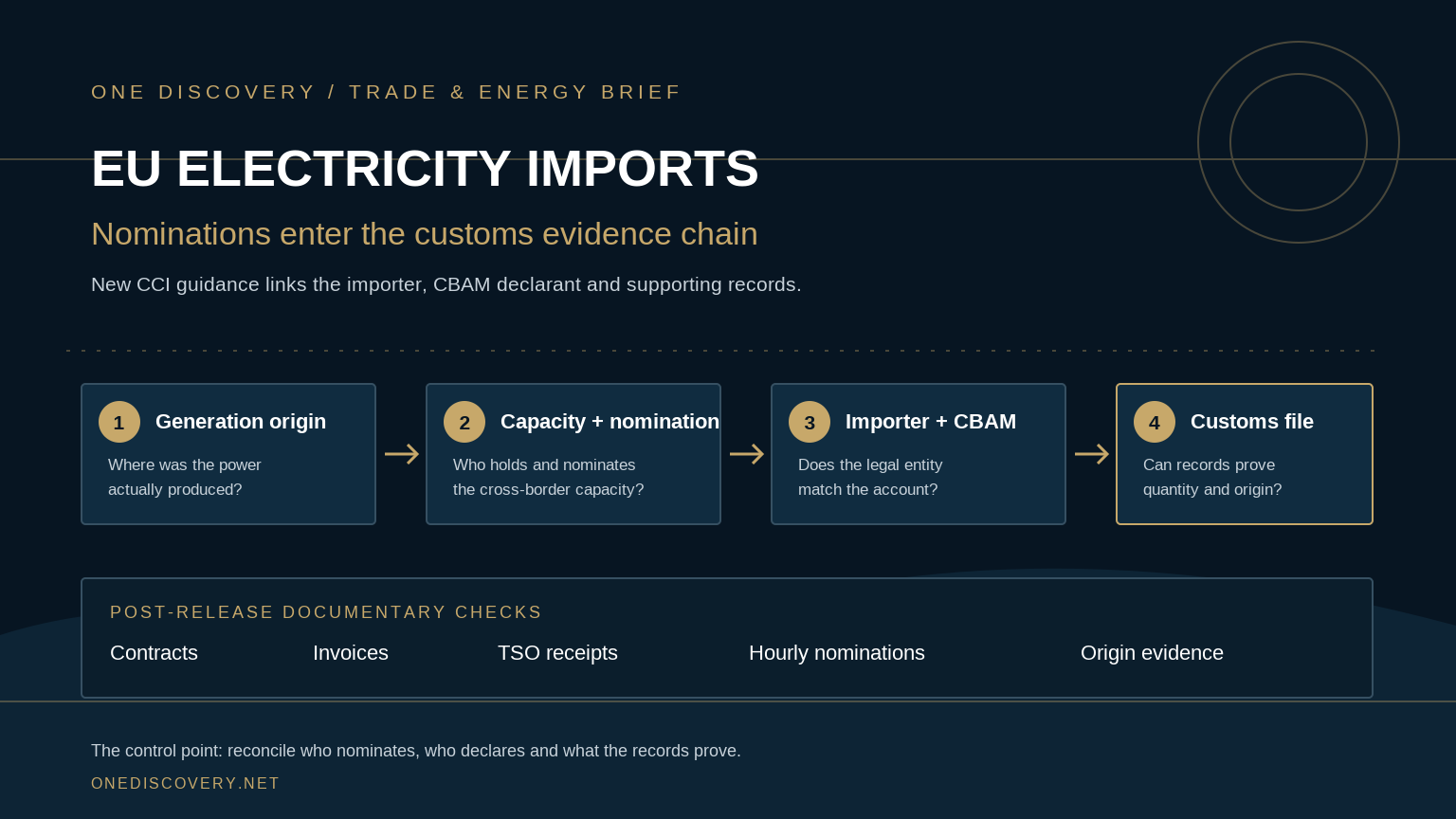
Cross-border electricity procurement in the EU now has a clearer customs evidence path. The European Commission has issued practical guidance on how electricity and natural gas moved through fixed installations should be declared and supervised under Centralised Clearance for Import (CCI). For power traders and buyers, the important change is operational: nominations, customs records, contracts and the identity of the CBAM declarant need to reconcile.
The final guidance is dated 12 October 2026 and is listed on the Commission's CCI page as a 22 October publication. The Directorate-General for Taxation and Customs Union highlighted it in a news item on 6 November. The document is explanatory rather than legally binding; the Union Customs Code, the CBAM Regulation and applicable national instructions take precedence.
Why electricity needs a different customs evidence trail
Electricity and natural gas transported by cables or pipelines cannot be physically presented to customs in the same way as a container of goods. Under the CCI model described by the Commission, the trader records the import in its own system through Entry in the Declarant's Records (EIDR), uses the applicable waiver from a presentation notification, and then submits a supplementary declaration through the CCI system.
For an operator choosing the CCI simplification, the authorisations have to fit together. The guidance says the EIDR authorisation must be granted before or at the same time as the CCI authorisation; both must have the same holder and the same supervising customs office. The operator must also hold Authorised Economic Operator status for customs simplifications (AEOC) to use CCI. These are conditions of this customs route, not a statement that every electricity trader must use CCI.
Because customs cannot physically inspect the flow at the border, supervision relies primarily on documentary checks after release. The Commission lists trader records, invoices, contracts, receipts from transmission operators and other evidence relevant to the imported quantities and origin. That makes the quality and retrievability of the transaction file a practical control point, not an administrative task to leave until an audit.
Who carries the CBAM obligation?
The guidance links the customs declarant to the authorised CBAM declarant. The entity responsible for CBAM must be the same entity that imports the electricity, submits the customs declaration and identifies the relevant CBAM account. If the CCI holder is importing in its own name, it needs the relevant CBAM authorisation. If it acts as an indirect customs representative, the importer on whose behalf it acts must hold that authorisation.
The CBAM account number must be included in the customs data using document code Y128, either in the additional reference field or among supporting documents. When the supplementary declaration is lodged, the CCI system is designed to validate the CBAM authorisation and account number through its integration with the EU Customs Single Window. Buyers should therefore check the legal entity and account identifier before the first import, rather than assume that a group company or trading affiliate can be substituted later without review.
One threshold point is easy to miss: electricity and hydrogen imports are not covered by the 50-tonne de minimis exemption introduced for certain other CBAM goods. Regulation (EU) 2025/2083 expressly excludes electricity and hydrogen from that exemption. Small electricity volumes should not be treated as automatically outside CBAM on the basis of the mass threshold.
Nominations can determine responsibility and quantity
For imports using explicit allocation of cross-border transmission capacity, the Commission's guidance gives nominations a direct compliance role. The person to whom the capacity has been allocated and who nominates it for import is treated, in that case, as the authorised CBAM declarant. The guidance connects that party with responsibility for calculating the embedded emissions of the imported electricity and surrendering the corresponding certificates.
The quantity declared for customs purposes is based on nominated electricity quantities. The guidance says quantities nominated as entering and leaving the Union customs territory during the same hour must be considered when determining what is released for free circulation. Its example is useful: if 10 MWh is nominated into the EU but only 8 MWh is intended for the Union market, the declaration covers the 8 MWh released for free circulation; the remaining 2 MWh must be supported as electricity in transit and shown to have left the customs territory.
Origin is a separate question from the route of trade. The guidance says the country of origin for electricity is the country where it was generated, even if the power is traded through another non-EU country before reaching the EU. A contract routed through an intermediary market does not, by itself, change the generating country. The Commission also distinguishes electricity that merely crosses the EU on its way to a third country from EU-generated electricity that leaves and later re-enters the Union. Those cases can have different customs and CBAM treatment, so a generic “transit” label is not enough.
Nor should a renewable-energy claim be treated as automatic proof of actual-emissions treatment. The CBAM Regulation uses default values for imported electricity unless the authorised declarant demonstrates that the specified conditions for actual emissions are met. Those conditions include firm nomination of the allocated interconnection capacity and alignment of the nominated capacity with generation over the same period, which cannot exceed one hour, alongside other requirements and independent verification.
Five procurement checks to make before closing the 2026 file
- Map every legal role. Record the generator, seller, capacity holder, nominating party, customs importer, CCI/EIDR holder and any indirect representative. Identify which entity is responsible for the customs declaration and CBAM account.
- Reconcile hourly data. Match nominations with transmission-system operator confirmations, metering or settlement records, invoices and the quantities entered in customs declarations. Keep a documented method for explaining differences.
- Separate origin from trading route. Capture the generating country independently from the country of the seller, exchange or intermediary. Retain evidence for any electricity claimed to be in transit.
- Write data access into contracts. Require counterparties to provide nomination records, transmission receipts, origin information and correction notices within defined time limits. Include audit cooperation, record-retention and change-of-importer procedures.
- Validate the customs and CBAM identifiers. Confirm that the authorised declarant, CBAM account number, Y128 reference and CCI/EIDR authorisations match before release. Do not rely on a group-wide assumption that the entities are interchangeable.
What the timing means for power buyers
Imports made during 2026 still feed into the first annual CBAM declaration for that year. The first declaration and certificate surrender are due by 30 September 2027, while the Commission says certificates for 2026 imports will be available for purchase from February 2027. The gap between the import and settlement dates is a reason to preserve transaction evidence as each delivery occurs, not reconstruct it next year.
Separate changes to the wider CBAM framework remain in the EU legislative process. White & Case's 10 November 2026 review notes that the proposed electricity-related amendments have not yet completed that process. Procurement teams should distinguish enacted requirements from proposals and avoid rewriting a live contract around a change that is not yet law.
The practical takeaway is straightforward: for cross-border power, the contract, nomination, customs declaration and CBAM account must describe the same transaction. The new guidance gives traders a more consistent reference point, but it does not replace the need for entity-level checks, reliable hourly records and advice on the rules applicable in the Member State concerned. For a broader look at supplier evidence under the mechanism, see our earlier EU CBAM supplier-data checklist.
Sources
- European Commission — New guidance on electricity imports under Centralised Clearance for Import (CCI), 6 November 2026
- European Commission — Guidance for import of electricity and natural gas under CCI, final version 12 October 2026
- EUR-Lex — Regulation (EU) 2025/2083 amending the Carbon Border Adjustment Mechanism
- EUR-Lex — Regulation (EU) 2023/956 establishing the Carbon Border Adjustment Mechanism
- European Commission — CBAM certificate price and 2026–2027 purchase timing
- White & Case — Taking stock of EU carbon pricing reform: focus on the ETS and CBAM, 10 November 2026
Market information only. This article is not legal, tax or compliance advice. Verify current EU and national requirements, authorisations and contractual responsibilities with qualified advisers before acting.