
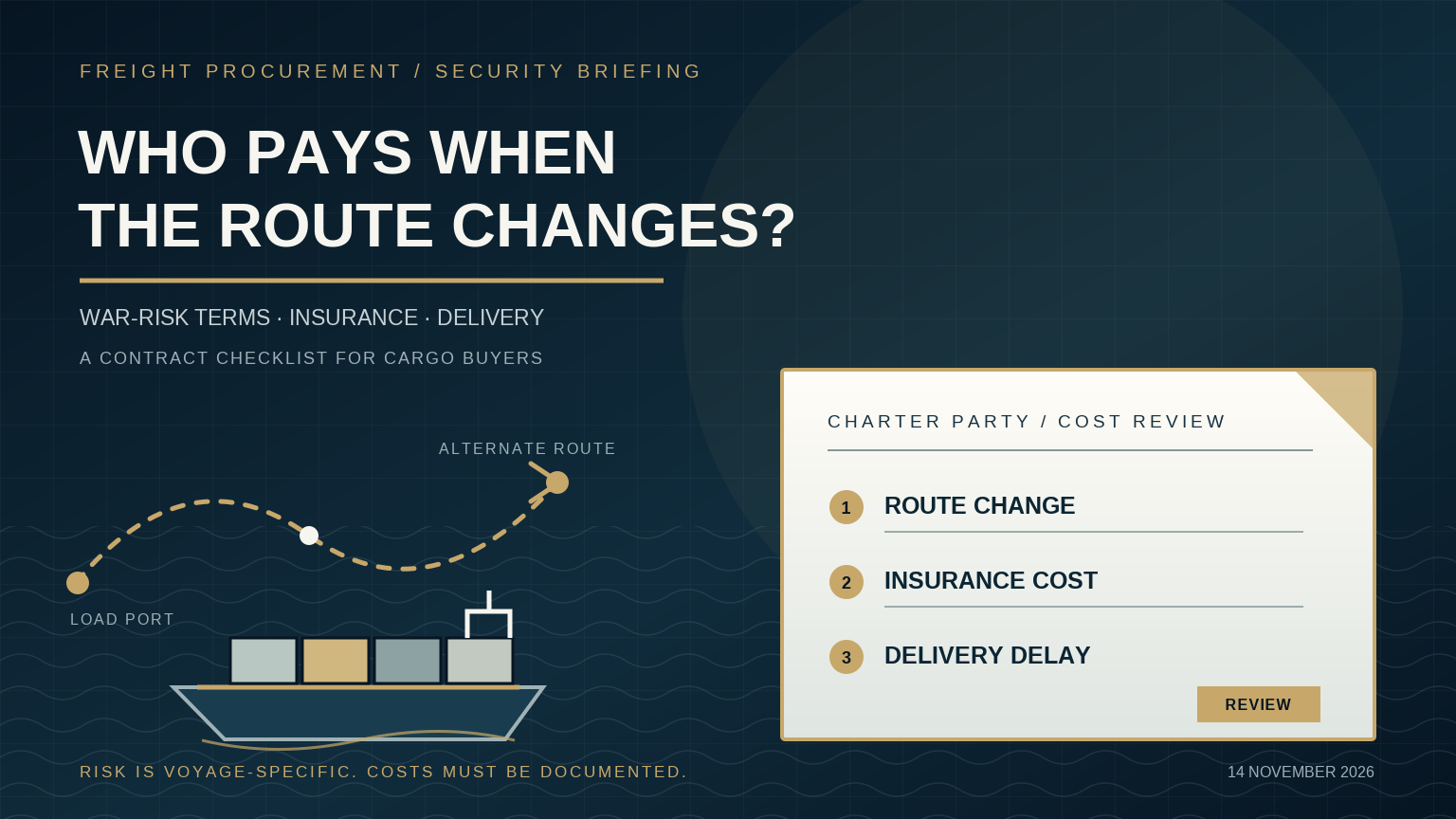
Maritime security is now a freight-contract issue as much as a routing issue. On 11 November 2026, the International Maritime Organization (IMO) said it had verified more than 130 attacks on internationally trading commercial vessels in the Strait of Hormuz since 28 February, with at least 25 seafarers killed and others missing or injured. At its 2–6 November Council session, the IMO separately condemned attacks on merchant shipping in the Red Sea and Bab el-Mandab and in the Black Sea. It also noted 17 attempted and actual piracy or armed-robbery incidents in the Western Indian Ocean and Gulf of Aden region since the start of 2026.
These are distinct maritime theatres, not one uniform risk zone. For importers, commodity buyers and freight procurement teams, the commercial question is specific: who can change the route, what evidence supports additional charges, how is delay treated, and who carries the cost if a vessel cannot complete the planned voyage?
On 13 November, Reuters reported that Iran’s Revolutionary Guards navy said an LNG tanker had struck a mine in the Strait of Hormuz. Reuters said vessel details were not immediately available. The statement should be treated as an attributed report, not as a confirmed identification of the vessel or a verified account of the incident.
Buyer takeaway: Do not price a regional headline as a universal surcharge. Confirm the voyage-specific risk, the signed war-risk clause, the applicable insurance terms and the evidence required for each additional cost.
Why the charter-party wording matters
BIMCO’s War Risks Clause for Voyage Charter Parties 2025 (VOYWAR 2025) is a useful reference because it addresses risk that can emerge before loading or while a voyage is under way. The clause defines war risks broadly, including actual, threatened or reported hostilities, mines, piracy, terrorism, malicious damage and blockades. It provides a mechanism for an owner to elect an alternative route where the master or owner reasonably judges that the vessel, cargo or crew may be exposed to war risks.
Under the model clause, a route change can trigger a freight adjustment based on estimated time and expenses incurred or saved, supported by the owner’s documentation. It also distinguishes the owner’s annual war-risk premiums from specified additional insurance costs that charterers may have to reimburse when a vessel proceeds to, through or remains in an exposed area. The owner is required to notify the charterer of insurance costs as soon as practicable and, if possible, before entering the area.
Those provisions do not automatically apply to every shipment. They matter only if the relevant charter party incorporates them, and amendments can materially change the result. Voyage-charter and time-charter clauses are also not interchangeable. BIMCO’s March 2026 guidance advises owners and charterers to review existing and future terms and cautions that increased risk, expense or commercial undesirability does not by itself make a force-majeure clause a general risk-allocation mechanism.
Five checks before you commit freight
- Make the risk assessment voyage-specific. Ask the carrier or freight forwarder for the planned route, expected transit window, known alternative ports and the process for reviewing security information before loading and during the voyage. Record the date of the assessment and the source used. A regional headline is not a substitute for a current assessment of the particular vessel, route, port call and cargo.
- Read the exact clause in the signed contract. Confirm whether the shipment is under a voyage or time charter, which war-risk clause edition is incorporated, and whether it has been amended. Check the owner’s rights to refuse an order, cancel, deviate or request alternative orders; the safe-port nomination process; notice channels and deadlines; and how a route change affects freight. Do not assume that a standard BIMCO clause is present merely because a broker or counterparty refers to it.
- Separate the insurance layers and the extra costs. Request written confirmation from the relevant insurer or broker about the cover applicable to the vessel and cargo, including the trading area, duration, limits, deductibles, exclusions and notification requirements. Distinguish the vessel’s annual premium from an additional war-risk premium or any additional kidnap-and-ransom cover. Check whether a proposed charge is supported by the policy, the charter-party wording and evidence of the amount incurred. Do not assume that hull, P&I or cargo insurance automatically covers delay, every form of loss or every additional expense.
- Price the deviation and the delay, not just the premium. Model the financial effect of a longer route, alternative discharge port, extra bunkers, port and terminal charges, transshipment, storage, demurrage, missed production windows and working-capital delay. Under VOYWAR 2025, the model freight adjustment is based on estimated time and expenses incurred or saved and must be supported by documentation. Your purchase contract or booking note may use different terms, so reconcile the actual documents before accepting a surcharge.
- Align notices and responsibilities across the chain. Make sure the sale contract, purchase order, booking confirmation, charter party and insurance instructions do not create conflicting delivery or notice obligations. Identify who informs the buyer, who can approve a substitute port, who updates the consignee and who preserves the evidence for an additional-cost claim. Review force-majeure language separately from war-risk and deviation provisions; one should not be treated as a substitute for the others. Safety decisions by the master and the protection of crew should not be reduced to a buyer’s delivery instruction.
What buyers should monitor now
As of 14 November 2026, the latest IMO public update reviewed for this briefing is its 11 November statement on the Strait of Hormuz. The IMO Council’s November session also makes clear that security exposure is not limited to one chokepoint: the Red Sea, Bab el-Mandab, Black Sea, Gulf of Aden and Western Indian Ocean each require their own current assessment.
Do not apply a blanket war-risk premium to every shipment or assume that a route is safe because a previous voyage completed. Ask for a voyage-specific explanation, verify the contractual basis for each additional charge and keep a dated record of notices, insurer guidance and revised delivery instructions. For broader freight planning, see One Discovery’s November container-freight contract checklist and cargo-securing buyer checks.
Sources
- IMO — Secretary-General calls on States to enforce maritime rules in the Strait of Hormuz (11 November 2026)
- IMO — Council, 138th session: maritime security challenges (2–6 November 2026)
- BIMCO — War Risks Clause for Voyage Charter Parties 2025 (VOYWAR 2025)
- BIMCO — Remember the BIMCO War Risks Clauses (3 March 2026)
- Reuters — Iran says tanker carrying LNG hit mine, suffered explosion in Hormuz (13 November 2026)
- Associated Press — EU naval patrol and rising piracy concerns in the Gulf of Aden (November 2026)
General market and procurement information only; not legal, insurance, security or maritime advice. Confirm the current voyage assessment, policy wording and signed contractual terms with the carrier, insurer, P&I club and qualified advisers before acting.