
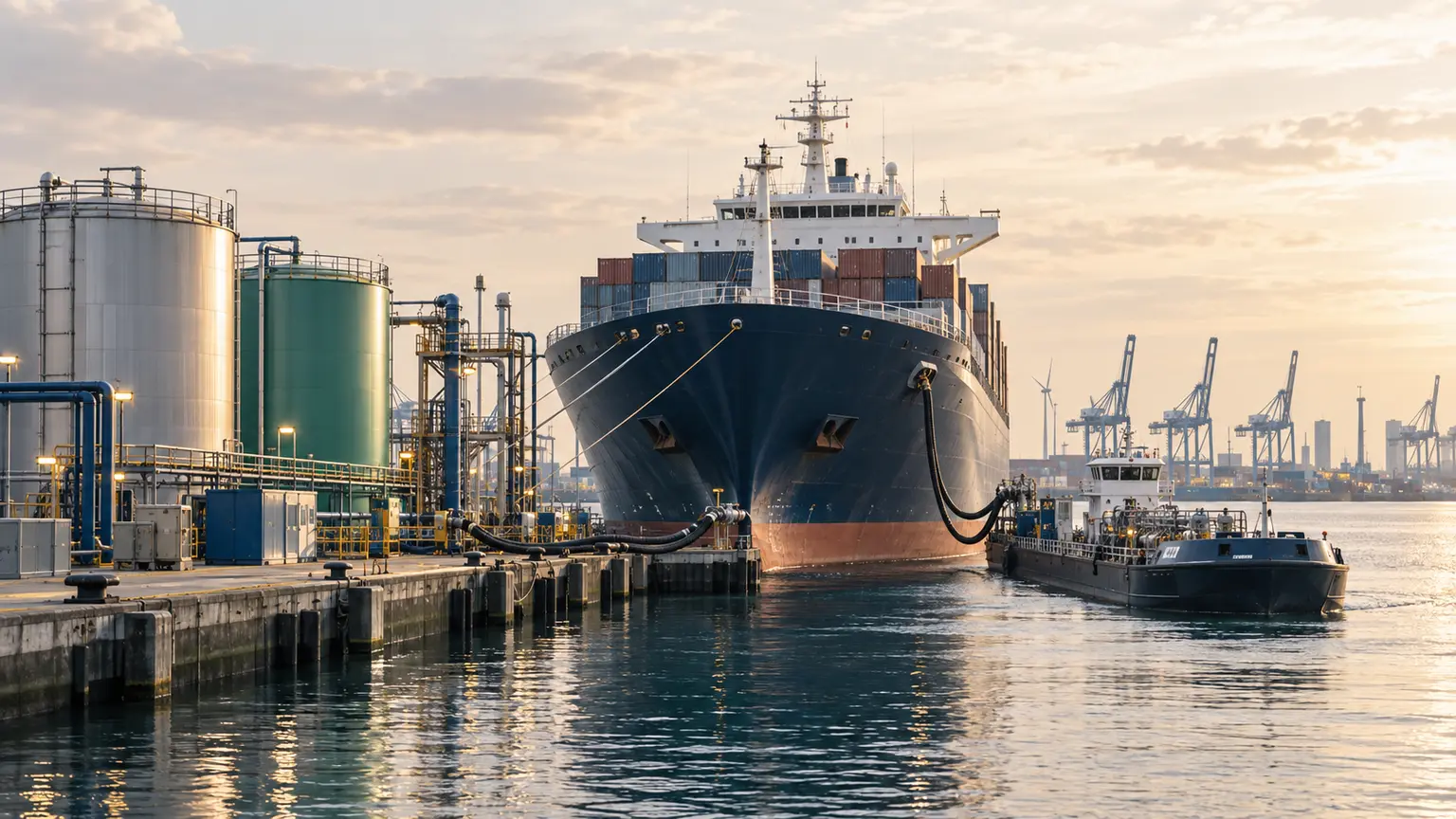
Marine biodiesel briefly became cheaper than conventional marine gasoil in Rotterdam this week, even before every regulatory benefit was counted. The Financial Times reported Argus data showing biodiesel at a record low of $985 per tonne on Monday before a rebound to $1,240, while marine gasoil reached $1,528.50 per tonne.
For ship operators and cargo buyers, the important development is not a single price print. It is the reversal of the usual assumption that a lower-carbon fuel must carry a premium. The right procurement response is to compare the total voyage economics—fuel, EU carbon exposure, FuelEU treatment, technical suitability and confirmed bunker availability—rather than selecting a product from the headline price alone.
Why the Rotterdam comparison changed
The Financial Times said biodiesel producers had reduced prices to support sales and help meet European emissions targets, while disruption affecting conventional diesel supply pushed marine gasoil higher. Rotterdam is a major bunkering and biofuel-production centre, so the spread there is commercially significant, but it should not be treated as a universal delivered price.
Port, delivery date, volume, blend, feedstock, sustainability certification and counterparty can all change the executable number. The reported low was also short-lived: the same article said biodiesel had already rebounded to $1,240 per tonne. That volatility is a reminder to date-stamp every comparison and confirm how long an indication remains valid.
The market signal is still meaningful. When the prompt price of a qualifying alternative fuel approaches or falls below the conventional benchmark, carbon-related costs can strengthen the alternative-fuel case instead of merely narrowing its premium.
EU rules now belong inside the fuel calculation
The European Commission says FuelEU Maritime has applied fully since 1 January 2025. It sets annual limits on the greenhouse-gas intensity of energy used by ships above 5,000 gross tonnage calling at European ports. The calculation uses a well-to-wake basis and covers carbon dioxide, methane and nitrous oxide, rather than looking only at emissions from combustion onboard.
FuelEU begins with a 2% reduction in greenhouse-gas intensity for 2025 and becomes progressively stricter. It is goal-based and technology-neutral, which means operators can choose the compliance strategy that fits a vessel and its operating profile. A fuel's value therefore depends on its verified lifecycle characteristics and the way it affects the ship's annual compliance position.
The EU Emissions Trading System adds a separate cost layer. Maritime emissions have been included since January 2024. The Commission states that companies must surrender allowances for 70% of emissions reported in 2025 during the 2026 phase-in, rising to 100% from 2027. Methane and nitrous oxide also enter the maritime ETS scope from 2026.
These rules do not create one standard “carbon discount” for every biodiesel cargo. The result depends on route scope, fuel pathway, verified emission factors, documentation and the operator's wider compliance position. Procurement and compliance teams need to use the same assumptions before comparing offers.
Why a cheaper quote may still fail operationally
The specification must match the vessel
Biodiesel can often be used in existing engines, but compatibility is not automatic. Confirm the fuel standard, blend level, storage stability, cold-flow properties, material compatibility and original-equipment-manufacturer guidance. The operator should also align fuel handling, sampling and onboard segregation procedures before delivery.
Sustainability evidence carries economic value
The commercial benefit relies on more than the product name. Buyers should verify the feedstock pathway, certification scheme, chain-of-custody evidence and greenhouse-gas data required for the intended regulatory treatment. Missing or inconsistent evidence can reduce the expected compliance value even when the physical fuel is usable.
Availability must match the bunkering window
A record market assessment does not prove that the required quantity is available at a particular berth and time. Obtain a firm indication covering product, volume, delivery mode, terminal or barge availability, lead time and cancellation terms. If a voyage depends on one port, model the cost of delay or a conventional-fuel fallback.
How buyers should compare marine-fuel options
A practical evaluation should use a common delivery basis and document each adjustment. At minimum, compare:
- the firm bunker price, currency, validity and delivery charge;
- energy content and expected consumption on the planned voyage;
- EU ETS exposure for the route and reporting period;
- FuelEU greenhouse-gas intensity and verified compliance treatment;
- specification, blend, engine and storage compatibility;
- sustainability certificates and chain-of-custody documents;
- confirmed physical volume and bunkering window; and
- the operational cost of delay, deviation or fallback fuel.
This comparison should be run again when the bunker date approaches. Fuel spreads and carbon allowances move, while availability can tighten independently of the published market. One Discovery's oil and diesel procurement analysis provides additional context on why crude and refined-product economics can diverge. The VLCC route-capacity insight explains how longer voyages can raise the value of fuel efficiency and reliable delivery.
The procurement conclusion
The Rotterdam reversal is evidence that regulation, feedstock supply and fossil-fuel disruption can change the fuel ranking quickly. It is not proof that biodiesel will remain cheaper in every port or for every vessel.
The strongest buying decision combines three tests: Is the fuel economically attractive after compliance costs? Is it technically and documentarily acceptable? Can the required volume be delivered inside the operational window? Only when all three answers are supported should a lower headline price be treated as executable value.
ONE DISCOVERY VIEW
Price the fuel, carbon and availability together. A favourable market assessment matters only when the specification, evidence and delivery plan also work for the vessel.
Sources
Compare the full execution economics behind a marine-fuel requirement.
Contact One Discovery