
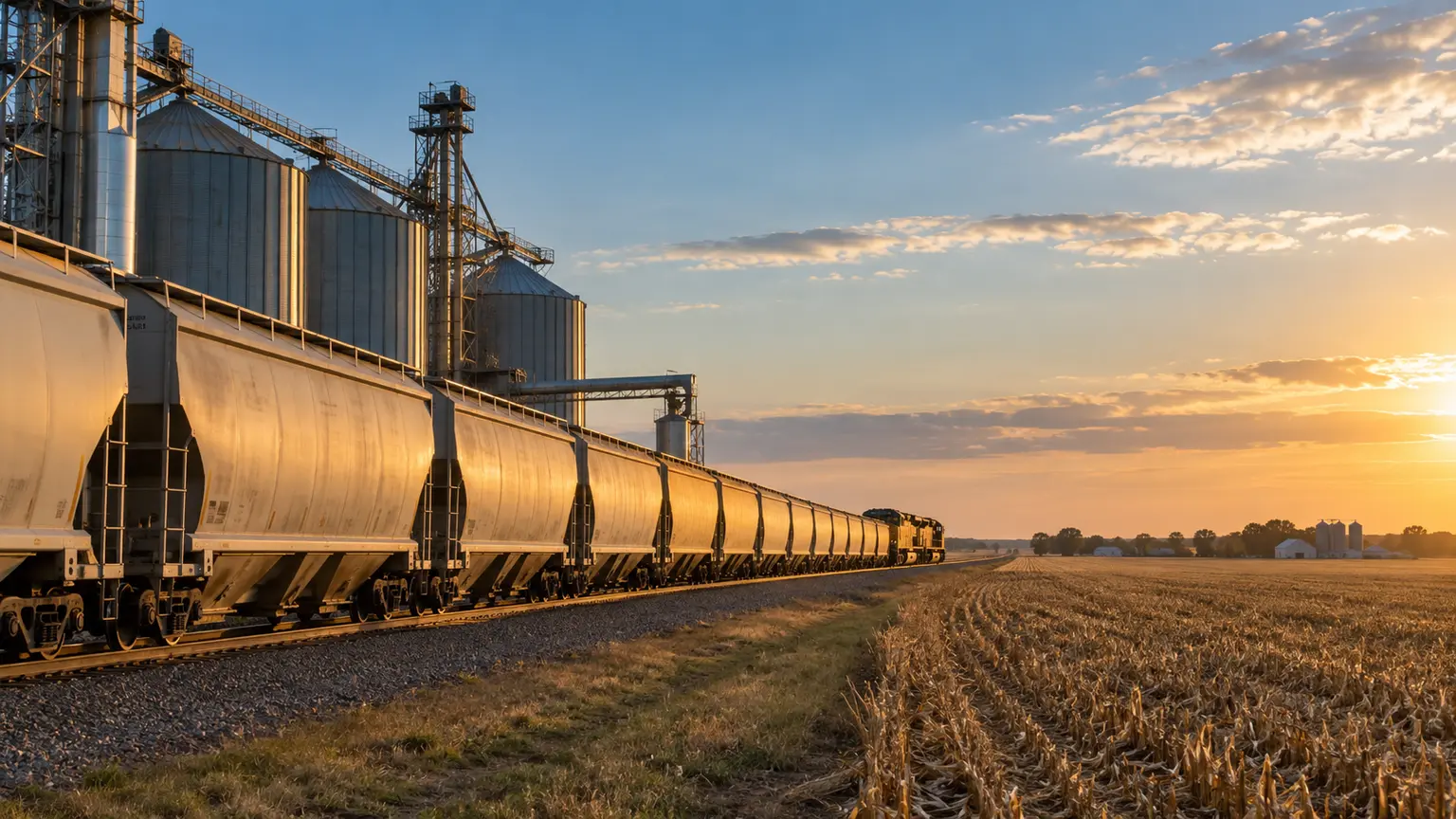
Fuel surcharges on U.S. grain rail movements have reached record levels just as corn and soybean harvests increase transportation demand. Reuters reported, citing U.S. Department of Agriculture data, that the average surcharge reached 48 cents per mile per railcar in the second week of September—153% above the weighted average a year earlier.
For buyers, this is not only a farmer-margin story. A higher rail charge can alter origin basis, elevator bids, delivered plant cost and export competitiveness. The practical response is to separate the commodity price from the transport formula, verify who carries the surcharge, and compare realistic routing alternatives before accepting an offer.
What the latest data says
Reuters reported that fuel surcharges represented 11% of the total rail transportation cost for corn and soybeans in the USDA's 10 September Grain Transportation Report, up from 5% a year earlier. Railroads combine these variable charges with line-haul freight rates to recover fuel costs under carrier-specific formulas.
The direction is clear, but the quoted national average is not a shipment-specific price. Actual exposure depends on the railroad, tariff, mileage, equipment, origin, destination and the date at which the carrier's fuel index is applied. A buyer should therefore use the USDA figure as a market signal, then obtain the current charge for the precise corridor and loading window.
The timing matters. Harvest creates a concentrated need to move grain from farms and country elevators toward processors, domestic users and export gateways. Where barge, truck or competing rail options are limited, the surcharge can be reflected in a weaker local basis or a higher delivered price. Which party absorbs it depends on the contract and the competitiveness of the origin.
Why the surcharge can lag the fuel market
A fuel surcharge is a formula, not a real-time diesel invoice. Carrier programmes may use published fuel benchmarks, thresholds and time lags. That means a surcharge can remain elevated after prompt diesel prices move lower, or adjust after the buyer has already negotiated the underlying grain differential.
This creates basis risk between the commercial quote and the transport cost ultimately invoiced. A phrase such as “freight included” is not sufficient unless the contract identifies whether future fuel changes are fixed, passed through, capped or recalculated at shipment.
Reuters reported that BNSF, CSX and Union Pacific said surcharges are intended to recover fuel expense and that programmes adjust as fuel prices change. The buyer's task is not to assume that every formula behaves the same way. It is to obtain the applicable tariff or contract provision and model how it works across the expected shipment period.
How higher rail costs travel through the grain chain
Origin basis can weaken
When an elevator must pay more to reach a processor or export terminal, it may protect its margin by bidding less for grain at origin. That is one reason producers in rail-dependent areas can experience the cost even when they do not receive a separate carrier invoice.
Delivered offers can diverge
Two origins with similar futures-linked prices may no longer be economically equivalent. The rail distance, route competition, transloading requirement and final-mile mode can make the nominally cheaper grain more expensive at destination.
Export parity can change
For international buyers, inland logistics are part of the export price formation. Higher costs to move grain to the Gulf, Pacific Northwest or other gateways can influence the competitiveness of a U.S. FOB offer. That effect is an economic inference, not a guarantee that every export quote will rise; exporters may absorb, hedge or offset part of the increase.
What buyers should verify before contracting
Define the delivery point and price basis
Confirm whether the quote is ex-warehouse, delivered rail, FOB terminal, CFR or CIF. Identify the point at which risk and cost transfer. A low origin price is not comparable with a delivered price until inland freight, elevation, handling and onward ocean freight are aligned.
Request the surcharge mechanism
Ask for the named carrier, tariff reference, fuel index, effective date, mileage assumption and adjustment frequency. State whether the charge is included, provisional or payable as a separate pass-through.
Test alternative routes
Compare rail with commercially executable barge, truck or alternative-origin scenarios. Include transloading, congestion, storage, quality preservation and additional handling—not only the line-haul rate. The cheapest theoretical route is irrelevant if equipment or capacity cannot be secured.
Protect the shipment window
Clarify railcar supply, loading deadlines, free time, demurrage, storage and remedies for missed delivery windows. Harvest congestion and fuel cost are different risks; the contract should allocate each one explicitly.
For broader grain-market context, review One Discovery's September corn and wheat balance analysis. The oil and diesel procurement checklist explains why transport exposure should be monitored separately from the headline commodity benchmark.
A practical landed-cost checklist
Before treating a grain offer as executable, confirm:
- the exact commodity, grade, crop year, quantity and loading period;
- the origin point, destination and nominated transport modes;
- the base freight rate and current fuel-surcharge formula;
- whether later surcharge changes pass through to the buyer;
- railcar, transload, storage and terminal availability;
- demurrage, detention and delay allocation; and
- the full delivered cost against credible alternative origins.
ONE DISCOVERY VIEW
A grain price is only as useful as the route behind it. Record rail fuel surcharges make the transport formula a primary procurement variable, not a line item to check after the commodity terms are agreed.
Sources
Compare the delivered economics behind a commodity requirement.
Contact One Discovery