
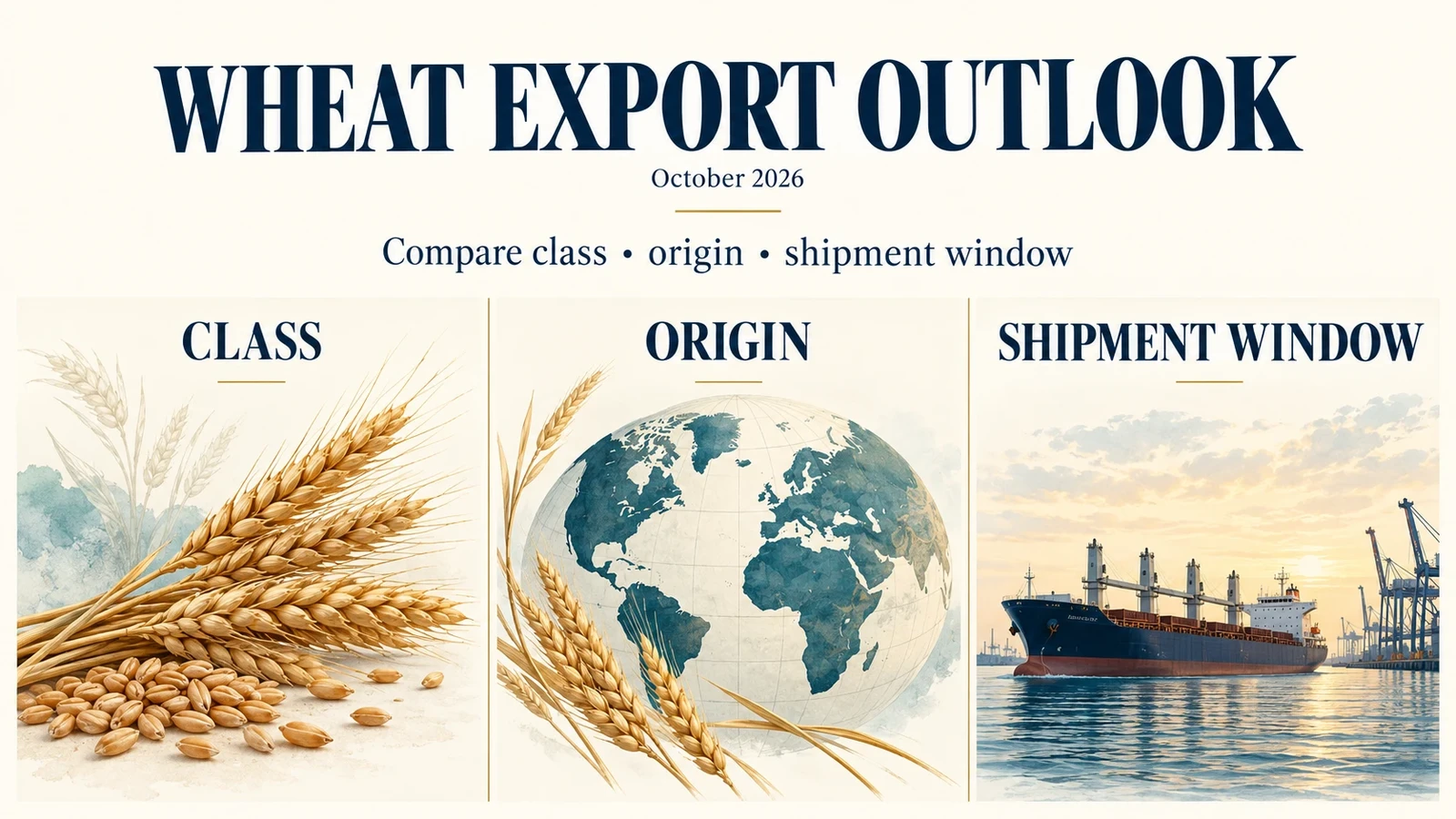
USDA's October 9 supply-and-demand report gives wheat importers a reason to refresh origin comparisons. The agency reduced its projection for world wheat trade in 2026/27 from 211.77 million tonnes in September to 208.97 million tonnes in October, while projected world ending stocks changed only slightly, from 276.29 million to 276.04 million tonnes.
That combination matters because an almost unchanged global stock figure can coexist with a smaller projected cross-border trade flow. For buyers, the useful response is to compare export offers for the required wheat class, destination and shipment period. The report does not establish a supplier's allocation, a commercial price or permission to ship.
This article examines the new October wheat balance and its implications for origin selection. It is a separate question from the September U.S. corn-stock revision discussed in our earlier corn import buyer checklist.
What changed in the October wheat outlook
The official WASDE tables show lower projected world wheat trade alongside slightly higher total supply and consumption. These are forecasts for the 2026/27 marketing year, rather than a count of cargoes available today. Marketing-year definitions and aggregate totals should be read using the report's own notes.
The U.S. balance also changed. USDA raised projected all-wheat ending stocks by 23 million bushels to 740 million bushels and reduced projected exports by 25 million bushels to 750 million bushels. Successful Farming's October 9 report independently describes these revisions and reports USDA's explanation that weaker sales and shipments for hard red winter and hard red spring wheat were partly offset by stronger white-wheat exports.
The changes are not uniform across wheat classes. A buyer needing particular milling characteristics should therefore avoid applying the all-wheat export adjustment directly to a hard-red, white or other specific specification. A national aggregate is a useful starting point, but it is not the specification attached to a purchase order.
A lower trade forecast changes the comparison exercise
One Discovery's analysis is that the October revision makes relative export competitiveness more relevant than the headline world stock total alone. When projected trade declines, procurement teams should ask which origin and wheat class can still meet their actual requirement at an acceptable delivered cost.
This does not mean that every export route is constrained, or that all buyers should switch suppliers. A forecast revision may reflect multiple changes in demand, export competition and shipment expectations. It should prompt an updated comparison, not a predetermined purchase decision.
Consider a mill reviewing two origins. One quotation may have a lower headline unit price but require a different blend, longer transport or additional quality testing. Another may cost more initially while meeting an existing approved specification. The meaningful comparison is the cost of usable grain delivered within the mill's required window, including any requalification work.
Keep wheat class and end use visible
Start by writing down the intended use and the acceptance criteria. Protein alone is insufficient to capture all milling and baking requirements. The purchase specification can also address moisture, test weight, falling number, foreign material and other agreed quality measures where relevant.
The buyer's technical team should determine which limits are mandatory, which are negotiable and how a substitution will be tested. A commercial team should not promise that an alternative origin is equivalent before the people using the wheat have reviewed it.
These are procurement recommendations, not new regulatory requirements announced by USDA. They help translate an aggregate market signal into a controlled sourcing process. Sampling, testing and rejection provisions should be documented in the contract rather than left to a conversation after arrival.
Compare offers using a consistent shipment window
An October market report and a quotation for a later shipment are different pieces of information. Ask every candidate supplier to identify the same loading period, quantity basis, named delivery place and quotation validity. Otherwise, apparently competing offers may represent different obligations.
Separate grain value from inland transport, terminal charges, ocean freight, insurance and financing. Identify which costs are fixed and which can change before loading. The terms should make clear who pays when a delay or additional charge arises.
For a CIF comparison, our freight and cargo-risk checklist explains why seller-paid freight should not be confused with the point at which cargo risk transfers. A lower delivered quotation is only useful when the contract's responsibilities are understood.
What evidence belongs behind an export offer?
A USDA forecast cannot authenticate a commercial seller. Buyers should separately establish the counterparty's identity, contractual role and evidence supporting the proposed cargo. An intermediary should accurately describe its role and identify which party will be responsible for performance.
Where a cargo is presented as allocated, ask what documentation supports that statement and how it relates to the named seller, product and shipment period. Review the inspection arrangements, documentary requirements and payment conditions together. No individual screenshot or generic certificate should replace a coherent transaction file.
This is particularly useful when a market headline produces a wave of unsolicited offers. The report can inform the questions a buyer asks, but it cannot answer whether any particular offer is genuine or executable.
A practical next step for wheat importers
Refresh the origin comparison before changing the buying plan. Keep the wheat class, required quality, shipment window and destination constant across offers. Record each quotation's date and identify any assumption that still needs evidence.
Then review the technical, logistics and contract questions together. If an alternative origin is attractive, qualify it before increasing dependence on it. If the incumbent remains competitive, document the reason rather than switching solely because the global forecast moved.
The October report offers a useful reminder: projected world stocks and projected international trade are different measures. For procurement teams, the decision rests on the specific wheat they can accept, the route they can execute and the contract they can enforce.